Espresso Shared Sequencer was designed to address these issues. By introducing a decentralized sequencing network along with fast confirmation, Espresso provides unified transaction ordering across multiple rollups while preserving the flexibility of modular architecture. This allows rollups to share infrastructure without sacrificing their independent execution environments.
As modular blockchains continue to evolve, shared sequencing layers are becoming a key component for connecting multiple rollup networks. Espresso contributes to this trend by offering a more stable and efficient foundation for cross-chain applications and multi-chain ecosystems.

Core Design and Operating Mechanism of Espresso Shared Sequencer
The primary goal of Espresso Shared Sequencer is to provide unified transaction ordering for multiple rollups while maintaining a general-purpose infrastructure.
To achieve this, the Espresso network itself does not include any rollup-specific logic. Instead, it acts as a universal sequencing network that serves different chains. This design allows Espresso to support various rollup architectures while remaining flexible and adaptable.
From an operational perspective, Espresso uses the HotShot consensus network for transaction ordering and confirmation. HotShot nodes are responsible for maintaining transaction order and reaching consensus. Rollups, on the other hand, retrieve ordering results through query service nodes. Because Espresso does not actively interact with rollups, each rollup can integrate with the network based on its own requirements.
This architecture positions Espresso as an independent sequencing layer. Rollups submit transactions to Espresso for ordering, then execute them after receiving confirmation. By sharing a sequencing layer, multiple rollups can synchronize transaction ordering, improving cross-chain coordination.
In addition, Espresso provides fast confirmation. Transactions are considered confirmed once consensus is reached within the sequencing network, without needing to wait for final settlement on the base layer. This reduces cross-chain latency and improves the user experience.
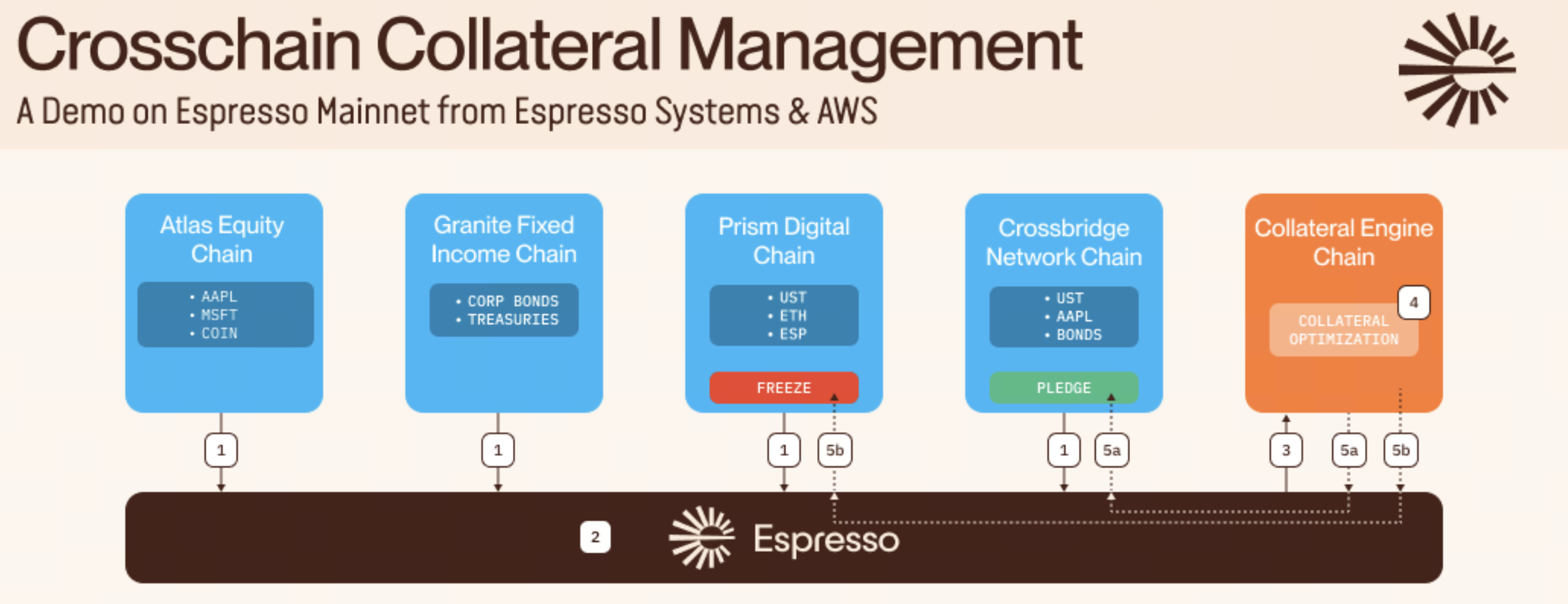
Architecture of Espresso Shared Sequencer
Espresso Shared Sequencer adopts a modular architecture that enables shared sequencing and fast confirmation for multiple rollups. Unlike traditional sequencers, Espresso does not embed rollup-specific logic. Instead, it provides a general sequencing network that can serve different chains, improving scalability and flexibility.
The overall architecture consists of three main components: the HotShot consensus network, query service nodes, and the rollup integration layer. These modules work together to allow multiple Layer 2 networks to share a sequencing layer while maintaining independent execution environments and data structures.
The HotShot consensus layer is responsible for transaction ordering and confirmation. When a rollup submits transactions to the Espresso network, validator nodes participate in consensus to generate a unified transaction order. This decentralized approach enhances security and reduces the risks associated with centralized sequencers.
Query service nodes provide a public interface for rollups. Since Espresso does not actively communicate with rollups, rollups must retrieve ordering and confirmation data through these query nodes. This design increases generality and supports multi-chain ecosystems.
| Architecture Component |
Core Function |
Description |
| HotShot Consensus Network |
Transaction ordering and consensus |
Validator nodes participate in ordering and produce a unified sequence |
| Query Service Nodes |
Data access interface |
Rollups retrieve ordering and confirmation data |
| Rollup Integration Layer |
Network integration |
Enables different rollups to connect to the shared sequencing layer |
| Data Availability Layer (optional) |
Data storage and verification |
Can integrate with solutions such as EigenDA or Celestia |
| Fast Confirmation Mechanism |
Pre-confirmation |
Provides low-latency transaction confirmation |
This modular architecture allows Espresso to flexibly support different rollup needs. Developers can choose to use sequencing, confirmation, or data availability features depending on their specific use cases. This positions Espresso as a shared infrastructure layer within the modular blockchain ecosystem.
How Espresso Solves Rollup Fragmentation
As the number of rollup networks grows, liquidity fragmentation and application fragmentation have become increasingly significant issues. Without a unified sequencing mechanism, cross-chain transactions often require complex bridging processes, leading to higher latency.
Espresso Shared Sequencer addresses this by providing unified transaction ordering across multiple rollups. When networks share the same sequencing layer, cross-chain applications can coordinate execution more easily, improving efficiency in multi-chain environments.
This is especially important for DeFi applications, where liquidity is often spread across different rollups. Fragmentation increases complexity for cross-chain transactions. A shared sequencing layer enables synchronized execution, improving capital efficiency.
Additionally, shared sequencing improves the experience of cross-chain bridges. Asset transfers between rollups can rely on unified ordering and fast confirmation, reducing delays and increasing reliability.
Security Mechanisms of Espresso Shared Sequencer
Espresso Shared Sequencer enhances security through a decentralized validator network. Multiple validators participate in transaction ordering and confirmation, reducing the risks associated with centralized sequencers.
The HotShot consensus mechanism ensures consistent transaction ordering and reliable confirmation. Once consensus is reached, the transaction order is finalized and distributed to connected rollups.
Espresso also allows rollups to use their own tokens to elect sequencer nodes. This further decentralizes control and strengthens network security.
Decentralized sequencing also improves censorship resistance. Since multiple nodes participate in ordering, it becomes significantly harder for any single entity to manipulate transaction execution.
Differences Between Espresso and Centralized Sequencers
Traditional rollups typically rely on centralized sequencers to process transactions. While this approach offers low latency, it introduces risks such as single points of failure and potential censorship.
Espresso Shared Sequencer, by contrast, uses a decentralized sequencing mechanism where multiple nodes jointly maintain transaction order. This reduces systemic risk and improves network resilience.
Espresso also provides fast confirmation, reducing the need for users to depend on pre-confirmations from centralized sequencers. This increases both transparency and security.
In cross-chain scenarios, centralized sequencers struggle to coordinate multiple rollups effectively. A shared sequencing layer, however, can unify transaction ordering, making it better suited for multi-chain ecosystems.
Use Cases of Espresso Shared Sequencer
Espresso Shared Sequencer can be applied to cross-rollup DeFi applications. With unified transaction ordering, multi-chain trading protocols can execute operations synchronously, improving efficiency.
Cross-chain bridges are another key use case. Espresso’s fast confirmation and unified ordering help accelerate asset transfers between rollups.
It also benefits on-chain gaming and multi-chain applications. Assets can move across rollups more seamlessly, while unified ordering reduces operational complexity.
As more rollups integrate with Espresso, the range of use cases for shared sequencing layers will continue to expand, further driving multi-chain ecosystem growth.
Development Trends of Shared Sequencing Layers
As modular blockchain architecture advances, shared sequencing layers are emerging as a critical infrastructure category. Multiple projects are exploring shared sequencing to improve cross-chain interoperability.
These layers are not limited to cross-rollup transactions. They also support multi-chain DeFi and broader cross-chain applications, making them a key building block of modular blockchain systems.
As the rollup ecosystem continues to grow, demand for shared sequencing layers is expected to increase. More projects are likely to adopt this model to enhance coordination across networks.
Within this trend, Espresso Shared Sequencer is well positioned to become an important player in the shared sequencing space and help drive the evolution of multi-chain ecosystems.
Conclusion
Espresso Shared Sequencer provides a shared sequencing infrastructure for multiple rollups through decentralized ordering and unified transaction sequencing. This design improves cross-chain interoperability while reducing transaction latency.
As modular blockchains and multi-rollup ecosystems continue to evolve, the importance of shared sequencing layers will only grow. With its flexible modular architecture, Espresso offers a stable foundation for multi-chain applications and plays a key role in advancing cross-chain ecosystems.
FAQ
-
What is the core function of Espresso Shared Sequencer?
It provides shared sequencing and rapid confirmation for multiple rollups.
-
Does Espresso support different data availability layers?
Yes, Espresso is compatible with various data availability layers, including modular DA solutions.
-
Is Espresso decentralized?
Espresso utilizes distributed validator nodes and a consensus mechanism to enhance decentralization.
-
What scenarios is Espresso suitable for?
Espresso is applicable to cross-rollup DeFi, cross-chain bridges, and multi-chain applications.