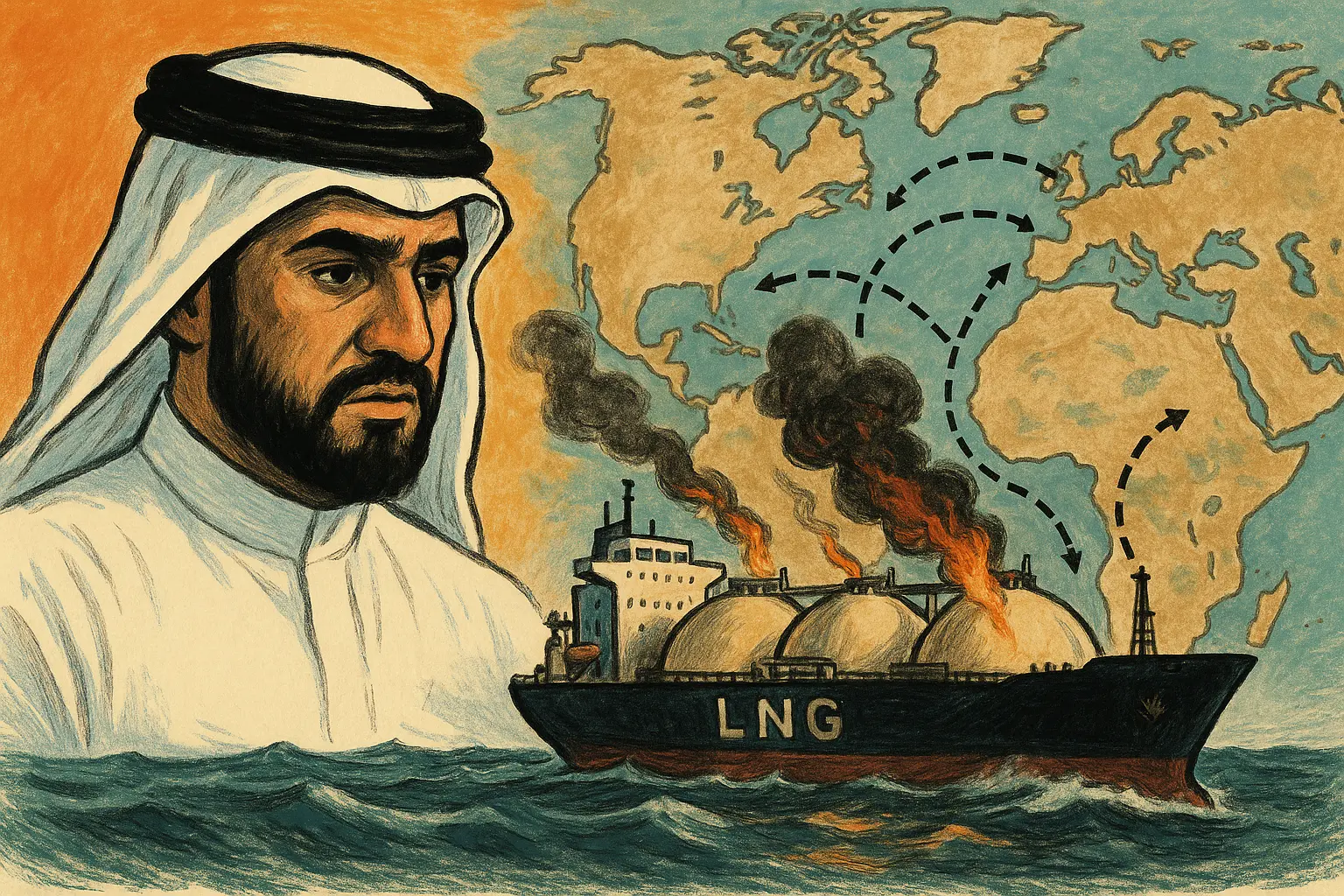
A drone strike on Ras Laffan has eliminated 17% of Qatar’s LNG export capacity for three to five years, forcing QatarEnergy to invoke force majeure while Hormuz Strait shipping collapses 86%. What was a projected 2026 surplus has become structural deficit, setting a new long-term price floor.
The Supply Shock: Scale, Duration, and Compounding Factors
The attack targeted infrastructure at Ras Laffan Industrial City, the world’s largest LNG exporting complex. Damage to critical processing and export facilities is projected to take three to five years to repair, removing approximately 12.8 million tons of annual LNG supply — a volume roughly equivalent to two months of global LNG spot trade.
The disruption extends beyond the damaged facilities. The Hormuz Strait, through which roughly 20% of the world’s oil and a substantial share of LNG historically transited, has seen shipping volumes collapse by 86%, with over 150 vessels including LNG tankers currently immobilized. This dual impact — liquefaction capacity offline and export routes blocked — has eliminated what was previously the marginal pricing anchor for the entire global gas market.
Morgan Stanley analysis confirms that if production halts extend beyond one month, the market transitions decisively into structural deficit territory. That threshold has already been surpassed. Additionally, the North Field expansion project — Qatar’s primary near-term supply growth engine — now has its first commercial volumes deferred to early 2027, according to Morgan Stanley estimates, removing approximately 1 million tons from 2026 supply forecasts.
Market Response: 40% Benchmark Surge and Emerging Demand Destruction
Asian LNG benchmark prices surged nearly 40% within days of the attack, as market participants rapidly repriced exposure to the confirmed multi-year supply reduction. Pre-crisis consensus had modeled a 6-million-ton global LNG surplus for 2026; the sudden removal of 12.8 million tons of Qatari supply effectively eliminated that cushion overnight.
However, elevated prices are generating visible demand responses that will ultimately limit the upside.
Key Demand-Side Adjustments Underway
India: Reducing natural gas consumption; implementing rationing measures in response to rising spot prices
Pakistan: Curtailing gas usage across industrial and residential sectors
China: Accelerating pivot to domestic gas production and Russian pipeline imports, reducing spot LNG dependency
S&P Global Commodity Insights: Projecting below-consensus LNG demand growth in multiple key importing nations, with structural volume losses possible if elevated prices persist
These responses establish a demand ceiling. While the physical supply constraints support a structurally higher price floor, the market’s capacity to reduce consumption and switch fuels limits how far prices can rise — a dynamic that is expected to prevent a recurrence of the extreme European price spike seen in 2022.
New Long-Term Pricing Range: Floor Set by Supply, Ceiling Set by Demand
The LNG market is establishing a new equilibrium defined by two opposing forces. On one side, the three-to-five-year repair timeline for Qatari facilities and the ongoing Hormuz Strait disruption set a firm price floor; on the other, demand destruction and fuel substitution in price-sensitive importing countries constrain the upside.
In practical terms, LNG is unlikely to return to pre-crisis price levels before Qatari capacity is substantially restored. Alternative supply sources — including Australian, U.S., and East African LNG exporters — carry higher delivered costs to Asian markets and cannot fully substitute for Qatar’s scale or proximity. The long-term supply agreements disrupted by force majeure are also likely to be renegotiated at higher floor prices, locking in the reset across a broad range of contract structures.
The ultimate price level will depend primarily on the pace of repair at Ras Laffan and whether the North Field expansion can be brought forward. Until those variables are resolved, the market will operate in a structurally tighter environment than any point since the post-pandemic demand surge.
Frequently Asked Questions
How much of Qatar’s LNG capacity was affected, and for how long?
Approximately 17% of Qatar’s LNG export capacity was damaged at Ras Laffan, with repair timelines estimated at three to five years. This translates to roughly 12.8 million tons of annual supply removed from global markets. QatarEnergy has invoked force majeure on multiple long-term supply contracts as a direct result of the damage.
Why did Asian benchmark prices surge 40% if Qatar represents only one supplier?
Qatar is the world’s largest single LNG exporter by volume, and the speed of the disruption — combined with Hormuz Strait shipping disruption affecting over 150 vessels — created immediate spot market tightness. The market had also been priced for surplus conditions in 2026; the elimination of that buffer in days accelerated the repricing. Morgan Stanley confirmed the market has effectively transitioned from oversupply to structural deficit.
Is there any near-term relief for LNG buyers?
Near-term relief is limited. Ras Laffan repairs are estimated at three to five years; North Field expansion first volumes are deferred to early 2027. Alternative suppliers in Australia, the United States, and East Africa can absorb some demand but at higher delivered costs. Demand destruction in India, Pakistan, and China provides a partial offset but does not restore supply balance. S&P Global Commodity Insights projects LNG demand in several key markets coming in below prior forecasts, reflecting the price-driven consumption adjustment already underway.
Disclaimer: The information on this page may come from third parties and does not represent the views or opinions of Gate. The content displayed on this page is for reference only and does not constitute any financial, investment, or legal advice. Gate does not guarantee the accuracy or completeness of the information and shall not be liable for any losses arising from the use of this information. Virtual asset investments carry high risks and are subject to significant price volatility. You may lose all of your invested principal. Please fully understand the relevant risks and make prudent decisions based on your own financial situation and risk tolerance. For details, please refer to
Disclaimer.


