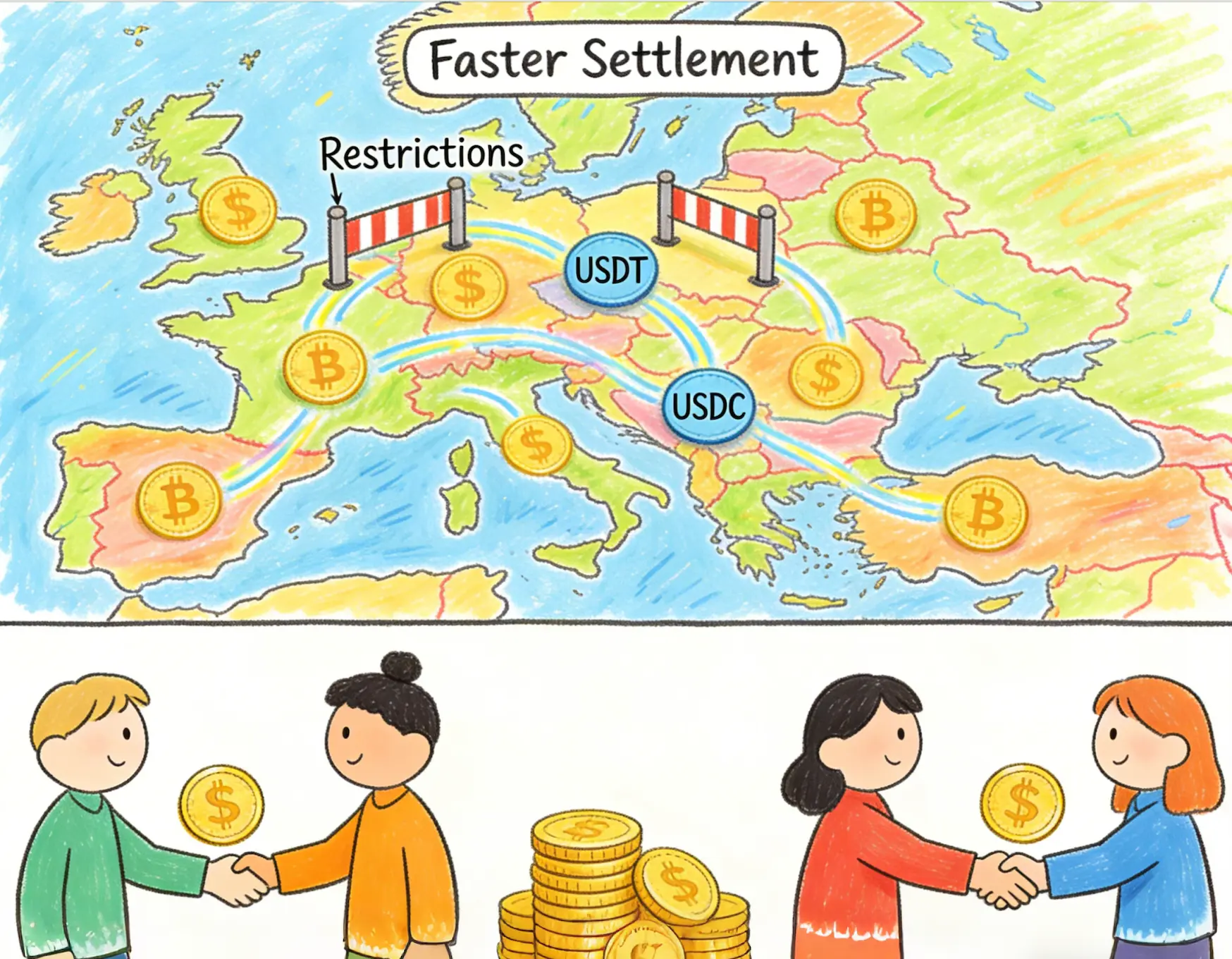
 Stablecoin issuer Circle urged European policymakers on March 20, 2026, to accelerate updates to the bloc’s digital asset framework, warning that delays risk pushing institutional adoption of tokenized markets toward the United States and other jurisdictions.
In feedback submitted on the European Commission’s proposed Market Integration Package, Circle called the plan a “meaningful step” toward modernizing capital markets but identified gaps around scalability, supervision, and settlement that require faster, more flexible rules. The company specifically proposed “adaptive” thresholds tied to market conditions rather than periodic legislative updates, and advocated for expanding the role of MiCA-compliant stablecoins in securities settlement beyond “significant” tokens.
DLT Pilot Regime Reform Recommendations
Expanding Eligible Assets and Volume Thresholds
Circle broadly supported the proposed changes to the EU’s Distributed Ledger Technology (DLT) Pilot Regime, including expanding eligible assets and raising trading-volume limits. However, the company argued that current static caps continue to constrain liquidity and institutional participation. Circle proposed introducing “adaptive” thresholds that adjust based on market conditions, rather than relying on infrequent legislative updates.
Clear Path to Permanent Rules
The firm also called for a clearer pathway from the pilot phase to permanent rules, reducing uncertainty for market participants building on DLT infrastructure. Circle warned that delays in reforming the pilot regime could push activity toward the U.S., where onchain market infrastructure is advancing more quickly.
Stablecoin Role in Securities Settlement
Expanding Access Beyond “Significant” Tokens
A key focus of Circle’s response was expanding the use of MiCA-compliant stablecoins in securities settlement. The company welcomed proposals to recognize electronic money tokens (EMTs) for cash-leg settlement but warned that limiting settlement access only to “significant” tokens—a classification under MiCA that applies to stablecoins with broad usage—risks excluding euro-denominated stablecoins and slowing adoption.
Settlement Account Access
Circle called for allowing crypto asset service providers, not just banks and central securities depositories (CSDs), to offer settlement accounts. The current structure, which restricts settlement accounts to traditional financial institutions, adds friction and complexity to transactions involving stablecoins, according to the company.
Supervision and Collateral Frameworks
ESMA Oversight Scope
Circle pushed for a narrower scope for centralized EU supervision, suggesting that European Securities and Markets Authority (ESMA) oversight should be limited to large, cross-border firms while smaller players remain under national regulators. This approach, the company argued, would balance harmonization with operational efficiency.
Stablecoins as Collateral
Circle called for clearer rules allowing stablecoins to be used as collateral, pointing to parallel efforts in the U.S. and UK to integrate digital assets into collateral frameworks. The absence of such rules in the EU creates a competitive disadvantage and limits the utility of euro-denominated stablecoins.
Competitive Context and Urgency
Risk of Activity Migration
Circle warned that delays in EU reforms could push tokenized market activity toward the U.S., where regulators and exchanges are moving more quickly to accommodate onchain securities and settlement infrastructure. The SEC recently approved Nasdaq’s pilot program for trading tokenized shares, and U.S. policymakers have advanced stablecoin legislation through the GENIUS Act.
Institutional Adoption
The company framed its recommendations as necessary to enable institutional adoption of tokenized markets. Current limits on DLT pilot regimes and settlement access create friction that discourages larger financial institutions from participating, Circle argued.
Frequently Asked Questions
What reforms is Circle proposing for the EU’s DLT Pilot Regime?
Circle urged the EU to expand eligible assets, raise volume thresholds, and replace static caps with “adaptive” thresholds tied to market conditions. The company also called for a clearer path from the pilot phase to permanent rules to reduce uncertainty for market participants.
How does Circle want to expand the role of stablecoins in securities settlement?
Circle advocated for allowing MiCA-compliant stablecoins to be used in securities settlement beyond the “significant” token category, arguing that restricting settlement access to a subset of stablecoins could exclude euro-denominated options and slow adoption. The company also called for crypto asset service providers to be permitted to offer settlement accounts.
Why is Circle urging the EU to accelerate these reforms?
Circle warned that delays risk pushing tokenized market activity toward the U.S., where regulators have advanced tokenized securities pilots and stablecoin legislation. The company argued that current constraints on DLT pilot regimes and settlement access create friction that discourages institutional participation in EU markets.
Disclaimer: The information on this page may come from third parties and does not represent the views or opinions of Gate. The content displayed on this page is for reference only and does not constitute any financial, investment, or legal advice. Gate does not guarantee the accuracy or completeness of the information and shall not be liable for any losses arising from the use of this information. Virtual asset investments carry high risks and are subject to significant price volatility. You may lose all of your invested principal. Please fully understand the relevant risks and make prudent decisions based on your own financial situation and risk tolerance. For details, please refer to
Disclaimer.


