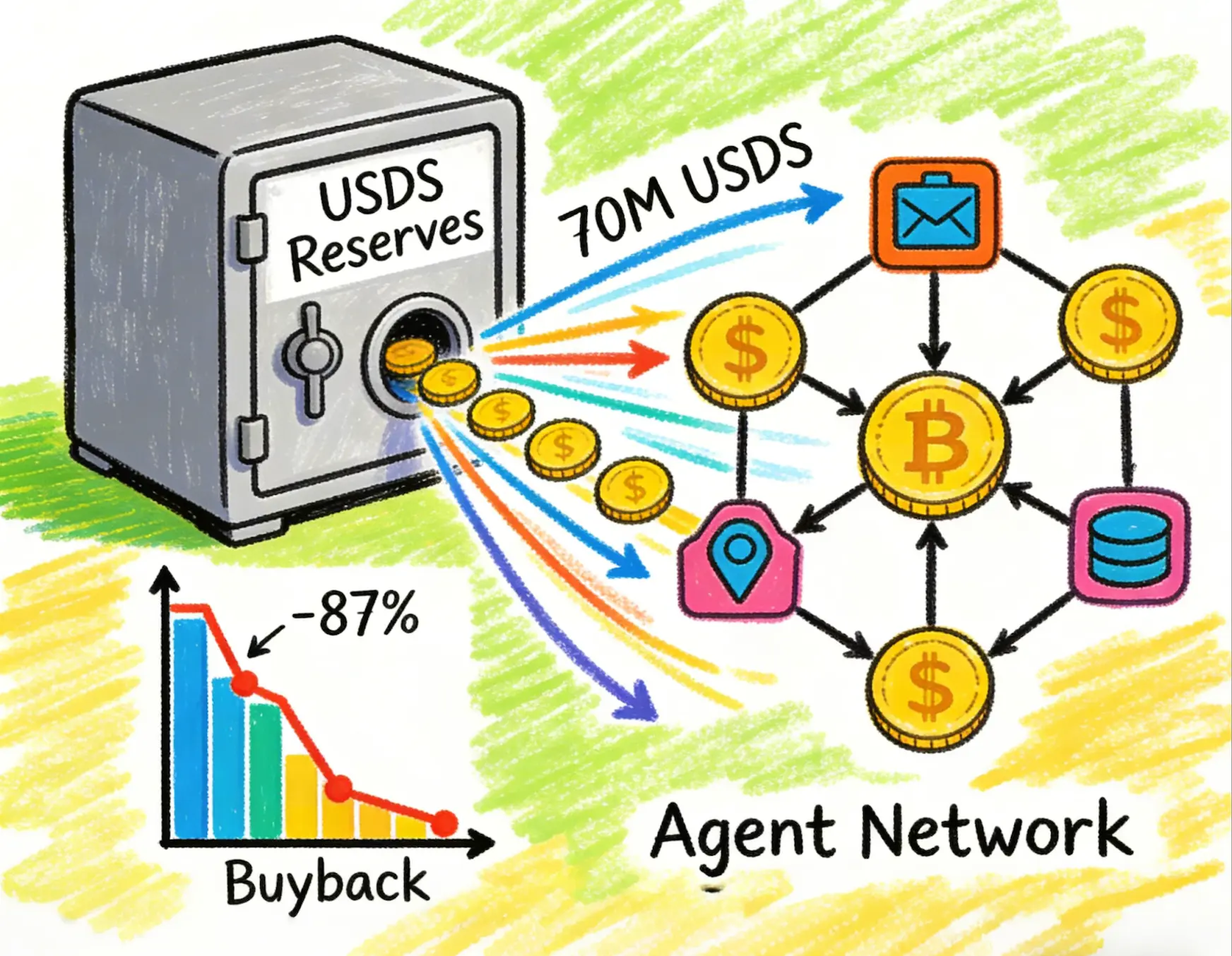
 Sky Protocol (formerly MakerDAO) has approved approximately 70 million USDS in Genesis Capital allocations to expand its Sky Agent Network, while simultaneously reducing its daily SKY token buyback program by 87% from $300,000 to $37,600 for three months to strengthen stablecoin reserves.
The dual governance actions, announced March 14-15, 2026, aim to diversify capital deployment supporting the Sky Savings Rate and build protocol capital buffers amid founder Rune Christensen’s warning of a potential “massive oil shock” stemming from geopolitical tensions in Iran.
The Genesis Capital allocations, scheduled for the March 26 Executive Vote, represent the final major funding tranche for the protocol’s launch-phase independent capital allocators, while the buyback reduction temporarily prioritizes surplus buffer replenishment over tokenholder incentives.
Genesis Capital: 70M USDS Agent Network Expansion
Allocation Breakdown
Sky governance has proposed the following Genesis Capital distributions to bootstrap new Sky Agents during the protocol’s early expansion phase:
Agent
Type
Allocation (USDS)
Keel Finance
Launch Agent
10 million
Amatsu
New Executor Agent
25 million
Ozone
New Executor Agent
25 million
Unannounced Agent
Launch Agent 6
10 million
Total
70 million
Capital Control and Exit Mechanism
The funds remain within protocol control, held in segregated sub-proxy accounts governed by SKY token holders. A structured phase-out schedule will gradually reduce reliance on Genesis Capital as agents mature and launch their own liquid tokens, with timing tied to market liquidity and protocol capital buffers.
Sky Savings Rate Implications
The expanded agent network broadens the protocol’s revenue base through diversified capital deployment. While the Sky Savings Rate remains governance-set rather than a direct pass-through of agent returns, a more competitive agent network strengthens the protocol’s long-term capacity to sustain yield for USDS holders.
Buyback Reduction: Strategic Pause to Strengthen Reserves
Program Adjustment Details
On March 12, 2026, Sky governance voted to reduce its programmatic SKY buyback from $300,000 per day to $37,600 per day—an 87% reduction—for a three-month period beginning in mid-March.
Rationale: Geopolitical Precaution
The reduction follows founder Rune Christensen’s warning that the conflict in Iran could trigger broader financial infrastructure stress, with the pause intended to bolster reserves backing Sky’s stablecoins USDS and DAI during potential market volatility.
Reserve and Supply Metrics
-
USDS supply: Approximately $7.9 billion, up 22% over 30 days
-
DAI supply: Approximately $4.5 billion, up nearly 2% over the same period
-
Aggregate backstop capital: Approximately $50 million, flat during recent supply growth
Credit Rating Context
S&P Global assigned Sky a “B-” credit rating in 2025, citing the protocol’s limited surplus reserve buffer relative to potential credit losses on assets and weak earnings capacity as material ratings weaknesses. The buyback pause directly addresses these concerns by redirecting protocol revenue toward surplus buffer accumulation.
Complementary Strategic Objectives
Capital Efficiency vs. Tokenholder Incentives
The buyback program, initiated in February 2025, had consumed $116.6 million in USDS purchasing SKY tokens distributed to stakers—a mechanism designed to incentivize governance participation. Pausing the program reallocates protocol revenue toward reserve accumulation while maintaining SKY staking rewards through existing mechanisms.
Additional Stabilization Mechanisms
Beyond the surplus buffer, Sky retains alternative stabilization tools including issuing new SKY tokens and clawing back capital from subsidiary protocols such as Spark, which could provide approximately $25 million in additional support if required.
Frequently Asked Questions
What is the Sky Agent Network and why is Sky allocating 70 million USDS to it?
The Sky Agent Network consists of independent capital allocators that deploy protocol funds to generate returns supporting the Sky Savings Rate. The 70 million USDS Genesis Capital allocation bootstraps four new agents—Keel, Amatsu, Ozone, and an unannounced sixth agent—during the protocol’s early expansion phase. Funds remain in governance-controlled segregated accounts and will phase out as agents mature and issue their own tokens.
Why did Sky slash its buyback program by 87%?
Sky reduced daily SKY buybacks from $300,000 to $37,600 for three months to prioritize building the protocol’s surplus buffer—the capital backing USDS and DAI stablecoins. The decision responds to founder concerns about potential financial infrastructure stress from geopolitical tensions, while addressing credit rating agency observations that the buffer had remained flat at approximately $50 million despite surging stablecoin supply.
How are USDS holders protected under these changes?
USDS holders are protected by multiple layers including the Aggregate Backstop Capital (excess protocol capital), segregated governance-controlled accounts for agent allocations, transparent onchain governance parameters, and additional stabilization tools such as SKY issuance and subsidiary asset clawbacks. The buyback reduction specifically aims to strengthen the surplus buffer that ratings agencies identified as a vulnerability.
What is the status of the March 26 Executive Vote?
The Genesis Capital allocations will proceed to an executive vote on March 26, 2026. If approved by SKY token holders, funds will be transferred to the designated agents’ segregated accounts. This represents the final major Genesis Capital transfer, with only one additional allocation remaining after this round.
Disclaimer: The information on this page may come from third parties and does not represent the views or opinions of Gate. The content displayed on this page is for reference only and does not constitute any financial, investment, or legal advice. Gate does not guarantee the accuracy or completeness of the information and shall not be liable for any losses arising from the use of this information. Virtual asset investments carry high risks and are subject to significant price volatility. You may lose all of your invested principal. Please fully understand the relevant risks and make prudent decisions based on your own financial situation and risk tolerance. For details, please refer to
Disclaimer.


