As demand surges for artificial intelligence model training, search engine indexing, and network data analysis, access to public internet data has become a critical infrastructure. Traditional data collection networks typically rely on centralized affiliate services, which are costly and often lead to concentrated access and opaque resource allocation.
Grass was developed to address these challenges. By aggregating idle bandwidth from everyday users, Grass establishes a distributed network access layer that enables data requests to be fulfilled via decentralized nodes—reducing reliance on centralized bandwidth providers. This approach transforms internet bandwidth into a shareable, verifiable, and incentivized network resource.
What is Grass’s role in decentralized infrastructure?
Grass serves as a “distributed bandwidth supply network” within decentralized infrastructure. It connects two participant groups: users with idle bandwidth and service providers seeking access to public network data.
Grass’s significance lies in converting previously unquantifiable personal network resources into infrastructure assets that can participate in protocol operations. Through node verification, traffic distribution, and credit incentives, Grass empowers ordinary users to supply the underlying network—much like “shared hard drive space” in decentralized storage networks, but Grass shares “network bandwidth.”
What is Grass’s basic operational workflow?
Grass operates through four primary steps: node onboarding, bandwidth contribution verification, network task distribution, and credit reward issuance.
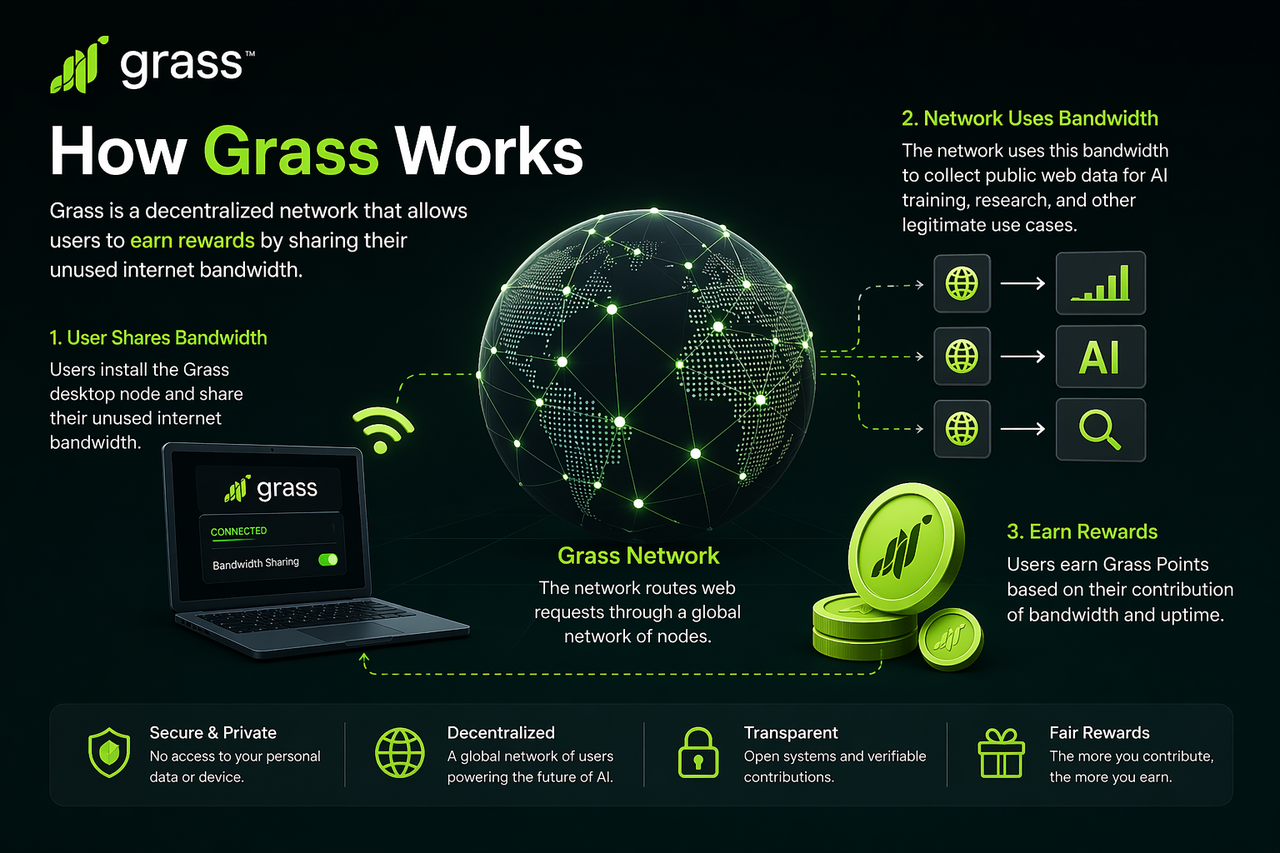
First, users join the network by installing Grass node software. Once online, the system detects available network resources and confirms stable connectivity.
Next, the Grass network verifies node status—including uptime, bandwidth quality, and accessibility—to ensure nodes can deliver reliable network services. Verified nodes are then added to the resource pool.
When a data access request arises, Grass assigns tasks to eligible nodes, which then handle public network access requests.
Finally, the system tracks credits based on each node’s contribution—including uptime, task volume, and stability—and allocates reward credits to users.
This process creates a closed loop for resource contribution, allowing user bandwidth to be continuously converted into protocol contribution value.
How is user-shared bandwidth utilized?
Grass nodes contribute only idle bandwidth—not all network traffic—from user devices. Service providers access public web data through Grass’s distributed nodes, rather than through centralized servers.
The core advantage of this model is greater dispersion of traffic sources. With many nodes participating, data access requests are fulfilled across diverse regions and network environments, enhancing network resilience and coverage.
For users, Grass leverages idle resources, so node contributions do not alter network usage directly but provide additional services within the available bandwidth. Grass nodes are used for public network request distribution—not for accessing private files or personal data on user devices.
How is the Grass node reward mechanism calculated?
Grass’s reward mechanism is a credit model based on network contribution. More stable contributions and longer participation generally earn more credits, but actual amounts depend on node quality, task demand, and protocol rules.
Rewards are influenced by three key factors:
- Uptime: Longer online duration increases opportunities for task allocation, forming the basis for rewards.
- Node quality: Stable connections and fast response times boost task efficiency and network value, potentially earning higher weighting.
- Task contribution: Nodes completing more valid network requests accumulate more credits.
This mechanism ties rewards to real contributions, creating ongoing incentives for node operators to supply bandwidth long-term. Credits represent contribution records; their value and future utility depend on Grass protocol rules and do not guarantee fixed returns.
How does Grass verify that node contributions are genuine and effective?
Ensuring genuine node contributions is a major challenge in bandwidth sharing networks. Grass addresses this through node status and task completion verification.
Node status verification confirms whether nodes are online and available, preventing invalid nodes from occupying the resource pool.
Task completion verification records node activity to confirm real network request processing. Only verified, valid contributions are counted toward credit rewards.
This verification mechanism reduces false contributions and ensures Grass’s incentive system is built on verifiable resource sharing.
How does Grass differ from traditional affiliate networks?
Traditional affiliate networks are operated by centralized providers who deploy servers and sell access, with resource supply and reward distribution controlled by the platform—making it difficult for ordinary users to participate.
Grass decentralizes resource supply. Bandwidth is provided collectively by user nodes, with the protocol handling verification and task distribution—not a single provider controlling all resources.
This structure gives Grass two advantages: broader resource distribution and more transparent reward allocation. Ordinary users can participate as resource providers, not just service consumers.
Summary
Grass aggregates idle bandwidth from users to build a verifiable, incentivized decentralized bandwidth sharing network. Its core mechanisms—node onboarding, bandwidth verification, task distribution, and credit rewards—enable users to contribute network resources and participate in distributed data access infrastructure.
This model increases the decentralization of public network data access and introduces new incentives for resource sharing. From the DePIN (Decentralized Physical Infrastructure Network) perspective, Grass transforms idle bandwidth into verifiable network resources, allowing ordinary users to help build decentralized network infrastructure.
FAQs
What is Grass’s core function?
Grass’s core function is to enable users to share idle bandwidth, provide distributed connectivity for decentralized data access, and reward contributors via a credit system.
Where do Grass rewards come from?
Grass rewards are based on node contributions to network resources—including uptime, network quality, and task volume. The system allocates credits according to each node’s contribution.
Does Grass occupy all network resources?
No. Grass utilizes idle bandwidth on user devices and only participates in network task distribution within the available bandwidth.
How does Grass differ from traditional affiliate services?
Traditional affiliate services are provided by centralized companies, while Grass’s bandwidth is collectively supplied by user nodes, resulting in more dispersed resource supply and greater transparency in incentives.
Why is Grass’s verification mechanism important?
The verification mechanism ensures node contributions are genuine and effective, preventing false online status or invalid tasks from impacting reward allocation. It is fundamental to the proper operation of bandwidth sharing networks.







