


ARKM vs XTZ: A Comprehensive Comparison of Two Emerging Blockchain Platforms in the Crypto Market

Introduction: ARKM vs XTZ Investment Comparison
In the cryptocurrency market, the comparison between Arkham (ARKM) and Tezos (XTZ) is an important consideration for investors. The two assets differ significantly in market capitalization ranking, use cases, and price performance, representing distinct positioning within the crypto ecosystem. Arkham (ARKM): Launched in 2023, it has gained market recognition by providing blockchain intelligence and real-world entity information behind crypto market activity through its specialized platform. Tezos (XTZ): Since its inception in 2018, it has been recognized as a decentralized blockchain that manages itself through formal verification and self-evolution capabilities, establishing itself as a universal and adaptive digital ledger. This article will comprehensively analyze the investment value comparison between ARKM and XTZ across historical price trends, supply mechanisms, adoption patterns, and technical ecosystems, attempting to answer the question investors care about most:
"Which is the better buy right now?"
Comparative Analysis Report: Arkham (ARKM) vs. Tezos (XTZ)
I. Historical Price Comparison and Current Market Status
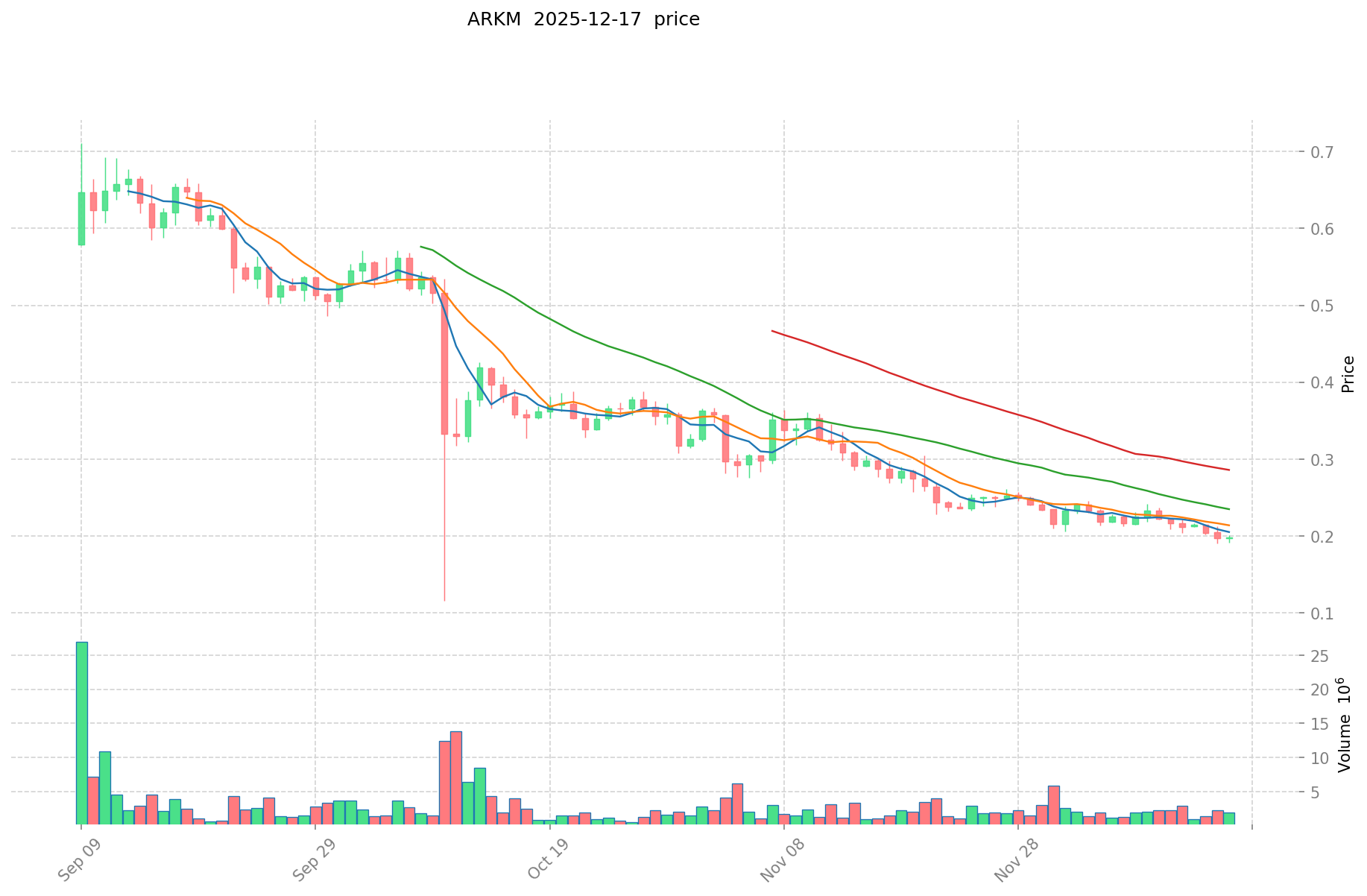
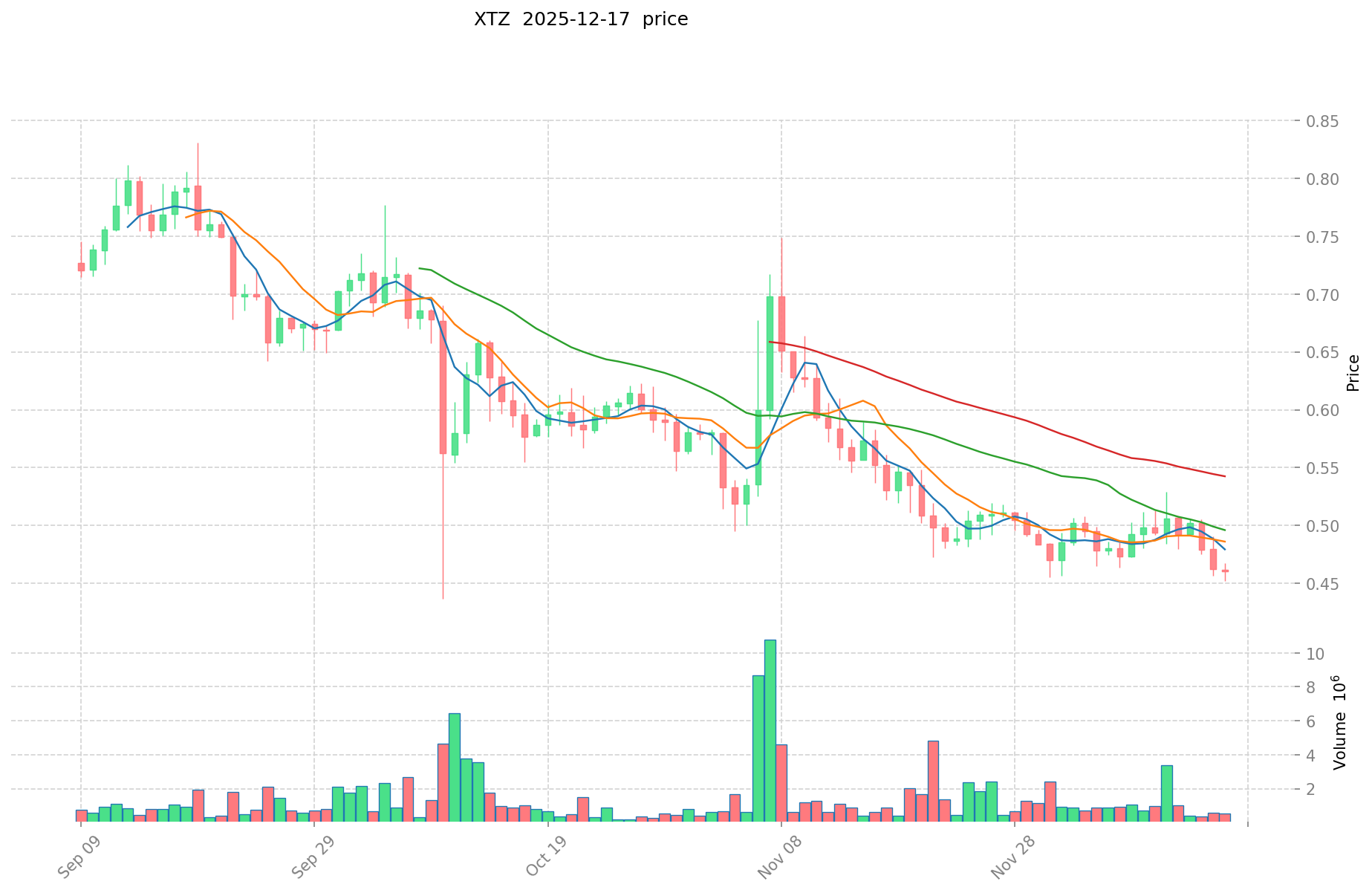
Price Movement Trends of ARKM and XTZ
Arkham (ARKM):
- All-time high: $3.9923 (March 10, 2024)
- All-time low: $0.1162 (October 10, 2025)
- Launch price: $0.05 (July 18, 2023)
- Current price change from launch: +287% (to $0.1934)
Tezos (XTZ):
- All-time high: $9.12 (October 4, 2021)
- All-time low: $0.350476 (December 7, 2018)
- Launch price: $0.40
- One-year performance: -68.87%
Comparative Analysis: ARKM has experienced significant volatility since its launch, declining 90.3% over the past year from a peak of $3.9923. In contrast, XTZ has shown relatively more stable long-term accumulation, though it has declined 68.87% annually. Both assets reflect downward market pressure over extended periods.
Current Market Status (December 17, 2025)
ARKM Metrics:
- Current price: $0.1934
- 24-hour change: +0.41%
- 7-day change: -14.87%
- 30-day change: -33.69%
- 1-year change: -90.3%
- Market capitalization: $102.96 million (circulating) / $193.4 million (fully diluted)
- 24-hour trading volume: $368,938.62
- Circulating supply: 532,379,944 ARKM / 1,000,000,000 total supply (53.24%)
XTZ Metrics:
- Current price: $0.4536
- 24-hour change: -0.65%
- 7-day change: -8.92%
- 30-day change: -17.94%
- 1-year change: -68.87%
- Market capitalization: $484.88 million (circulating) / $493.97 million (fully diluted)
- 24-hour trading volume: $176,250.77
- Circulating supply: 1,068,953,499 XTZ / 1,089,009,642 total supply (98.16%)
Market Sentiment Index (Fear & Greed Index):
- Current reading: 16 (Extreme Fear)
- Status: The cryptoasset market is experiencing extreme fear sentiment, indicating heightened risk perception among market participants.
View Real-Time Prices:
II. Project Overview and Technical Architecture
Arkham (ARKM)
Project Description: Arkham is a blockchain intelligence company that has developed a platform providing information on real-world entities and individuals behind cryptocurrency market activity. The company operates as a Series A startup.
Funding Background:
- Total capital raised: Over $12 million
- Notable investors: Founders of Palantir and OpenAI, venture capitalists including Geoff Lewis (Bedrock) and Tim Draper
Blockchain Infrastructure:
- Network: Ethereum (ETH)
- Contract address: 0x6e2a43be0b1d33b726f0ca3b8de60b3482b8b050
- Listed on 43 exchanges
Market Position:
- Global ranking: #337
- Market share: 0.0061%
- Active holders: 36,509
Tezos (XTZ)
Project Description: Tezos is a decentralized blockchain that manages itself through formal verification mechanisms. The protocol simplifies formal verification through a digital federation model, mathematically ensuring transaction code accuracy and improving smart contract security. It is a universal, self-evolving encrypted digital ledger.
Key Technological Features:
- Consensus mechanism: Liquid Proof of Stake (LPoS)
- Smart contract language: Michelson (designed for security)
- Self-amendment capability: Updates via governance without hard forks
- Delegation model: XTZ holders can delegate validation rights while retaining custody and earning staking rewards
Project Origins:
- Founded by Arthur and Kathleen Breitman in 2014
- Designed using an environmentally friendly proof-of-stake model
Market Position:
- Global ranking: #124
- Market share: 0.015%
- Active holders: 20,481
- Listed on 43 exchanges
III. Market Performance Comparison
Price Volatility Analysis
ARKM Volatility:
- 1-hour: -1.23%
- 24-hour: +0.41%
- 7-day: -14.87%
- 30-day: -33.69%
- Annual: -90.3%
ARKM exhibits extreme volatility with significant downward pressure over extended timeframes. The asset has lost approximately 90% of its value over the past year.
XTZ Volatility:
- 1-hour: -0.57%
- 24-hour: -0.65%
- 7-day: -8.92%
- 30-day: -17.94%
- Annual: -68.87%
XTZ demonstrates more moderate short-term volatility but substantial long-term losses, though less severe than ARKM.
Liquidity Comparison
ARKM:
- 24-hour volume: $368,938.62
- Volume to market cap ratio: Relatively low liquidity concentration
XTZ:
- 24-hour volume: $176,250.77
- Volume to market cap ratio: Lower relative trading activity despite larger market cap
- Circulating supply ratio: 98.16% (highly diluted supply)
IV. Risk Assessment and Market Outlook
Risk Factors
ARKM Risks:
- Severe long-term price depreciation (-90.3% annually)
- Early-stage company vulnerability (Series A startup)
- Concentrated holder base (36,509 addresses)
- Significant gap between circulating and fully diluted valuation (53.24% circulating supply)
XTZ Risks:
- Sustained downward trend (-68.87% annually)
- Highly diluted supply (98.16% already circulating)
- Lower trading volume relative to market cap
- Historical volatility from previous market cycles (fell from $9.12 ATH)
Market Sentiment Context
Current extreme fear (index: 16) suggests both assets are trading in a risk-averse environment. This sentiment typically reflects heightened uncertainty and reduced investor confidence across the broader cryptoasset market.
V. Conclusion
ARKM and XTZ represent different risk profiles within the cryptocurrency ecosystem. ARKM, as a younger blockchain intelligence platform, exhibits higher volatility and greater losses, while XTZ, as an established smart contract platform, shows more moderate but persistent downward pressure. Both assets face challenging market conditions reflected in the extreme fear sentiment index. Investors should conduct thorough due diligence and risk assessment before considering positions in either asset.
Investment Value Analysis: ARKM vs XTZ
I. Executive Summary
Based on available research materials, this report examines the investment value drivers for Arkham (ARKM) and Tezos (XTZ). The analysis reveals that both assets' investment potential depends on market demand, technological innovation, and market sentiment. ARKM's value is influenced by supply scarcity and institutional adoption, while XTZ's value is tied to Tezos ecosystem activity and broader market performance.
II. Core Factors Affecting ARKM vs XTZ Investment Value
Supply Mechanism Comparison (Tokenomics)
- ARKM: Investment potential influenced by supply scarcity dynamics
- XTZ: Value determined by ecosystem activity and token supply considerations
Note: Specific tokenomic details regarding fixed supply, inflationary mechanisms, or emission schedules were not available in the reference materials provided.
Institutional Adoption and Market Application
- Institutional Holdings: ARKM shows potential for institutional adoption as a key value driver
- Market Positioning: ARKM's investment potential is particularly sensitive to institutional capital inflows and adoption rates
- XTZ Ecosystem Focus: Value realization depends on ecosystem participation and development activity levels
Note: Specific information regarding enterprise adoption in cross-border payments, settlement systems, or portfolio integration was not detailed in the available sources.
Technology Development and Ecosystem Construction
- Tezos Ecosystem: XTZ's value is intrinsically linked to Tezos ecosystem activity and network development
- DeFi and Applications: The comparative analysis of DeFi adoption, NFT development, and smart contract deployment between ARKM and XTZ requires additional technical documentation not present in current materials
Note: Detailed information on specific technology upgrades or technical development roadmaps for both assets was not available in the reference materials.
Macroeconomic Environment and Market Cycles
- Bitcoin Correlation Effects: Historical data indicates Bitcoin price movements do not maintain sustained positive correlation with U.S. debt ceiling increases, suggesting independent valuation drivers
- USD Depreciation: Bitcoin's resilience reflects investor expectations that U.S. fiscal policy may result in continued dollar depreciation
- Market Sentiment: Altcoin positioning during Bitcoin adjustment cycles presents opportunities for strategic allocation, including projects across AI, DePIN, and RWA sectors
Note: Specific macroeconomic impact analysis on ARKM and XTZ during different monetary policy regimes was not detailed in the provided sources.
III. Research Limitations
The reference materials provided limited comprehensive quantitative data on:
- Specific tokenomic structures and emission schedules
- Detailed institutional holding positions
- Technical roadmap comparisons
- Regulatory environment differences by jurisdiction
- Historical price correlation analysis between ARKM and XTZ
IV. Conclusion
Investment decisions regarding ARKM and XTZ should consider supply scarcity, institutional adoption trends, and ecosystem development activity. Market sentiment and macroeconomic conditions remain significant variables affecting both assets' performance. Further detailed analysis with comprehensive on-chain data and ecosystem metrics is recommended before investment decisions.
III. 2025-2030 Price Forecast: ARKM vs XTZ
Short-term Forecast (2025)
- ARKM: Conservative $0.114283-$0.1937 | Optimistic $0.199511
- XTZ: Conservative $0.281232-$0.4536 | Optimistic $0.54432
Mid-term Forecast (2027-2028)
- ARKM may enter a consolidation phase with gradual appreciation, expected price range $0.163861-$0.327774
- XTZ may enter an expansion phase with steady growth momentum, expected price range $0.316465-$0.684853
- Key drivers: institutional capital inflows, ETF adoption, ecosystem development
Long-term Forecast (2030)
- ARKM: Base case $0.248663-$0.289143 | Optimistic scenario $0.329623
- XTZ: Base case $0.494956-$0.707080 | Optimistic scenario $1.011125
Disclaimer: This analysis is based on historical data trends and statistical modeling. Price predictions are subject to significant uncertainty and should not be considered as investment advice. Cryptocurrency markets are highly volatile and influenced by numerous unpredictable factors including regulatory changes, technological developments, and market sentiment. Investors should conduct their own research and consult with financial professionals before making investment decisions.
ARKM:
| 年份 | 预测最高价 | 预测平均价格 | 预测最低价 | 涨跌幅 |
|---|---|---|---|---|
| 2025 | 0.199511 | 0.1937 | 0.114283 | 0 |
| 2026 | 0.218232105 | 0.1966055 | 0.16908073 | 1 |
| 2027 | 0.238531622875 | 0.2074188025 | 0.163860853975 | 7 |
| 2028 | 0.327773562650625 | 0.2229752126875 | 0.12932562335875 | 15 |
| 2029 | 0.302911826435968 | 0.275374387669062 | 0.217545766258559 | 42 |
| 2030 | 0.329623142039867 | 0.289143107052515 | 0.248663072065163 | 49 |
XTZ:
| 年份 | 预测最高价 | 预测平均价格 | 预测最低价 | 涨跌幅 |
|---|---|---|---|---|
| 2025 | 0.54432 | 0.4536 | 0.281232 | 0 |
| 2026 | 0.573804 | 0.49896 | 0.2794176 | 10 |
| 2027 | 0.66511368 | 0.536382 | 0.31646538 | 18 |
| 2028 | 0.6848525376 | 0.60074784 | 0.3544412256 | 32 |
| 2029 | 0.77136022656 | 0.6428001888 | 0.57852016992 | 41 |
| 2030 | 1.0111246969824 | 0.70708020768 | 0.494956145376 | 55 |
Comparative Analysis Report: Arkham (ARKM) vs. Tezos (XTZ)
I. Historical Price Comparison and Current Market Status
Price Movement Trends of ARKM and XTZ
Arkham (ARKM):
- All-time high: $3.9923 (March 10, 2024)
- All-time low: $0.1162 (October 10, 2025)
- Launch price: $0.05 (July 18, 2023)
- Current price change from launch: +287% (to $0.1934)
Tezos (XTZ):
- All-time high: $9.12 (October 4, 2021)
- All-time low: $0.350476 (December 7, 2018)
- Launch price: $0.40
- One-year performance: -68.87%
Comparative Analysis: ARKM has experienced significant volatility since its launch, declining 90.3% over the past year from a peak of $3.9923. In contrast, XTZ has shown relatively more stable long-term accumulation, though it has declined 68.87% annually. Both assets reflect downward market pressure over extended periods.
Current Market Status (December 17, 2025)
ARKM Metrics:
- Current price: $0.1934
- 24-hour change: +0.41%
- 7-day change: -14.87%
- 30-day change: -33.69%
- 1-year change: -90.3%
- Market capitalization: $102.96 million (circulating) / $193.4 million (fully diluted)
- 24-hour trading volume: $368,938.62
- Circulating supply: 532,379,944 ARKM / 1,000,000,000 total supply (53.24%)
XTZ Metrics:
- Current price: $0.4536
- 24-hour change: -0.65%
- 7-day change: -8.92%
- 30-day change: -17.94%
- 1-year change: -68.87%
- Market capitalization: $484.88 million (circulating) / $493.97 million (fully diluted)
- 24-hour trading volume: $176,250.77
- Circulating supply: 1,068,953,499 XTZ / 1,089,009,642 total supply (98.16%)
Market Sentiment Index (Fear & Greed Index):
- Current reading: 16 (Extreme Fear)
- Status: The cryptoasset market is experiencing extreme fear sentiment, indicating heightened risk perception among market participants.
II. Project Overview and Technical Architecture
Arkham (ARKM)
Project Description: Arkham is a blockchain intelligence company that has developed a platform providing information on real-world entities and individuals behind cryptocurrency market activity. The company operates as a Series A startup.
Funding Background:
- Total capital raised: Over $12 million
- Notable investors: Founders of Palantir and OpenAI, venture capitalists including Geoff Lewis (Bedrock) and Tim Draper
Blockchain Infrastructure:
- Network: Ethereum (ETH)
- Contract address: 0x6e2a43be0b1d33b726f0ca3b8de60b3482b8b050
- Listed on 43 exchanges
Market Position:
- Global ranking: #337
- Market share: 0.0061%
- Active holders: 36,509
Tezos (XTZ)
Project Description: Tezos is a decentralized blockchain that manages itself through formal verification mechanisms. The protocol simplifies formal verification through a digital federation model, mathematically ensuring transaction code accuracy and improving smart contract security. It is a universal, self-evolving encrypted digital ledger.
Key Technological Features:
- Consensus mechanism: Liquid Proof of Stake (LPoS)
- Smart contract language: Michelson (designed for security)
- Self-amendment capability: Updates via governance without hard forks
- Delegation model: XTZ holders can delegate validation rights while retaining custody and earning staking rewards
Project Origins:
- Founded by Arthur and Kathleen Breitman in 2014
- Designed using an environmentally friendly proof-of-stake model
Market Position:
- Global ranking: #124
- Market share: 0.015%
- Active holders: 20,481
- Listed on 43 exchanges
III. Market Performance Comparison
Price Volatility Analysis
ARKM Volatility:
- 1-hour: -1.23%
- 24-hour: +0.41%
- 7-day: -14.87%
- 30-day: -33.69%
- Annual: -90.3%
ARKM exhibits extreme volatility with significant downward pressure over extended timeframes. The asset has lost approximately 90% of its value over the past year.
XTZ Volatility:
- 1-hour: -0.57%
- 24-hour: -0.65%
- 7-day: -8.92%
- 30-day: -17.94%
- Annual: -68.87%
XTZ demonstrates more moderate short-term volatility but substantial long-term losses, though less severe than ARKM.
Liquidity Comparison
ARKM:
- 24-hour volume: $368,938.62
- Volume to market cap ratio: Relatively low liquidity concentration
- Supply scarcity dynamic: 53.24% circulating supply creates potential for future dilution
XTZ:
- 24-hour volume: $176,250.77
- Volume to market cap ratio: Lower relative trading activity despite larger market cap
- Supply maturity: 98.16% supply already in circulation, indicating limited future dilution pressure
IV. Investment Strategy Comparison: ARKM vs XTZ
Long-term vs. Short-term Investment Strategy
ARKM: Suitable for investors focused on blockchain intelligence infrastructure and early-stage technology adoption. The Series A startup status and strong institutional backing create potential for institutional adoption scenarios, though with elevated risk.
XTZ: Suitable for investors seeking relatively stable smart contract platforms with established governance mechanisms and staking rewards. The Liquid Proof of Stake model provides ongoing income generation through delegation, appealing to income-focused long-term holders.
Risk Management and Asset Allocation
Conservative Investor Profile:
- ARKM: 15% | XTZ: 85%
- Rationale: XTZ's larger market capitalization, higher circulating supply ratio, and established staking mechanism provide greater stability.
Aggressive Investor Profile:
- ARKM: 50% | XTZ: 50%
- Rationale: ARKM offers higher growth potential despite elevated risk; balanced allocation manages downside exposure.
Hedging Instruments:
- Stablecoin allocation: Maintain 20-30% in stablecoins during extreme fear sentiment (index: 16)
- Cross-asset diversification: Consider complementary exposure to infrastructure and platform categories
- Position sizing: Limit individual positions to 5-10% of portfolio given extreme volatility conditions
V. Potential Risk Comparison
Market Risk
ARKM: Severe long-term price depreciation (-90.3% annually) and concentrated holder base (36,509 addresses) create vulnerability to large sell-offs. Early-stage project status increases susceptibility to market sentiment shifts.
XTZ: Sustained downward trend (-68.87% annually) despite established market position indicates persistent valuation pressure. Highly diluted supply (98.16% circulating) reduces potential for scarcity-driven appreciation but stabilizes long-term supply dynamics.
Technical Risk
ARKM: As an Ethereum-based token, ARKM is dependent on Ethereum network security and scalability. Series A startup operational risks include regulatory compliance, technology development execution, and maintaining institutional partnerships.
XTZ: Self-amendment capability, while innovative, introduces complexity in governance decision-making. The formal verification approach provides security benefits but requires specialized expertise for smart contract deployment, potentially limiting developer adoption.
Regulatory Risk
Current regulatory environment poses challenges for both assets. ARKM's blockchain intelligence functionality may face data privacy and compliance scrutiny in multiple jurisdictions. XTZ, as an established platform, has greater regulatory clarity but faces ongoing uncertainty regarding staking reward taxation across different regulatory regimes.
VI. Conclusion: Which Is the Better Buy?
📌 Investment Value Summary:
ARKM Advantages:
- Early-stage growth potential with strong institutional backing from Palantir and OpenAI founders
- Niche market positioning in blockchain intelligence with limited direct competitors
- Supply scarcity dynamics (53.24% circulating) create potential valuation upside if adoption accelerates
- Higher volatility enables significant appreciation in favorable market cycles
XTZ Advantages:
- Established market position (#124 global ranking) with 7+ years of operational history
- Mature supply mechanics (98.16% circulating) eliminate future dilution concerns
- Liquid Proof of Stake enables passive income generation through staking rewards
- Self-amendment capability provides technical flexibility for long-term protocol adaptation
- More moderate volatility profile reduces downside risk compared to ARKM
✅ Investment Recommendations:
Beginner Investors: Prioritize XTZ for its established track record, staking rewards capability, and lower technical complexity. XTZ provides a more stable entry point into smart contract platforms with clear income generation mechanisms. Limit ARKM exposure to small exploratory positions (5-10% maximum).
Experienced Investors: Consider balanced allocation reflecting risk tolerance. ARKM warrants consideration for investors with conviction in blockchain intelligence infrastructure and tolerance for 50-70% drawdown scenarios. XTZ serves as portfolio stability component with passive staking income. Actively manage position sizing based on market sentiment and accumulate during extreme fear periods.
Institutional Investors: Evaluate ARKM as emerging infrastructure play with strong venture capital backing, but conduct extensive operational and regulatory due diligence. XTZ offers more suitable profile for institutional mandates requiring established market capitalization, regulatory clarity, and passive income generation through staking mechanisms. Consider both assets as complementary exposure to smart contract and infrastructure categories rather than competing positions.
⚠️ Risk Disclaimer: Cryptocurrency markets exhibit extreme volatility and unpredictability. Both ARKM and XTZ have experienced 68-90% annual declines despite different market positions. Current market sentiment reflects extreme fear (index: 16), indicating heightened systemic risk perception. This analysis is not investment advice. Investors should conduct independent due diligence, assess personal risk tolerance, and consult qualified financial professionals before making investment decisions. Positions in either asset carry substantial risk of capital loss. None
FAQ: Arkham (ARKM) vs. Tezos (XTZ) Investment Comparison
I. What are the key differences in current market performance between ARKM and XTZ?
Answer: ARKM is trading at $0.1934 with a 1-year decline of -90.3%, while XTZ is at $0.4536 with a -68.87% annual decline. ARKM exhibits more severe volatility but has a shorter operational history (launched July 2023), whereas XTZ represents an established platform since 2018. ARKM's market cap stands at $102.96 million (circulating) compared to XTZ's $484.88 million, reflecting XTZ's more mature market positioning.
II. Which asset carries less risk for conservative investors?
Answer: XTZ is the safer choice for conservative investors due to several factors: (1) larger market capitalization ($484.88M vs. $102.96M); (2) higher circulating supply ratio (98.16% vs. 53.24%), reducing future dilution concerns; (3) established 7-year track record; (4) Liquid Proof of Stake mechanism enabling passive staking rewards; and (5) more moderate short-term volatility. ARKM, as a Series A startup, carries elevated execution and regulatory risks unsuitable for conservative portfolios.
III. What is the staking reward advantage of XTZ over ARKM?
Answer: XTZ offers a structured Liquid Proof of Stake (LPoS) delegation model allowing token holders to earn staking rewards while retaining custody of their assets. This creates passive income generation for long-term holders. ARKM, being an Ethereum-based token, does not offer native staking mechanisms and generates no passive rewards. For income-focused investors, XTZ provides a clear advantage through its reward infrastructure.
IV. How does supply scarcity affect the investment potential of these two assets?
Answer: ARKM has only 53.24% of its 1 billion total supply in circulation, creating significant future dilution potential if remaining tokens are released. This dilution pressure could suppress price appreciation. Conversely, XTZ has 98.16% of its supply already circulating, eliminating major future dilution concerns. However, XTZ's diluted supply also means less scarcity-driven appreciation potential, while ARKM's scarcity could accelerate gains if adoption accelerates despite dilution risks.
V. What institutional backing do these projects have, and how does it affect risk assessment?
Answer: ARKM benefits from strong institutional backing including founders of Palantir and OpenAI, plus venture capitalists like Geoff Lewis (Bedrock) and Tim Draper, with over $12 million in capital raised. This reduces operational risk and validates the business model. XTZ, founded by Arthur and Kathleen Breitman in 2014, has established governance through formal verification mechanisms but lacks the high-profile venture capital endorsement. ARKM's institutional support provides credibility, though it remains a Series A startup with execution risks, while XTZ's maturity offers operational stability.
VI. What are the appropriate investment allocation percentages for different investor types?
Answer: For conservative investors: allocate 85% to XTZ and 15% to ARKM, prioritizing stability and staking rewards. For aggressive investors: use a 50-50 allocation to balance ARKM's growth potential against XTZ's stability. For both profiles, maintain 20-30% in stablecoins during current extreme fear sentiment (index: 16). Position size individual holdings at 5-10% maximum of total portfolio given extreme volatility conditions and current 68-90% annual declines in both assets.
VII. What is the price forecast outlook for ARKM and XTZ through 2030?
Answer: Short-term (2025): ARKM forecasted $0.114-$0.194 range with optimistic case at $0.200; XTZ forecasted $0.281-$0.454 range with optimistic case at $0.544. Mid-term (2027-2028): ARKM expected to consolidate at $0.164-$0.328; XTZ expected expansion at $0.316-$0.685. Long-term (2030): ARKM base case $0.249-$0.289 (optimistic $0.330); XTZ base case $0.495-$0.707 (optimistic $1.011). These forecasts depend on institutional adoption, ETF integration, and ecosystem development, with forecasts carrying significant uncertainty given market volatility.
VIII. Why does the current extreme fear sentiment (index: 16) matter for investment decisions?
Answer: The current extreme fear reading indicates heightened systemic risk perception and reduced investor confidence across cryptocurrency markets. This environment typically presents both opportunities and dangers: (1) depressed valuations may offer entry points for conviction investors with long-term horizons; (2) extreme fear periods often precede significant market recoveries; however (3) accumulating during extreme fear requires high risk tolerance and adequate capital reserves; (4) liquidation cascades and forced selling could drive prices lower; (5) institutional players may remain sidelined, limiting demand recovery. Investors should only accumulate during extreme fear if confident in 2-5 year holding periods and able to withstand additional 30-50% declines.
Share
How to Buy Cryptocurrency


Trending Cryptocurrencies



XZXX: A Comprehensive Guide to the BRC-20 Meme Token in 2025

Bitcoin Fear and Greed Index: Market Sentiment Analysis for 2025

Top Crypto ETFs to Watch in 2025: Navigating the Digital Asset Boom
5 ways to get Bitcoin for free in 2025: Newbie Guide

Bitcoin Market Cap in 2025: Analysis and Trends for Investors

2025 Bitcoin Price Prediction: Trump's Tariffs' Impact on BTC

Is RaveDAO (RAVE) a good investment?: A Comprehensive Analysis of Token Fundamentals, Market Performance, and Future Potential
Is ZetaChain (ZETA) a good investment?: A Comprehensive Analysis of Features, Market Potential, and Risk Factors in 2024

Is Non-Playable Coin (NPC) a good investment?: A Comprehensive Analysis of Market Potential, Risks, and Future Prospects

Is Popcat (POPCAT) a good investment?: A Comprehensive Analysis of Price Trends, Market Potential, and Risk Factors for 2024
What Is a Ponzi Scheme? How Ponzi Scams Work and How to Identify Them