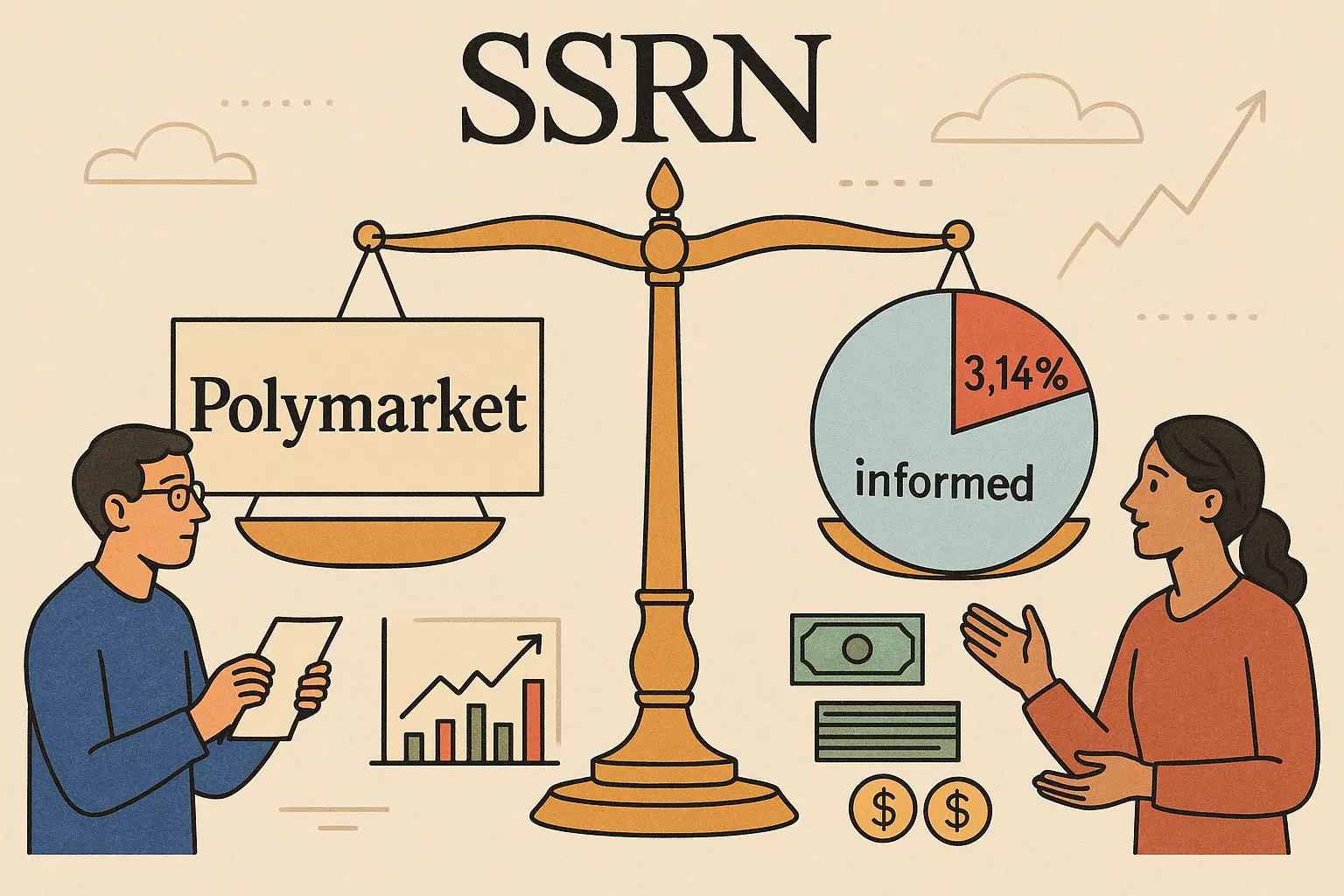
According to an academic working paper published on SSRN on April 20, a research team from London Business School and Yale University analyzed Polymarket’s complete trading records and concluded: the platform’s pricing accuracy is mainly driven by 3.14% informed traders, rather than the collective wisdom of all accounts. The study covers 98,906 events, 210,322 markets, involves 1.72 million accounts, and totals $13.76 billion in trading volume.
Research Method and Core Findings
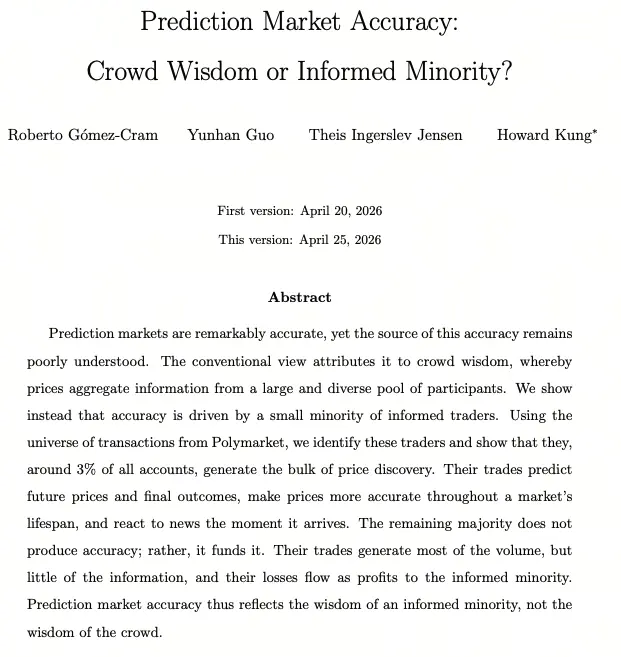
(Source: SSRN)
According to the paper, the researchers used a “Sign Randomization Test” statistical method, grouping traders based on the source of their profits (real skill vs. random luck).
The results show that on Polymarket only 3.14% of accounts meet the standard of “skill-based winners”: they can consistently profit (with robust out-of-sample test results), participate on average in 79 markets, and their position direction always matches the final market outcome. The remaining 96% of accounts either break even due to luck or lose money. According to the paper, for every one-percentage-point increase in the net buy-in volume of skill-based traders, the probability of correctly predicting the final outcome increases by 8 basis points; although the lucky winners’ accounts have positive balances, they show no meaningful predictive ability in either of the two tests.
Skill Persistence: Better Than Mutual Funds
According to the paper, the researchers randomly split events into a training set and a test set: in the training set, traders categorized as “skilled” had 44% still remain in that classification in the test set; among “unskilled” losing traders categorized as such, 51% still retained the original classification. By comparison, in the parallel test, only 10% of mutual funds categorized as “skilled” could keep their classification. The paper notes that prediction markets exhibit unusually high persistence on both the skill and anti-skill sides.
Insider Trading Identification and CFTC Action
According to the paper, the researchers identified 1,950 accounts that meet timing and confidence standards, suggesting trading may have been based on non-public information; on average, each account profited about $15,000.
One well-documented case involves three accounts: in the hours before the start of a U.S. secret military operation on January 3, 2026, the three accounts built positions in contracts related to Venezuelan President Nicolás Maduro; the three accounts together earned more than $630,000 in profit. According to publicly available court records, on April 23, 2026, the CFTC filed a lawsuit in this case, accusing an active-duty U.S. service member of using one of the accounts to engage in insider trading.
The paper also concludes that insider trading activity is too concentrated in isolated events to explain the broader price-discovery mechanism across the entire platform.
Account Composition Distribution
According to the paper, the overall distribution of Polymarket accounts is as follows: 67% of accounts belong to the “unlucky and unskilled” losing group, which bears all of the platform’s cumulative losses; market makers and technically proficient “buyers” together account for less than 3.5% of the total number of accounts, yet they receive more than 30% of total earnings.
Frequently Asked Questions
What are the authors and data scale of this Polymarket study?
According to the SSRN research paper, it was published on April 20, 2026 (with revisions on April 25), and is co-authored by Roberto Gomez-Cram, Yunhan Guo, and Howard Kung of London Business School, as well as Theis Ingerslev Jensen of Yale University. The data covers Polymarket’s 98,906 events, 1.72 million accounts, and total trading volume of $13.76 billion.
What exactly is the performance of the 3.14% informed traders found in the research?
According to the paper, for each one-percentage-point increase in the net buy-in volume of these skill-based traders, the probability of correctly predicting the final market outcome increases by 8 basis points. In the skill persistence test, 44% of accounts maintain their skill rating, far higher than the 10% for mutual funds.
What are the details of the CFTC’s lawsuit regarding the insider trading case in the Maduro contracts?
According to the research paper and publicly available court records, on April 23, 2026, the CFTC filed a lawsuit accusing an active-duty U.S. service member of using Polymarket accounts to conduct insider trading in contracts related to Maduro, in the hours before the start of a U.S. secret military operation on January 3, 2026. The three involved accounts together earned more than $630,000.
Disclaimer: The information on this page may come from third parties and does not represent the views or opinions of Gate. The content displayed on this page is for reference only and does not constitute any financial, investment, or legal advice. Gate does not guarantee the accuracy or completeness of the information and shall not be liable for any losses arising from the use of this information. Virtual asset investments carry high risks and are subject to significant price volatility. You may lose all of your invested principal. Please fully understand the relevant risks and make prudent decisions based on your own financial situation and risk tolerance. For details, please refer to
Disclaimer.
Related Articles
Prediction market theory founder Robin Hanson: insider information is one of the value propositions of prediction markets
Polymarket and Kalshi have rolled out restrictions on insider trading under regulatory pressure; however, Robin Hanson, the founder of the prediction market theory, believes that inside information is a core mechanism for market value and for quickly reflecting the truth. He used the metaphor of a poker table to warn about the risks of information asymmetry, and argued that if insiders were completely excluded, the market might just become a riddle dressed up as a financial product. The article says he views prediction markets as democracy rather than elite monopolization, and questions whether, if officials’ trading were banned, reporters’ leaks should also be restricted. This view comes from ABMedia’s chain-news report.
ChainNewsAbmedia2h ago
CLARITY Bill enters a critical 28-day window! Polymarket: Probability of passing drops to 38%
According to data from Polymarket prediction markets on April 27, the probability that the “Digital Asset Market Clarity Act” (CLARITY Act) will be completed into law in 2026 has fallen from a previous peak of 70% to 38-50%. As of April 27, there are only 28 days left until May 25, 2026, Memorial Day holiday in the United States.
MarketWhisper6h ago
Research reveals: Polymarket players take home 30% of profits by winning 3% of the positions—more than 70% of players absorb all losses
A new study analyzes Polymarket’s trading records from 2023–2025 and shows that only 3.14% of experienced winners control more than 30% of the profits. Crowd participation alone is not enough to explain overall accuracy; at the same time, it tracks 1,950 highly suspicious insider trading accounts that, while not driving predictions, amplified price volatility. The case shows that large bets were placed and profits were made before the U.S. announced developments regarding Venezuela. The research questions “wisdom of crowds” and emphasizes the need for increasingly strict regulation.
ChainNewsAbmedia8h ago
Polymarket Analysis: Crypto Events Account for 40% of Top 10 Most Volatile Markets
Gate News message, April 27 — Polysights, a third-party prediction market data platform, analyzed over 20,000 Polymarket markets from the past six months and released a volatility ranking. The analysis revealed that cryptocurrency-related markets account for four of the top ten most volatile markets
GateNews9h ago
Polymarket Announces April 28 Upgrade: Collateral Assets Migrated to pUSD, Trading Paused for About 1 Hour
According to an official announcement posted on X on April 27 by Polymarket developers, Polymarket will roll out a full platform infrastructure upgrade at 11:00 UTC on April 28, with trading paused for about 1 hour. This upgrade includes new generation trading contracts, a rebuilt order book, and the introduction of a new collateral token, pUSD. The platform’s existing collateral assets will be migrated from USDC.e to pUSD.
MarketWhisper9h ago
Polymarket Non-Sports Volume Reaches $7.5B vs. Kalshi's $1.6B, Says Blockchain Capital Partner
Gate News message, April 27 — According to Spencer Bogart, a partner at Blockchain Capital, Kalshi and Polymarket have nearly identical total trading volumes of approximately $12.2 billion each (Kalshi at $12.29 billion, Polymarket at $12.22 billion). However, when sports-related trades are
GateNews10h ago


