
Futures
Access hundreds of perpetual contracts
TradFi
Gold
One platform for global traditional assets
Options
Hot
Trade European-style vanilla options
Unified Account
Maximize your capital efficiency
Demo Trading
Introduction to Futures Trading
Learn the basics of futures trading
Futures Events
Join events to earn rewards
Demo Trading
Use virtual funds to practice risk-free trading
Launch
CandyDrop
Collect candies to earn airdrops
Launchpool
Quick staking, earn potential new tokens
HODLer Airdrop
Hold GT and get massive airdrops for free
Pre-IPOs
Unlock full access to global stock IPOs
Alpha Points
Trade on-chain assets and earn airdrops
Futures Points
Earn futures points and claim airdrop rewards


Promotions
AI
Gate AI
Your all-in-one conversational AI partner
Gate AI Bot
Use Gate AI directly in your social App
GateClaw
Gate Blue Lobster, ready to go
Gate for AI Agent
Gate MCP
Gate Skills Hub
10K+ Skills
From office tasks to trading, the all-in-one skill hub makes AI even more useful.
GateRouter
Smartly choose from 30+ AI models, with 0% extra fees


Celebrating the 30th anniversary! The "tokenization" of the Pokémon card trading market is booming, with weekly earnings of $5.38 million.
Author: Ariel, Crypto City
Pokémon 30th Anniversary: Tokenized Pokémon Card Market Weekly Revenue Surges
To mark Pokémon’s 30th anniversary, the market for Pokémon card NFTs—also known as “tokenized” Pokémon cards—is bustling with trading activity. As of the week ending April 6, revenue reached $5.38 million, nearing the all-time high recorded in September 2025.
Compared with six months ago, the recent Pokémon card trading boom has structural differences.
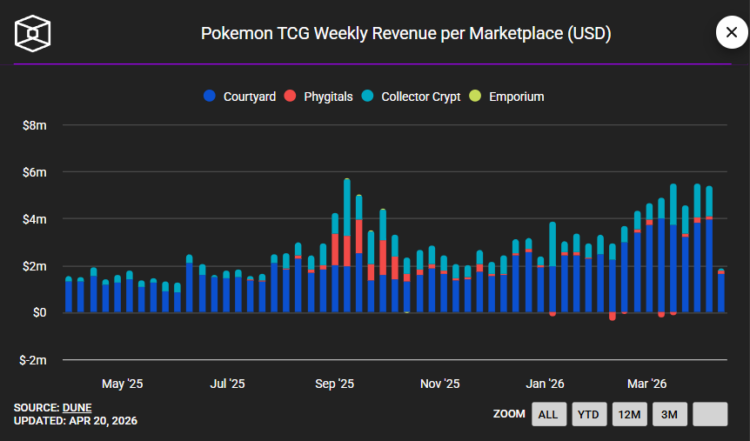
Foreign media outlet 《The Blcok》 noted that the peak in September 2025 stemmed from a one-week spike triggered after a single platform, Collector Crypt, issued tokens. However, recent high points have continued for six consecutive weeks, with most revenue coming from the well-known digital collectibles platform Courtyard.
Image source: The Block | “Tokenized” Pokémon card market trading is bustling, with weekly revenue reaching $5.38 million as of the week ending April 6
The Pokémon card NFT market has re-energized, closely tied to the Pokémon 30th anniversary. In 2026, Nintendo will officially release 30th-anniversary merchandise simultaneously worldwide, confirming that it will include the old back designs and popular cards from across past generations. The NFT market has already reflected the demand for the commemoration ahead of time.
Tokenized Pokémon cards differ from profile picture NFTs
Unlike the NFT trading frenzy in previous years that was based purely on virtual profile pictures, turning Pokémon cards into “tokenized collectibles” for on-chain trading has become a viable real-world asset (RWA) subcategory.
Taking Courtyard as an example, the platform stores physical Pokémon cards in a third-party vault, issues tokens that can be exchanged for the physical cards as backing, and thereby attracts collectors who want liquidity while avoiding the native speculative risks of cryptocurrencies.
These platforms enabling open Pokémon card trading mainly use tokenization technology as a liquidity tool, moving away from the purely speculative trading model of earlier NFTs.
As Pokémon cards are continuously exchanged and physically settled, the pricing function of the on-chain market has been validated, providing a successful template for tokenized intellectual property rights and collectibles.
It should be noted that the tokenized Pokémon card market is a separate secondary market, with no affiliation to Pokémon Company, Nintendo, or any other official entity.
Riding the Pokémon 30th anniversary wave, Courtyard’s estimated annual revenue reaches $200 million
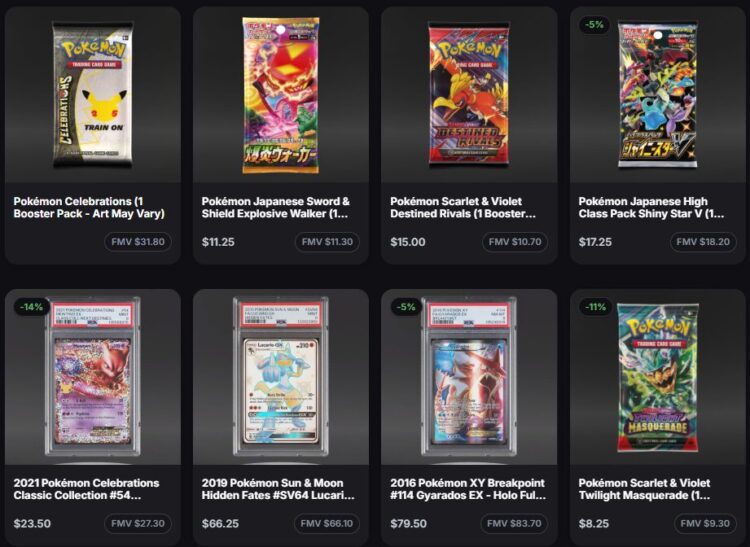
《The Block》 estimates that, if revenue can be maintained at the current level, Courtyard’s 2026 fiscal year revenue is projected to reach $200 million, surpassing the scale of most mid-sized NFT trading platforms in 2021. At the same time, marketing spending has been significantly reduced because the platform’s demand directly benefits from the boom in the physical card market, without the need to re-promote profile picture-style NFTs.
Courtyard’s short-term risk is that the bull-market momentum for physical cards could stall. But in the long run, the current trend suggests that “tokenized collectibles” have found a market-fitting product positioning, and in the future they may establish new business models for categories such as sports cards and luxury watches.
Image source: Courtyard | Tokenized trading of Pokémon cards on Courtyard
Physical Pokémon stores face security challenges; tokenization provides a safer alternative
Recently, as the value of Pokémon cards has been boosted by the 30th anniversary events, physical storefronts have faced security tests. According to 《BBC》, multiple break-in and robbery incidents involving Pokémon card shops have recently occurred across the UK. For example, several stores in places such as Cheshire and Bristol have become targets of attacks, and some retailers have lost inventory worth as much as tens of thousands of pounds.
With the risk of theft facing physical Pokémon cards, the tokenized market offers a contactless, relatively secure option for ownership and trading.
By entrusting high-value cards to professional custodians and converting them into on-chain tokens, collectors can continue participating in the card trading market while reducing the risk of theft.