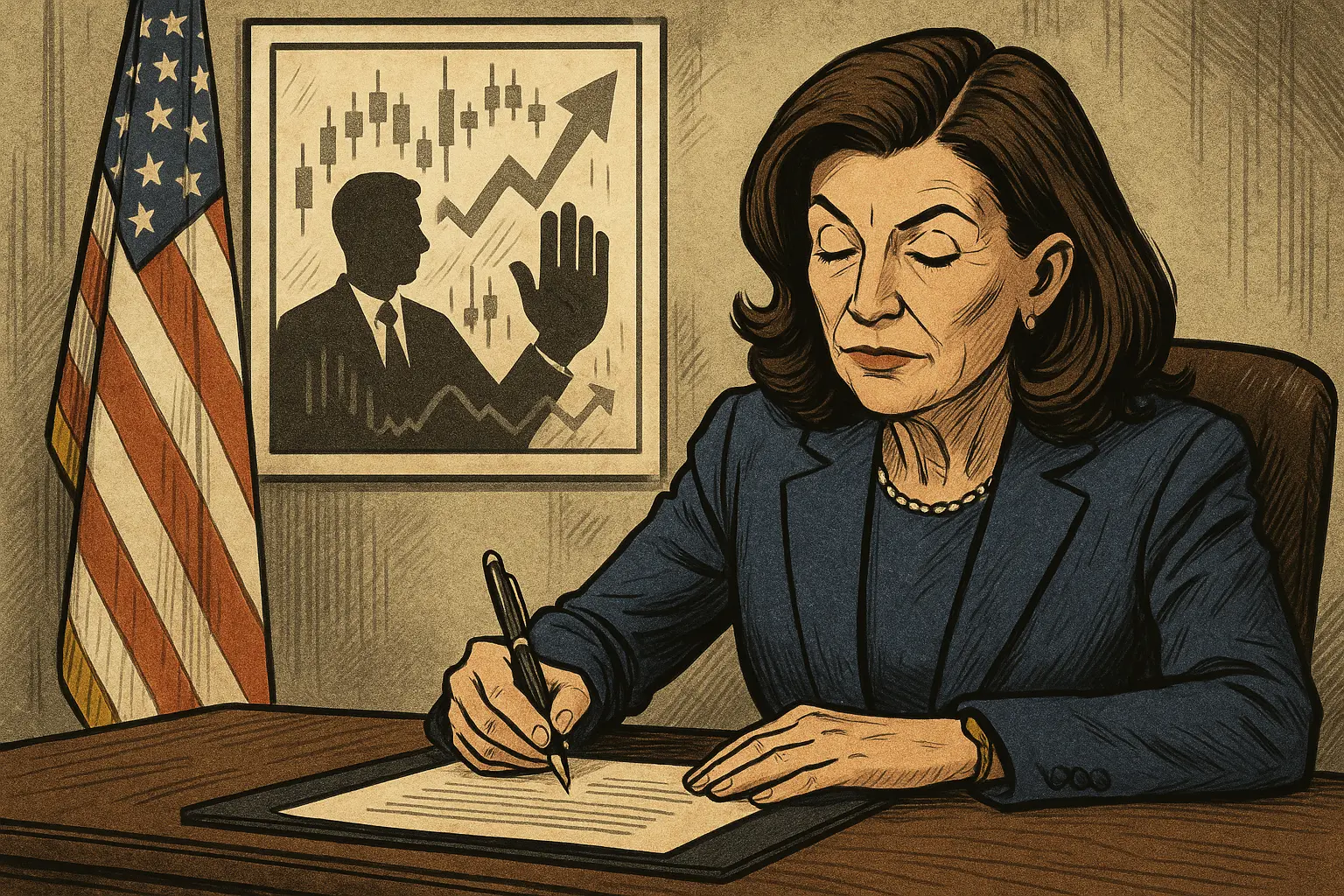
New York Governor Kathy Hochul signed an executive order on Wednesday, April 22, banning state officials and employees from placing bets on prediction markets using nonpublic information obtained through their positions, or assisting any third party in doing so. On the same day, prediction market platform Kalshi announced that it had completed an internal investigation into three political candidates who placed bets in their own campaign activities, and fined and suspended them.
Details of executive orders in New York and Illinois
Under an executive order signed by Governor Hochul on April 22, the prohibited parties include “any state agency officials or employees appointed by the governor or by any agency appointed by the governor, and any members of public bodies appointed by the governor.” The order bans the above individuals from profiting, avoiding losses, or assisting anyone else in doing so in prediction markets or similar services using nonpublic information obtained in the course of performing public duties.
On Tuesday, April 21, Illinois Governor JB Pritzker also issued a similar executive order barring state employees from using nonpublic information to place bets on prediction markets.
Kalshi’s internal investigation into three candidates
According to a statement released by the Kalshi platform on April 22, the company completed internal trading investigations into the following three political candidates, and fined and suspended them based on the fact that they placed bets in prediction market contracts related to their own campaign activities:
Matt Klein: the current state senator from Minnesota, running for a seat in the U.S. House of Representatives
Ezekiel Enriquez: previously ran for a seat in the Texas House of Representatives
Mark Moran: a Democratic candidate participating in the primary for a U.S. Senate seat in Virginia
In its statement, Kalshi said: “No matter the size of the trade, any political candidate who can affect the market by whether they are running violates our rules. Any trade found to have violated the exchange’s rules will be punished, no matter how small.”
On April 22, Moran publicly stated on the X platform that he placed a $100 bet in his own campaign contract, with the goal of drawing public attention to Kalshi’s platform rules, and cited it as saying: “I just want to get caught.”
Federal and state regulatory conflicts and legislative developments
According to a public statement from the chairman of the U.S. Commodity Futures Trading Commission (CFTC), Michael Selig, the CFTC has “exclusive jurisdiction” over prediction markets, and earlier this month filed lawsuits against Illinois, Arizona, and Connecticut, alleging that the three states closed “federally regulated designated contract markets.”
On Tuesday, April 21, New York State Attorney General Letitia James filed a lawsuit against Coinbase and Gemini over their prediction market operations, accusing the two companies of illegally offering betting services to users on events including sports games and election results, and characterizing the related services as “illegal gambling activities.”
In January of this year, a Polymarket account profited $400k from a contract related to the downfall of Venezuelan President Nicolás Maduro, triggering formal congressional attention to the use of insider information in prediction markets. After that, Democratic U.S. Representative Richie Torres introduced a draft bill proposing to ban federal elected officials, political appointees, and employees of the executive branch from placing bets in prediction market contracts involving “government policy, government actions, or political outcomes.”
Frequently Asked Questions
What is the scope of the ban under New York Governor’s executive order?
Under the executive order signed by Governor Hochul on April 22, the banned parties include state agency officials and employees appointed by the governor or by agencies appointed by the governor, as well as members of public bodies appointed by the governor. The order prohibits them from using nonpublic information obtained through their positions to profit in prediction markets or to assist others in profiting.
Which three candidates did Kalshi investigate in this case, and what were the reasons for the violations?
According to Kalshi’s April 22 statement, the three candidates investigated and punished were Matt Klein, Ezekiel Enriquez, and Mark Moran. The reason for the violations was that they placed bets in prediction market contracts related to their own campaign activities, violating Kalshi’s exchange rules.
Why are there legal conflicts between the CFTC and the states regarding regulation of prediction markets?
According to a public statement by CFTC Chairman Michael Selig, the CFTC argues that it has exclusive federal jurisdiction over prediction markets. It filed lawsuits in early April 2026 against Illinois, Arizona, and Connecticut, accusing the three states of illegally shutting down federally regulated designated contract markets.
Disclaimer: The information on this page may come from third parties and does not represent the views or opinions of Gate. The content displayed on this page is for reference only and does not constitute any financial, investment, or legal advice. Gate does not guarantee the accuracy or completeness of the information and shall not be liable for any losses arising from the use of this information. Virtual asset investments carry high risks and are subject to significant price volatility. You may lose all of your invested principal. Please fully understand the relevant risks and make prudent decisions based on your own financial situation and risk tolerance. For details, please refer to
Disclaimer.
Related Articles
Bitcoin Touches $80K in April on Polymarket, Odds Rise to 54%
Gate News message, April 23 — On Polymarket, the probability of Bitcoin touching $80,000 during April has risen to 54%, with trading volume on the contract reaching approximately $39.36 million.
The prediction market is set to settle on May 1 at 11:59
GateNews8m ago
Kalshi Launches Commodities Hub With Pyth as Data Provider for Oil, Gold, and Lithium Markets
Gate News message, April 23 — Prediction market platform Kalshi has partnered with crypto oracle protocol Pyth as a data provider for its newly launched Commodities Hub, an interface enabling users to trade binary options on commodities including Brent crude oil, gold, lithium, and soybeans. Pyth wi
GateNews3h ago
Polymarket Profit-Making Manipulation Scandal! Vitalik: Should Require Use of 3 or More Independent Sources
Vitalik Buterin made comments on April 23 regarding the Polymarket platform fan controller manipulation incident, saying that for this kind of event, prediction markets should be required to use at least 3 (or even more) independent sources’ medians as the basis for adjudication. Earlier, a user used a fan to raise the temperature data collected at a Paris weather sensing terminal, manipulated the outcome of a weather-related prediction market event, and profited about $34,000.
MarketWhisper4h ago
Jupiter launches a Telegram prediction market bot, adds Clans team-building feature
According to SolanaFloor’s April 23 report, the Solana-based decentralized trading aggregation platform Jupiter has officially launched the Jupiter Prediction Bot, bringing prediction market functionality to the Telegram platform so users can access prediction markets without leaving their messaging app.
MarketWhisper5h ago
Profitable Trader Bets $34K Against U.S. Military Intervention in Iran on Polymarket
Gate News message, April 23 — A high-performing trader (ID: Car, address: 0x7c3db723f1d4d8cb9c550095203b686cb11e5c6b) with over $1.25 million in lifetime profits has accumulated approximately $34,000 in "No" positions on Polymarket's "Will the U.S. invade Iran before 2027?" prediction market,
GateNews5h ago
Polymarket User Profits $34K by Manipulating Paris Airport Weather Sensor
A user made about $34,000 on Polymarket by tampering with a Paris CDG temperature sensor to inflate readings, affecting weather contracts settled with Météo France; two manipulation events on April 6 and 15; charges filed.
A trader earned roughly $34,000 on Polymarket by artificially boosting a sensor near Paris Charles de Gaulle Airport to spike a day's high temperature, exploiting mispriced weather options. Polymarket's weather settlements relied on Météo France data; the incidents occurred on April 6 and April 15, and Météo France has pressed market-manipulation charges.
GateNews5h ago


