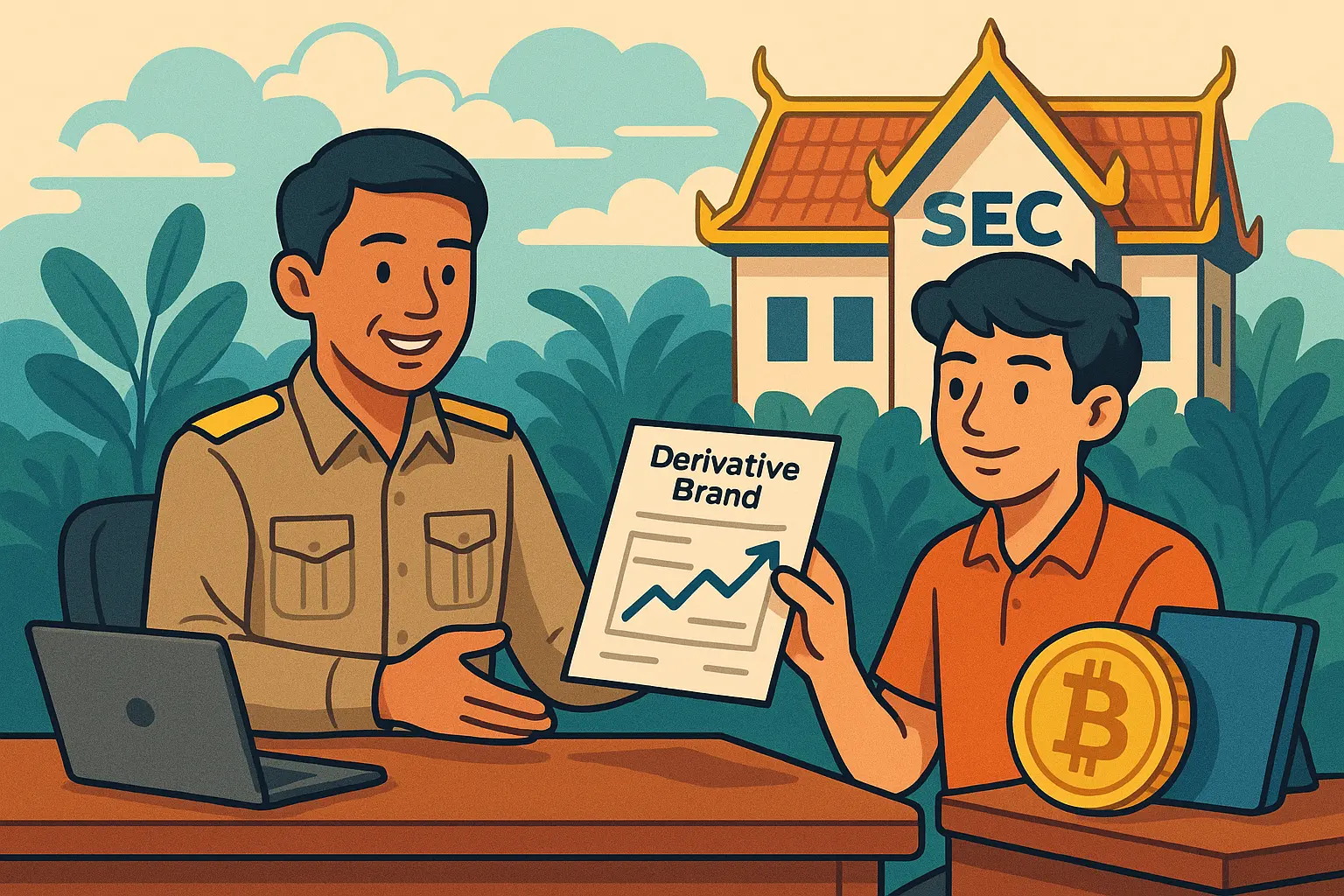
According to an April 23 announcement by the Thailand Securities and Exchange Commission (SEC), the agency has officially proposed amendments to its rules for licensing digital-asset derivative businesses. The proposal would allow firms that already hold digital-asset operating licenses to directly apply for a derivatives business license without needing to establish a separate legal entity. The proposal also introduces requirements for managing conflicts of interest for companies that operate both digital-asset and derivatives businesses, and it calls for financial standards for derivatives exchanges and clearing institutions to align with international benchmarks.
Key Proposed Amendments
According to the April 23 announcement by the Thailand SEC, this rule revision covers three core changes:
Exemption from the requirement to set up a new entity: Current rules require firms to establish a separate legal entity in order to apply for a derivatives brand license. After the proposed revision, licensed digital-asset operators may file applications directly within the existing corporate structure.
Introduction of a conflict-of-interest management mechanism: The proposal requires companies that conduct both digital-asset and derivatives businesses to establish conflict-of-interest prevention and control measures, including internal control requirements when applying for a derivatives brand license through a digital-asset trading center.
Financial standards aligned with international benchmarks: The proposal requires financial standards for derivatives exchanges and clearing institutions to align with international benchmarks.
The Thailand SEC announcement states that this revision is based on earlier rule changes that have already recognized digital assets as eligible underlying assets for futures contracts. Its goal is to expand investors’ access to hedging tools and portfolio management tools.
Latest Developments in the Industry
According to related reports, on Tuesday, April 21, Blockchain.com launched a perpetual futures trading feature within its self-custody wallets. The technology support is provided by Hyperliquid, allowing users to trade with leverage for more than 190 markets using Bitcoin as collateral.
At the beginning of 2026, both Kraken and Coinbase have already launched perpetual futures products linked to stocks for users outside the United States.
In March 2026, Michael Selig, an official at the U.S. Commodity Futures Trading Commission (CFTC), said that the CFTC is actively developing a regulatory framework for crypto perpetual futures.
Last week, Kraken’s parent company, Payward, announced that it had reached an agreement to acquire the U.S.-regulated derivatives trading platform Bitnomial.
Frequently Asked Questions
What are the core provisions of the Thailand SEC’s digital-asset derivatives rules revision?
According to the April 23 announcement by the Thailand SEC, the revision mainly includes: allowing licensed digital-asset operators to apply directly within the existing structure for a derivatives brand license (exempting the requirement to establish a new entity), adding conflict-of-interest management requirements, and requiring financial standards for derivatives exchanges and clearing institutions to align with international benchmarks.
What is the deadline for the Thailand SEC’s solicitation of opinions on the digital-asset derivatives rules proposal?
According to the April 23 announcement by the Thailand SEC, industry and the public may submit comments on the proposal, with a deadline of May 20, 2026.
What is the purpose of Payward reaching an acquisition agreement for Bitnomial?
According to related reports, last week Kraken’s parent company Payward announced the acquisition of the U.S.-regulated derivatives trading platform Bitnomial. The purpose is to prepare for Kraken’s entry into the U.S. derivatives market.
Disclaimer: The information on this page may come from third parties and does not represent the views or opinions of Gate. The content displayed on this page is for reference only and does not constitute any financial, investment, or legal advice. Gate does not guarantee the accuracy or completeness of the information and shall not be liable for any losses arising from the use of this information. Virtual asset investments carry high risks and are subject to significant price volatility. You may lose all of your invested principal. Please fully understand the relevant risks and make prudent decisions based on your own financial situation and risk tolerance. For details, please refer to
Disclaimer.
Related Articles
Delphi AI Prediction Market Launches on Gensyn Mainnet
Gate News message, April 23 — AI prediction market protocol Delphi has officially launched on Gensyn, an AI computing protocol, enabling humans and AI agents to conduct prediction trades on the same platform. Settlement is completed on-chain through verified AI oracles.
Gensyn previously launched D
GateNews2m ago
MetYa and Zypher Network Partner to Build Privacy-First Web3 Platform with AI and Zero-Knowledge Tech
Gate News message, April 23 — MetYa and Zypher Network announced a strategic partnership yesterday (April 22) to advance Web3 experiences through the integration of artificial intelligence and zero-knowledge technologies. The collaboration aims to build a privacy-focused digital environment
GateNews20m ago
OristaPay Launches Telegram AI Payment Gateway with TON and BytePlus
Gate News message, April 23 — OristaPay, a brand under Yuanbi Technology, announced today at the TON AI Builders Day and Telegram AI Ecosystem Co-creation Summit in Hong Kong that it has established an end-to-end payment solution for AI agents operating on the Telegram ecosystem.
During a live
GateNews42m ago
Rocket Launchpad Integrates MarsCat's RelayX Protocol for Privacy-First Web3 Communication
Gate News message, April 23 — Rocket Launchpad has partnered with MarsCat, a firm backed by Animoca Brands, to integrate the RelayX protocol into its ecosystem. The collaboration aims to provide early-stage decentralized projects with a privacy-focused, serverless communication framework that
GateNews52m ago
Circle Partners OSL to Expand USDC Access Across Markets
OSL integrates USDC for 1:1 conversions, trading pairs, and unified margin use across crypto and fiat markets.
Partnership adds tokenized assets like USYC, linking traditional finance products with blockchain-based liquidity tools.
Circle introduces native USDC bridging, enabling secure c
CryptoFrontNews52m ago
Bonanza Factory Completes PoC for Vietnam MB Bank Digital Asset Exchange VND Integration
Gate News message, April 23 — Bonanza Factory, a South Korean compliance solutions provider, has completed a proof-of-concept (PoC) with Vietnam's Military Commercial Joint Stock Bank (MB Bank) for VND-based deposit and withdrawal integration between the bank and digital asset exchanges, and is
GateNews1h ago


