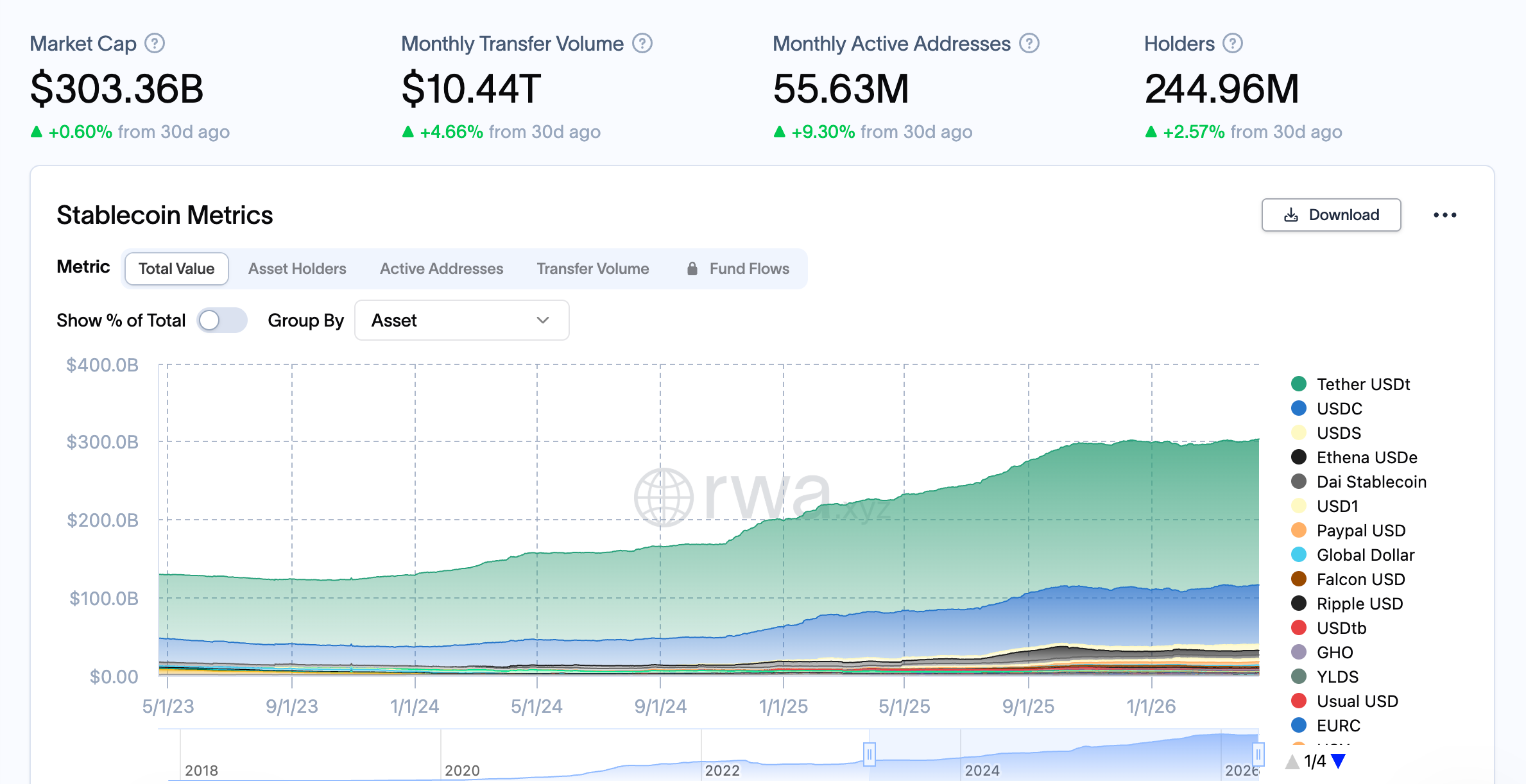
Cointelegraph reported on April 20 that Abhi Srivastava, Vice President of the Digital Economy Group at Moody’s Investor Service, said that with the United States’ existing payment infrastructure capabilities and the U.S. ban on stablecoin payment-yield regulations, stablecoins are unlikely to massively replace traditional deposits domestically in the short term. However, as the stablecoin market cap surpasses $300 billion, the long-term competitive pressure on the banking industry cannot be underestimated.
Short-Term Protection: The U.S. Ban and Mature Payment Infrastructure Create a Double Barrier
Srivastava’s analysis is based on two structural factors. First, the United States’ existing payment systems already provide fast, low-cost remittance services, so stablecoins’ differentiated advantages in payment scenarios are relatively limited. Second, the U.S. has clearly prohibited stablecoin payment yields at the regulatory level, preventing stablecoins from competing positively with bank deposits through higher interest rates—this is the most direct policy factor limiting their ability to replace traditional deposits.
He said that the role of stablecoins in payments, cross-border e-commerce, and on-chain finance is still “limited” for now, but that role is “constantly expanding.”
Long-Term Risk: Deposit Outflows and Reduced Lending Capacity
 (Source: RWA.xyz)
Srivastava clearly pointed out that short-term safety does not mean long-term peace of mind. As stablecoins and tokenized RWA become increasingly mainstream, the banking industry may face two long-term pressures: one is deposit outflows, where users move funds from traditional bank accounts to on-chain stablecoins; the other is a resulting decline in lending capacity, because the shrinkage of the deposit base directly limits banks’ ability to create credit.
Once the stablecoin market cap surpasses $300 billion, it has already sent a structural warning signal to the market.
CLARITY Bill Stalls: Yield Stablecoins Become the Core Focus of Political Tug-of-War
The issue of stablecoin regulation has been deeply embedded in legislative bargaining in the U.S. Congress. The Digital Asset Market Transparency Act (CLARITY Bill) establishes an overall regulatory framework for the cryptocurrency market, but it is currently still stalled in Congress. Part of the reason is that the crypto industry, led by Coinbase, opposed the early draft, including controversial provisions such as a lack of legal protection for open-source software developers and a ban on issuing yield stablecoins.
North Carolina Senator Tom Tillis said he planned to release an updated draft version that both sides could accept. But according to Politico, the related draft has not been published yet. Multiple crypto industry executives have warned that if the CLARITY Bill fails to pass, the crypto industry may face harsher crackdowns from future hostile regulatory agencies.
FAQ
Why does Moody’s think stablecoins don’t threaten banks in the short term?
Moody’s analysis is based on two specific factors: the U.S.’s existing payment infrastructure is already fast and low-cost, so stablecoins’ comparative advantages are limited; and the U.S. bans stablecoin payment yields at the regulatory level, preventing stablecoins from directly attracting depositors through an interest-rate advantage. Together, these two factors limit the likelihood that stablecoins could massively replace traditional bank deposits domestically in the short term.
Why have yield stablecoins become the core controversy in the CLARITY Bill?
Banking industry lobbying groups worry that if yield stablecoins are legalized, funds will flow from traditional bank accounts to higher-yield stablecoins on-chain, eroding banks’ deposit base and lending capacity. The crypto industry, on the other hand, believes the related ban limits innovation. This conflict of interest has left the bill in a situation where it is difficult to reach cross-party consensus, becoming a core obstacle to legislative progress.
If the CLARITY Bill fails to pass, what impact would it have on the stablecoin ecosystem?
Some crypto industry executives warn that if the bill fails, a stricter regulatory environment may arrive in the future, bringing greater uncertainty to the market. On the other hand, the lack of a clear regulatory framework may also limit institutional investors’ adoption of stablecoins, affecting the long-term development potential of the entire stablecoin ecosystem and institutional confidence.
Disclaimer: The information on this page may come from third parties and does not represent the views or opinions of Gate. The content displayed on this page is for reference only and does not constitute any financial, investment, or legal advice. Gate does not guarantee the accuracy or completeness of the information and shall not be liable for any losses arising from the use of this information. Virtual asset investments carry high risks and are subject to significant price volatility. You may lose all of your invested principal. Please fully understand the relevant risks and make prudent decisions based on your own financial situation and risk tolerance. For details, please refer to
Disclaimer.
Related Articles
Crypto Fund Inflows Hit $1.4B Last Week; Solana Trades Near $85.85 With $300 Upside Potential
Digital asset investment products saw $1.4 billion in inflows, driven by eased geopolitical tensions and a Bitcoin surge above $76,000. Bitcoin led with $1.116 billion in inflows, while Ethereum attracted $328 million. Solana showed resilience despite minor outflows, with analysts predicting potential gains if key resistance levels are surpassed.
GateNews1h ago
Crypto Investment Funds See Strong Weekly Inflows, Second-Best Performance Since January
Global crypto investment funds experienced significant inflows this week, driven by Bitcoin ETFs and improved investor sentiment amid stabilized markets. Factors influencing this trend include greater institutional participation, risk appetite, and macroeconomic signals.
GateNews5h ago
Trump First Explicitly Said “Regime Change” for Iran: The White House Officially Forwarded Three Signals
Trump first directly mentioned Iran’s “regime change” in a public statement, and explicitly said that the U.S. side would not be influenced by Israel. He used Venezuela as an analogy, implying that the U.S. may adopt a long-term pressure strategy against Iran. This will change the negotiation framework and increase the risk of oil-price and market volatility. Taiwan investors need to pay attention to the oil price trend, the reaction at the Fed hearing, and the agenda of the U.S.-China summit.
ChainNewsAbmedia7h ago
Indonesia Plans to Halt Diesel Imports from July 1 as B50 Biofuel Policy Takes Effect
Indonesia aims to halt diesel imports by July 1, 2026, as it prepares to launch its B50 biofuel policy, blending 50% biodiesel with conventional diesel, according to Agriculture Minister Andi Amran Sulaiman.
GateNews8h ago
Germany's March PPI Rises 2.5% Month-on-Month, Beating 1.3% Forecast
Germany's producer price index rose 2.5% month-on-month in March, surpassing expectations of 1.3% and reversing February's 0.5% decline, signaling a rise in producer-level inflation.
GateNews17h ago
Japan's 40-Year Government Bond Yield Falls 7 Basis Points to 3.775%
Japan's 40-year government bond yield dropped to 3.775%, down 7 basis points, while the 20-year bond yield decreased to 3.230%, falling by 3.5 basis points.
GateNews17h ago


