Latam debt and equities, which have outperformed their peers in both developed and emerging markets, are becoming opportunities in a region where several countries are isolated from the energy crisis hitting other continents due to their energy dependence on conditions tied to the ongoing geopolitical conflicts.
Key Takeaways:
- With the Middle East war raging, fiat currencies in Brazil and Argentina rose, drawing future inflows next.
- Following a January Trump Administration intervention, Venezuela can offer a new future market opportunity.
- Brandywine’s Jack McIntyre, managing $44B, predicts Asian markets will shift funds to Latam oil next.
Latam, Isolated From Energy Issues, Becomes An Investment Opportunity During War Time
In wartime, investors adjust their portfolios to navigate the intricacies of war and maintain their performance accordingly.
In this situation, Latam markets, which have become a sort of safe haven for investors, are rising as alternatives that, in some ways, are isolated from the energy crisis caused by the ongoing conflict in the Middle East due to their endogenous oil production.
Argentina and Brazil’s fiat currencies are among the few that have appreciated against the dollar since the war started, and dollar bonds from Ecuador and Colombia, which have a significant oil output, have also performed well in their class. Analysts also signal Venezuela as a future opportunity, as the Trump Administration continues to push for changes after it intervened in the country in January.
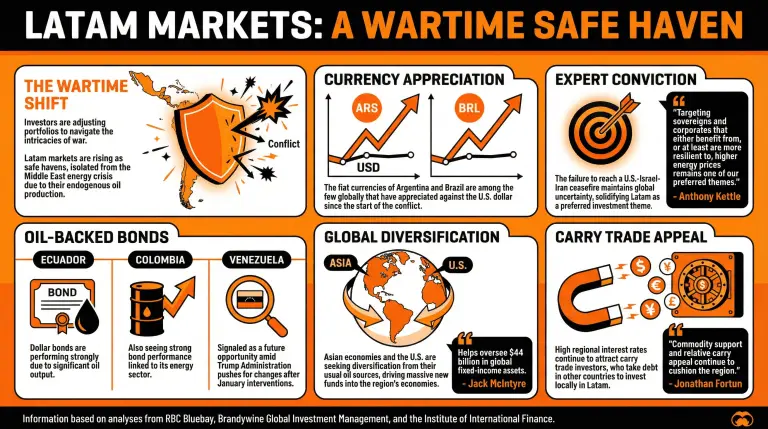
The failure to reach an end to the U.S.-Israel-Iran conflict after a short ceasefire only makes these bets hold up, as the uncertainty that overtakes main markets is less pervasive in the region.
Anthony Kettle, a senior emerging markets portfolio manager at RBC Bluebay in London, told Bloomberg that their highest conviction picks were now centered in Latam. “Targeting sovereigns and corporates that either benefit from, or at least are more resilient to, higher energy prices remains one of our preferred themes,” he stressed.
In addition, some are betting on the rise of these markets as Asian economies and even the U.S. start to seek diversification from their usual oil sources, bringing more funds to the region’s economies. Jack McIntyre, who helps oversee $44 billion in global fixed-income assets at Brandywine Global Investment Management, shares this opinion.
In addition, the regional high interest rates continue to make it attractive to carry trade investors, who take debt in other countries to invest in Latam. Jonathan Fortun, senior economist at the Institute of International Finance, said that recent numbers suggest that “commodity support and relative carry appeal” continue to cushion the region from market losses.
Disclaimer: The information on this page may come from third parties and does not represent the views or opinions of Gate. The content displayed on this page is for reference only and does not constitute any financial, investment, or legal advice. Gate does not guarantee the accuracy or completeness of the information and shall not be liable for any losses arising from the use of this information. Virtual asset investments carry high risks and are subject to significant price volatility. You may lose all of your invested principal. Please fully understand the relevant risks and make prudent decisions based on your own financial situation and risk tolerance. For details, please refer to
Disclaimer.
Related Articles
The Russian Federal Security Service cracked down on Telegram investment channel market manipulation, involving 19 companies and 55k illegal transactions
The Federal Security Service of Russia arrested three Telegram investment channel admins for manipulating stock prices through a "Pump&Dump" strategy, involving more than 55k trades across 19 large companies. Research shows that 11% of Telegram investment signals can affect stock returns, and more than 60% of investors rely on such signals. The central bank warned that it will monitor unusual transactions.
GateNews1m ago
U.S. stock market closes with the crypto sector collectively rising, with Circle up more than 12%
Gate News update: On April 14, after the U.S. stock market closed, the Dow Jones rose 0.63%, the S&P 500 Index rose 1.02%, and the Nasdaq rose 1.23%. The crypto sector moved higher across the board—Circle rose 12.09%, Solana rose 7.41%, a certain CEX rose 3.98%, Strategy (MSTR) rose 2.89%, SharpLink rose 2.76%, and Bitmine rose 1.08%.
GateNews4m ago
MicroStrategy raises $ using 11.5% STRC to buy Bitcoin, Saylor: If BTC rises more than 2% year-over-year, that’s enough to pay dividends
MicroStrategy announces it has increased its holdings of $1 billion worth of Bitcoin. Its total holdings now reach 780,897 BTC, and the fundraising is fully sold out through the preferred stock STRC. Founder Saylor stated that Bitcoin only needs an annual growth rate of more than 2.05% to cover dividends, avoiding dilution of common stock. This strategy demonstrates the company’s innovation in asset allocation and attracts other companies to imitate it.
ChainNewsAbmedia11m ago
STRC daily trading volume is $1.1 billion, and MicroStrategy announces a large-scale Bitcoin buy program
MicroStrategy’s sustainable priority stock STRC saw trading volume reach $1.16B on Monday, setting a record high and up 46.5% from the prior figure. On the same day, the company announced a $1 billion Bitcoin purchasing plan, bringing its holdings to 780,897 BTC. Analysts predicted that purchases the following day could exceed $1 billion, highlighting an active accumulation trend by institutions toward Bitcoin.
MarketWhisper24m ago
Why Is Bitcoin Up Today? Hormuz Blockade Triggers Short Squeeze and a BTC Test of $75k
On April 13, Bitcoin rose from its early-session low of 70,741 to trade as high as $74,900 during the session, approaching the $75,000 level. The main drivers came from two directions: after Trump ordered the blockade of the Strait of Hormuz, traders began to view Bitcoin as a geopolitical hedge asset; and a massive net short position that had been building as funding rates stayed persistently negative was met with liquidation, triggering a chain of liquidations totaling millions of dollars near the $70,000 support level.
MarketWhisper31m ago
Is it possible to bypass Financial Supervisory Commission (FSC) rules for buying crypto with card payments? O’DinDin promotes Wallet Pro, a service for buying crypto with a U.S. card payment
Odin Ding has launched the OwlPay and Wallet Pro services, focusing on B2B cross-border payments. By combining stablecoin technology with international financial systems, it showcases its fintech transformation. Through its partnership with MoneyGram, Wallet Pro enables cross-border transfers for cash purchases of stablecoins and operates in the U.S. market. The company’s offshore model avoids Taiwan’s strict regulation, and under the new draft legislation, it challenges the market competitive landscape; in the future, it will affect local operators’ compliance strategies.
CryptoCity34m ago


