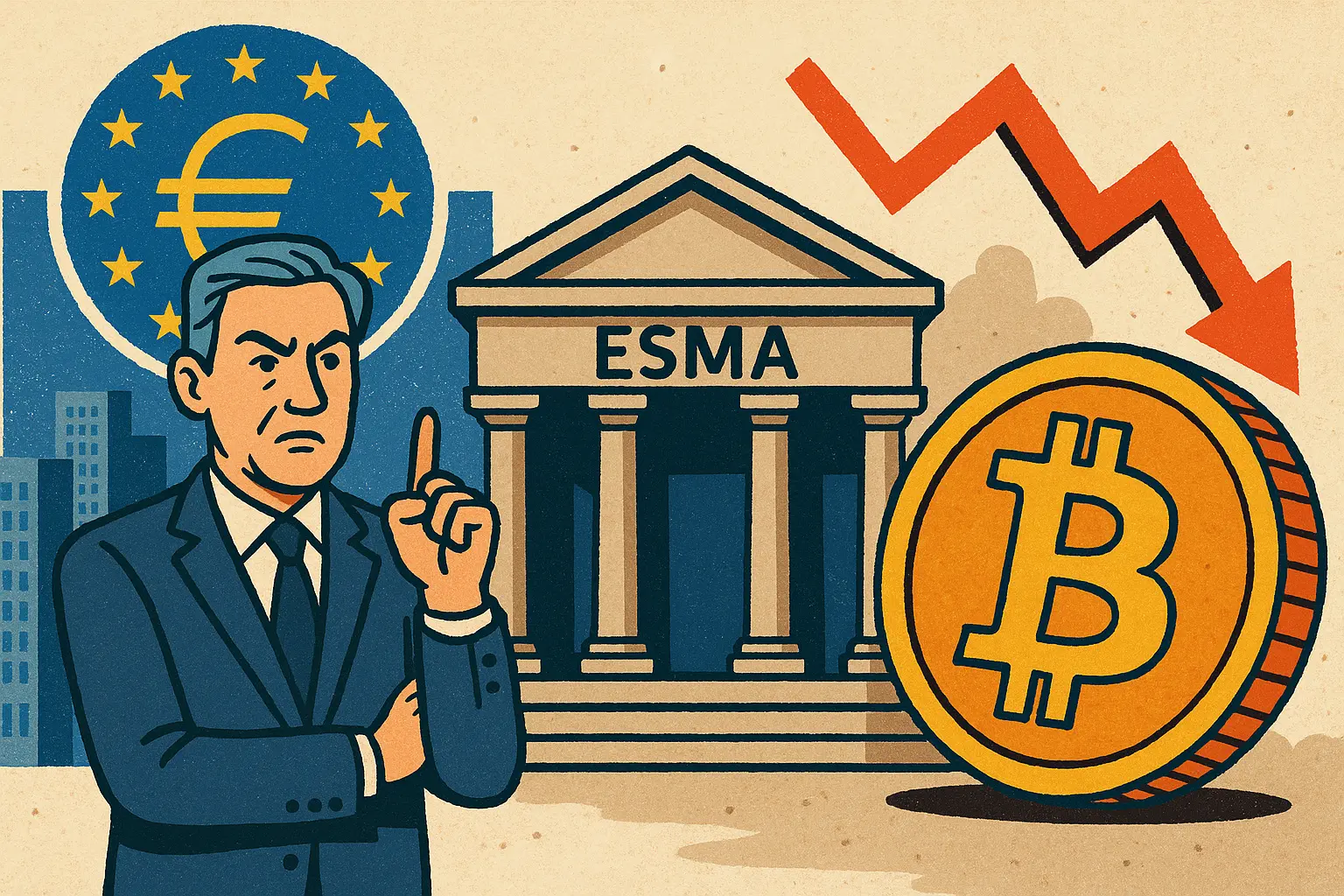
The European Central Bank (ECB) formally endorses the European Commission’s proposal to transfer regulatory authority over crypto-asset service providers (CASPs) from national regulators of member states to the European Securities and Markets Authority (ESMA), based in Paris, marking an important political endorsement for the ongoing process of centralizing crypto regulation in Europe. At the same time, the ECB also requires obtaining a non-voting seat on the ESMA board to ensure its technical expertise can continue to contribute to the development of relevant standards.
Policy implications of the ECB’s endorsement: moving from fragmented oversight to a unified EU framework
Under the current system, crypto-asset service providers must obtain local regulator licenses separately in each EU member state where they operate, leading to a “fragmented” situation characterized by overlapping compliance requirements and differing regulatory standards across countries. The European Commission’s proposal aims to authorize ESMA to take unified responsibility across the entire EU for issuing licenses to cryptocurrency firms, implementing policy, and monitoring the market.
In its formal opinion issued under the EU legislative procedure, the ECB describes the proposal as “an ambitious step toward deeper integration of EU capital markets and financial supervision,” and fully supports it. France and Germany have long advocated for centralized oversight, arguing that a unified framework helps prevent “regulatory arbitrage” between member states and keeps Europe’s regulatory process aligned with the United States and China. Member states such as Ireland and Luxembourg, which host a large number of international crypto companies, previously expressed concerns about losing regulatory autonomy, and the ECB’s public position is expected to strengthen the legislative momentum for adopting unified rules.
Core conditions attached by the ECB to the centralized supervisory framework
While supporting the centralized framework, the ECB also提出 clear requirements at the implementation level:
The ECB’s main attached conditions
ESMA resource allocation prioritized: The ECB explicitly warns that if ESMA does not have sufficient staffing levels and financial resources to take on new responsibilities, its effective enforcement capacity will be seriously affected
Phased transition mechanism: It recommends adopting a step-by-step approach, smoothly transitioning from national-level regulation to EU-level regulation to reduce compliance uncertainty for both crypto firms and regulatory bodies
ECB non-voting seat: Requires obtaining a non-voting seat on the ESMA board so that the ECB’s technical expertise can continue to participate in the development of crypto-asset technical standards and guidelines
The overall bill still needs to be considered through a dual review process by the governments of EU member states and the European Parliament. This procedure is expected to take several months. If it is ultimately approved, this change will reshape how Europe’s cryptocurrency industry is regulated and is expected to set the tone for global crypto regulatory trends.
Bitcoin market reaction: regulatory pressure suppresses bullish sentiment
The signal of strengthened regulation has already triggered an initial reaction at the market level. Traders generally believe that stricter regulatory barriers may dampen the speculative activity that usually drives up the price of Bitcoin and increase compliance costs for crypto businesses.
Market data from prediction markets shows that market confidence in Bitcoin reaching $100,000 before December 31, 2026 has fallen to 35.5%, while the probability of reaching $150,000 is only 9.5%. The largest single-day decline in Bitcoin recently occurred at 4:02 a.m., when it fell by about 3 percentage points. Traders view the sell-off at this specific time as corroborated by the market’s immediate reaction to regulatory news.
Frequently asked questions
How does the centralized supervisory framework supported by the ECB affect existing crypto-asset businesses?
After the proposal is approved, crypto-asset service providers only need to obtain a single EU-level license issued by ESMA to operate across the EU market, without applying for licenses individually in each member state. However, unified standard compliance requirements are expected to be more stringent, which may increase the overall compliance burden on small and medium-sized operators.
Why is ESMA suited to lead EU crypto regulation?
ESMA is the EU’s main securities market regulator, responsible for ensuring financial stability and transparency in capital markets. It already has cross-member-state regulatory operating frameworks and enforcement experience. Choosing ESMA rather than creating a new institution helps leverage its existing cross-border regulatory infrastructure and shortens the adaptation period from national-level oversight to EU-level oversight.
Why does the ECB’s stance trigger negative reactions in the Bitcoin market?
Some of the price momentum in the crypto market comes from speculative activity; stricter regulation usually means higher compliance thresholds and greater market scrutiny, which tends to suppress speculative sentiment overall. Prediction market data shows that market confidence in Bitcoin reaching $100,000 by the end of 2026 has fallen to 35.5%, indicating that regulatory policy direction is one of the core factors influencing short-term market sentiment.
Disclaimer: The information on this page may come from third parties and does not represent the views or opinions of Gate. The content displayed on this page is for reference only and does not constitute any financial, investment, or legal advice. Gate does not guarantee the accuracy or completeness of the information and shall not be liable for any losses arising from the use of this information. Virtual asset investments carry high risks and are subject to significant price volatility. You may lose all of your invested principal. Please fully understand the relevant risks and make prudent decisions based on your own financial situation and risk tolerance. For details, please refer to
Disclaimer.
Related Articles
Spark Strategy Lead Criticizes Aave's WETH Market Unfreezing, Warns of Retail User Lockup Risk
Gate News message, April 21 — Spark strategy lead monetsupply.eth criticized Aave's decision to unfreeze the WETH market on Ethereum, arguing the move is poorly considered and primarily benefits leverage traders. The decision, he contends, worsens the situation for ordinary users already trapped in
GateNews13m ago
What does it mean that Bitcoin’s recent volatility is lower than the Korea Composite Index (KOSPI)?
The article notes that Bitcoin’s volatility over the past month has fallen to around 42%, with the price staying within the $65,000–$75,000 range, significantly lower than Kospi’s volatility. The approval of U.S. spot ETFs has drawn institutional capital in, improving liquidity and hedging capability, and strengthening Bitcoin’s resilience. Korean equities have highlighted the risk of Middle East energy supply and sharp swings in oil prices, underscoring Bitcoin’s role as a de-nationalized, relatively stable safe-haven asset.
ChainNewsAbmedia40m ago
Deutsche Bank Survey Shows US Bitcoin Adoption Rose to 12% in March, Up from 7% in February
Gate News message, April 21 — An investor survey by German banking giant Deutsche Bank revealed that cryptocurrency adoption in the US rose to 12% in March, up from a low of 7% in February, returning to levels projected for July 2025.
The report highlighted recovery in institutional demand as a
GateNews1h ago
Altcoins Surge Back Above $1.3T as Markets Rally After Greenland Crisis Resolution
On January 22, altcoins rebounded nearly 10% to $1.39 trillion due to eased global tensions, with Ethereum leading gains. Despite some volatility, the combined market cap stabilized at $1.32 trillion as other altcoins also showed modest recovery.
Coinpedia2h ago
ARB Recovery Gains Steam as Staking Yields Jump Above 221%
ARB rebounded 10% with strong volume and improving bullish market structure.
Staking yields rose above 221%, attracting more yield-focused investor interest.
Resistance near $0.14 remains key, with liquidity risks below current price.
Arbitrum — ARB, is showing renewed strength after a s
CryptoNewsLand2h ago
ETH and Altcoins Could See Parabolic Surge Upon Following Bullish Russell 2000 ATH Path
ETH and altcoins coils see parabolic surge upon following a bullish indicators.
The Russell 2000 just set a new ATH at 2,798 for the first time.
This new ATH indicator is a bullish signal for altcoins.
The crypto community is pleased to see that both BTC and ETH are trading at higher
CryptoNewsLand4h ago


