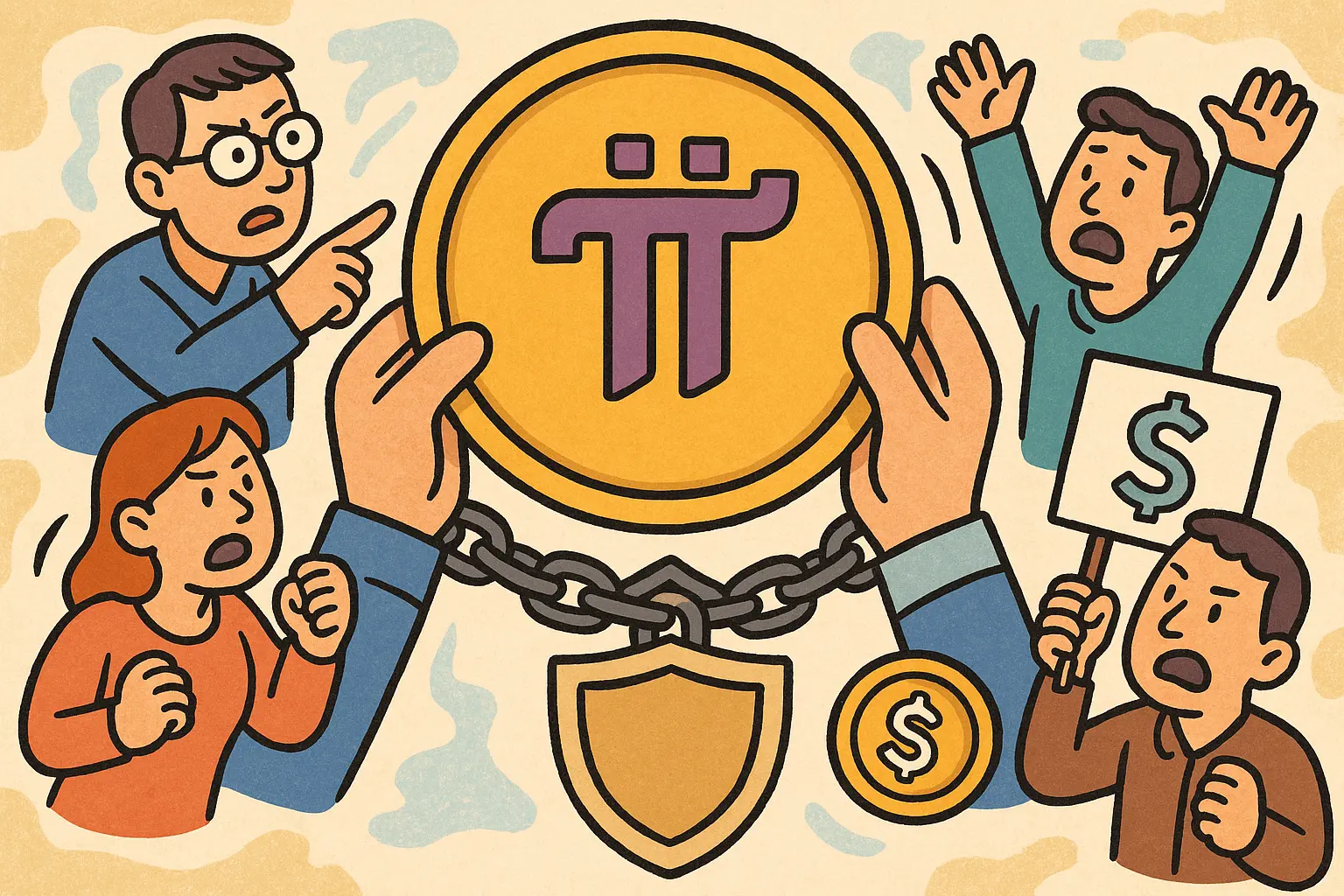
Pi Network member Daniel F posted a controversial statement, directly pointing to a logical contradiction in the design rationale of the PIRC token within the Pi Network ecosystem: if PIRC does have a downside protection mechanism with a floor that prevents declines from exceeding 23.8% of its initial listing value, it would require Pi liquidity to behave like a stablecoin rather than a speculative asset, which conflicts with Pi’s actual volatility on CEX.
Controversy at the core: Three-layer logical contradictions of the 23.8% floor mechanism
According to information circulating in the community, the design characteristics of the PIRC token reportedly include a protection clause: the token’s decline, relative to its Pi-denominated value at the time of its initial listing, does not exceed 23.8%. Daniel’s argument starts from this number, revealing layer by layer the logical tension behind it:
The logic chain behind the 23.8% floor
Premise One (stability assumption): This floor is based on Pi valuation, not on fiat-currency valuation. If Pi itself experiences significant volatility, losses for PIRC holders in terms of “Pi amount” may be limited, but when converted into U.S. dollars, the losses could be far greater than 23.8%. The real effectiveness of downside protection depends on Pi’s own stability
Premise Two (implied stablecoin-like trait): If PIRC’s decline never exceeds 23.8% of its Pi-denominated valuation, it effectively acknowledges that Pi’s liquidity performance is like that of a stablecoin. Daniel points out that this directly conflicts with the reality that Pi trades on CEX as a high-volatility speculative asset
Premise Three (the silent cost): If the project team publicly explains this contradiction, it would expose a fundamental difference between DEX pricing logic and CEX pricing logic; choosing silence, in turn, tacitly acknowledges the existence of this logical contradiction
A structural conflict between dual markets: CEX speculation vs DEX downside protection
Pi currently exists in parallel across two completely different market environments. On CEX, Pi’s price is determined by speculative market activity; by certain metrics, it has already fallen by more than 90% from its historical peak; while within the framework of decentralized exchanges (DEX) and Launchpad, the downside protection commitment for the PIRC token appears to adopt a different pricing logic.
A community member precisely identified the core of the contradiction: “If PIRC’s decline will never exceed 23.8% of its Pi-denominated valuation, then the expected decline of the Pi token with the strongest liquidity would also be around 23.8%—that’s just simple arithmetic.”
This means either (1) the 23.8% downside protection is more fragile than it looks (because it is priced using an asset that may experience substantial volatility), or (2) there is a structural barrier between the DEX pricing system and CEX prices that we have not yet understood.
The project team’s silence and the absence of transparency
Daniel emphasized that the core of his argument is transparency, not price prediction. He wrote: “If they explain that PIRC token losses will never exceed 23.8% of the initial value, then it is effectively admitting that Pi’s liquidity performs like a stablecoin. This will contradict CEX prices. To avoid this kind of paradox, they chose to stay silent.”
His central question is: “If Pi has high volatility, why doesn’t Pi’s liquidity for the middle token decrease along with it?” To date, this question has not received an official response. Whether the silence is due to strategic considerations, technical reasons, or timing choices, the community is still debating.
Frequently Asked Questions
What is the 23.8% downside protection for the PIRC token?
According to information circulating in the community, the PIRC token reportedly has a design feature: the token’s decline relative to its Pi-denominated value at the time of its initial listing does not exceed 23.8%. Daniel’s argument starts from this, revealing the implied logical premise behind it.
Why is there a contradiction between the 23.8% floor and CEX prices?
This floor is based on Pi valuation, not on U.S. dollar valuation. If Pi itself experiences significant fluctuations on CEX (down more than 90% from its peak), then the protection in the “Pi amount” layer cannot prevent major losses at the fiat level. A deeper contradiction is that the existence of the downside protection implies that Pi needs to have liquidity similar to a stablecoin, which directly conflicts with the speculative reality on CEX.
Has Pi Network officially responded to this contradiction?
As of now, Pi Network has not made any public explanation regarding the contradiction between the PIRC downside protection mechanism and CEX pricing logic. Daniel F and community members believe that this kind of silence itself is a signal worth paying attention to.
Disclaimer: The information on this page may come from third parties and does not represent the views or opinions of Gate. The content displayed on this page is for reference only and does not constitute any financial, investment, or legal advice. Gate does not guarantee the accuracy or completeness of the information and shall not be liable for any losses arising from the use of this information. Virtual asset investments carry high risks and are subject to significant price volatility. You may lose all of your invested principal. Please fully understand the relevant risks and make prudent decisions based on your own financial situation and risk tolerance. For details, please refer to
Disclaimer.
Related Articles
Pi Network issues a node upgrade warning: if you haven’t upgraded by April 27, you risk being disconnected
Pi Network has issued an official notice to node operators, requiring them to complete the mandatory upgrade of the agreement version 22.1 (v22.1) by April 27, 2026; otherwise, they face the risk of their nodes being cut off from network connectivity. According to a Pi Network announcement, this upgrade must be carried out in strict version order. Currently, the system is running on version 21.2; the next step is to upgrade to v22.1, and no versions may be skipped.
MarketWhisper22h ago
Pi Network Requires Protocol 22 Upgrade by April 27 or Nodes Will Disconnect
Pi Network mandates node operators to upgrade to Protocol 22 by April 27, 2026, to ensure network connectivity. The upgrade enhances stability and prepares for future smart contract features. Delaying could result in disconnection and missed opportunities.
GateNews23h ago
Pi Network mainnet unlocks 5.3 million tokens, increasing circulation and drawing market attention
Pi Network completed a token unlock on April 18, releasing about 5.3 million Pi tokens, which boosts market liquidity, but also sparks discussion about supply-and-demand pressure. The unlocking plan is intended to control market supply and support ecosystem development. The long-term impact will depend on how quickly the token’s utility expands through real-world applications. If demand and supply can grow in step, the price impact will be limited; otherwise, it may face pressure.
MarketWhisper04-20 02:50
Pi Network Launches First Smart Contract Feature on Testnet, Enabling Subscription Payments
Pi Network has launched its first Smart Contract feature on Testnet, enabling users to set up automatic subscription payments while maintaining control of their funds. This marks a shift toward ecosystem utility and lays the groundwork for potential mainnet deployment.
GateNews04-18 05:31
Pi Network Requires Mainnet Upgrade to v22.1 by April 27 or Risk Disconnection
Pi Network announced a mandatory upgrade to Protocol version 22.1, requiring completion by April 27, 2026, to maintain network connection. The upgrade is seen positively for enhancing security and performance, with next version expected by May 11, 2026.
GateNews04-17 06:05


