The Argentine Securities and Exchange Commission (CNV) now recognizes cryptocurrencies as assets that can be considered part of an individual’s net worth to qualify as an investor. The move might allow investors to reach the nearly $478K in assets to be part of this class.
Key Takeaways:
- CNV Resolution 1125/2026 lets crypto count for the $479K investor limit, expanding future market access.
- A 2022 Central Bank ban still halts retail crypto services, but banks are testing blockchain settlement.
- President Milei is expected to lift the 2022 banking ban soon, expanding Argentina’s crypto adoption.
Argentina Changes Law to Recognize Crypto as Net Worth for Qualified Investors
Argentina is slowly working to open its financial industry to crypto assets, moving to increase the recognition of cryptocurrency across all sectors of its economy.
The Argentine Securities and Exchange Commission (CNV) issued General Resolution 1125/2026, which establishes that virtual assets will be recognized as part of an individual’s worth for reaching the classification of a qualified investor in the country.
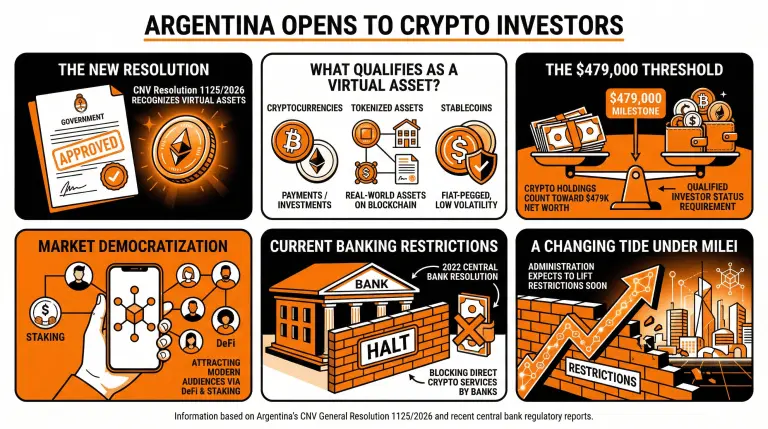
The resolution defines virtual assets as “any digital representation of value that can be traded and/or transferred digitally and used for payments or investments.” This means that cryptocurrencies, tokenized assets, and even stablecoins could be used as these assets.
The CNV argued that “the progressive incorporation of new asset classes—such as Virtual Assets—into investment portfolios renders their inclusion advisable for the purpose of demonstrating the required financial capacity, since they constitute an additional manifestation of the investor’s economic capacity and financial experience.”
Before, when investors disclosed their crypto holdings, these could not be accounted as part of the assets needed to reach the nearly $479,000 to enter this investment classification.
With this measure, the CNV seeks to democratize and open investment markets to new target audiences who are not normally interested in traditional investments and focus more on digital alternatives, including staking and decentralized finance platforms.
While Argentina is advancing in this regard, financial institutions cannot offer cryptocurrency services to their customers, as the central bank issued a resolution in 2022 to “mitigate the risks associated with operations with these assets that could be generated for users of financial services and for the financial system as a whole.”
Nonetheless, some banks are testing blockchain-based plumbing for their internal settlements. Reports indicate this restriction will be lifted in the short term, as President Milei’s administration opens up to crypto.
Disclaimer: The information on this page may come from third parties and does not represent the views or opinions of Gate. The content displayed on this page is for reference only and does not constitute any financial, investment, or legal advice. Gate does not guarantee the accuracy or completeness of the information and shall not be liable for any losses arising from the use of this information. Virtual asset investments carry high risks and are subject to significant price volatility. You may lose all of your invested principal. Please fully understand the relevant risks and make prudent decisions based on your own financial situation and risk tolerance. For details, please refer to
Disclaimer.
Related Articles
Nigeria's FIRS Begins Trial Against Major CEX Over Alleged Tax Evasion
Nigeria's tax authority, FIRS, has begun legal proceedings against a centralized exchange for alleged tax evasion related to VAT and CIT on cryptocurrency transactions. The trial is set for April 11, 2025, as questions arise regarding the obligation of foreign entities to comply with local tax laws.
GateNews29m ago
Encouraging innovation! U.S. judges ban Arizona from regulating prediction markets, and pause the prosecution against Kalshi
A U.S. federal district court ruled that Arizona cannot use its gambling laws to prosecute the prediction market platform Kalshi, finding that the U.S. Commodity Futures Trading Commission has exclusive jurisdiction. The ruling affects the boundary between state and federal authority in financial market regulation, and Kalshi insists that its business is financial products rather than traditional gambling. Rulings on prediction markets vary across states, and the Trump family has also expressed support for prediction markets.
CryptoCity1h ago
Is it possible to bypass FSC regulations on buying crypto with card payments? Oadingding rolls out the Wallet Pro service for buying crypto with a U.S. debit card
The OwlPay and Wallet Pro services launched by OdinTing use stablecoin technology to enable B2B cross-border payments, and they partner with international payments giants to showcase their ambitions to expand in the fintech space. By operating from abroad, OdinTing bypasses Taiwan’s regulatory restrictions, offering faster virtual-asset trading, while also facing the newly issued Virtual Assets Services Act; in the future, it may become a reference template for other foreign-invested companies entering the Taiwan market.
CryptoCity2h ago
Encouraging innovation! A U.S. judge bars Arizona from regulating a prediction market and suspends the prosecution of Kalshi
A U.S. federal district court ruled that Arizona is prohibited from relying on its gambling laws to prosecute prediction market platform Kalshi, finding that the federal Commodity Futures Trading Commission has exclusive jurisdiction. The ruling affects the boundary between state and federal authority in financial market regulation, while Kalshi insists that its business falls under financial products rather than traditional gambling. Rulings on prediction markets vary from state to state, and the Trump family has also expressed support for prediction markets.
CryptoCity4h ago
Bypassing FSC regulations to buy crypto with a credit card: Is it possible? Odin Ding promotes Wallet Pro, a service for buying crypto with a U.S. debit card
OwlPay and Wallet Pro services launched by OdinTing use stablecoin technology to enable B2B cross-border payments, and partner with international payment giants to showcase its expansion ambitions in the fintech space. By operating from abroad, OdinTing bypasses Taiwan’s regulatory restrictions, offering fast virtual-asset trading; meanwhile, as it faces the newly promulgated Virtual Asset Services Act, it is likely to become a reference template for other foreign-invested companies entering the Taiwan market.
CryptoCity5h ago
Nigeria SEC Chief Vows Crackdown on Naira Manipulators, Plans to Delist NGN from P2P Platforms
Nigeria's SEC, led by Emomotimi Agama, will intensify efforts to tackle naira manipulation in the crypto sector by removing the currency from peer-to-peer platforms. Following previous enforcement actions, industry stakeholders are urging for clearer regulations and a unified policy approach.
GateNews5h ago


