In a new report, TRM Labs stated that while illicit finance threats remain in Latam, including cartel-linked OTC brokers, Venezuelan sanctioned flows, and Chinese laundering networks, regulations are encircling these threats, with every major Latam market increasing its compliance efforts.
Key Takeaways:
- TRM Labs reports stablecoins drive 95% of illicit Latam inflows, forcing VASPs to upgrade tech next.
- The Sinaloa Cartel laundered $103B in 2025, pushing governments to enforce upcoming AML laws.
- Following these reports, Latam countries are enhancing their compliance standards.
TRM Labs: Regulation is Narrowing Threat Windows In Latam
Crypto regulations are advancing internationally, and Latam is not an exception, even with numerous documented threats. According to TRM Labs, a blockchain intelligence firm, regulations are coming to make cryptocurrency transactions and flows more secure in the region.
In a recent report, TRM Labs disclosed that stablecoins have become the dominant payment rails across Latam, accounting for 95% of inflows to sanctioned entities globally in a region that, due to its economic traits, is open to the adoption of these new technologies.
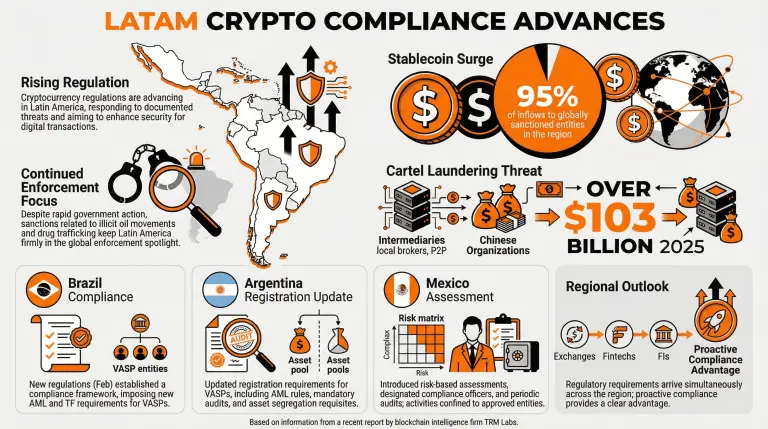
TRM Labs states that the threats are well-documented in the region, including flows linked to the Sinaloa Cartel, leveraging local brokers and P2P exchanges to launder funds using Chinese organizations as intermediaries to process over $103 billion in 2025 alone.
In addition, the institution highlighted that sanctions that remain in place related to illicit oil movements and drug trafficking keep Latam in the enforcement spotlight. Nonetheless, governments are moving quickly to plug these holes and strengthen compliance across the sector.
In Brazil, new regulations passed in February establish a compliance framework that includes new anti-money laundering (AML) and terrorism financing (TF) requirements for virtual asset service providers (VASPs) to receive authorization to operate.
Argentina also tightened oversight over the crypto market, with updated registration requirements for VASPs that include AML rules, audit, and asset segregation requisites.
Mexico also introduced risk-based assessments, designated compliance officers, and periodic compliance audits for entities, as virtual asset activities are still confined to organizations approved by the Central Bank of Mexico (Banxico).
TRM Labs concluded that “for exchanges, fintechs, and financial institutions operating in Latin America, regulatory requirements are arriving across the region simultaneously. Institutions building compliance infrastructure ahead of enforcement deadlines carry a clear operating advantage.”
Disclaimer: The information on this page may come from third parties and does not represent the views or opinions of Gate. The content displayed on this page is for reference only and does not constitute any financial, investment, or legal advice. Gate does not guarantee the accuracy or completeness of the information and shall not be liable for any losses arising from the use of this information. Virtual asset investments carry high risks and are subject to significant price volatility. You may lose all of your invested principal. Please fully understand the relevant risks and make prudent decisions based on your own financial situation and risk tolerance. For details, please refer to
Disclaimer.
Related Articles
Tennessee Bans Crypto ATMs Statewide, Second U.S. State After Indiana
Tennessee has become the second U.S. state to outright ban crypto ATMs, with Governor Bill Lee signing House Bill 2505 into law on April 13. The bill passed both chambers unanimously and will take effect July 1, making it a misdemeanor to operate or host the machines anywhere in the state.
CryptoFrontier32m ago
DeFi Leaders Urge SEC to Formalize Broker Guidance Into Rulemaking
DeFi Industry Pushes for SEC Rulemaking on Broker Classification
The DeFi Education Fund, alongside 35 other crypto industry leaders, has urged the Securities and Exchange Commission to formalize its recent decentralized finance interface guidance into formal rulemaking, according to a letter
CryptoFrontier32m ago
U.S. OCC Sets Draft Framework for Stablecoin Issuers Under GENIUS Act Framework
OCC draft sets federal rules for stablecoin issuers and custody services, focusing on safety and regulatory compliance.
Proposal excludes AML and sanctions rules, leaving those areas for separate coordination with Treasury agencies.
Framework marks initial step in multi-agency
CryptoFrontNews2h ago
DOJ Drops Criminal Investigation into Powell, Clearing Path for Crypto-Friendly Warsh as Next Fed Chair
Gate News message, April 25 — The U.S. Department of Justice has dropped its criminal investigation into Federal Reserve Chair Jerome Powell, clearing the way for the Senate to confirm Kevin Warsh as the incoming Federal Reserve chair. On Friday, April 24, U.S. Attorney for the District of
GateNews2h ago
US Sanctions Iran-Linked Crypto Wallets, Tether Freezes $344M USDT
U.S. Treasury Secretary Scott Bessent announced that the federal government is sanctioning multiple wallets linked to Iran as part of President Donald Trump's ongoing efforts to increase economic pressure on the country amid an ongoing ceasefire. The move comes a day after Tether froze $344
CryptoFrontier3h ago
U.S. Crypto Market Structure Bill Gains Bipartisan Support, Trump Administration Backs Legislation
Gate News message, April 25 — Senator Cynthia Lummis signaled on April 25 that Congress is positioned to advance a comprehensive crypto market structure bill with bipartisan backing and support from the Trump administration. "We have bipartisan support. We have President Trump's support. This is
GateNews4h ago


