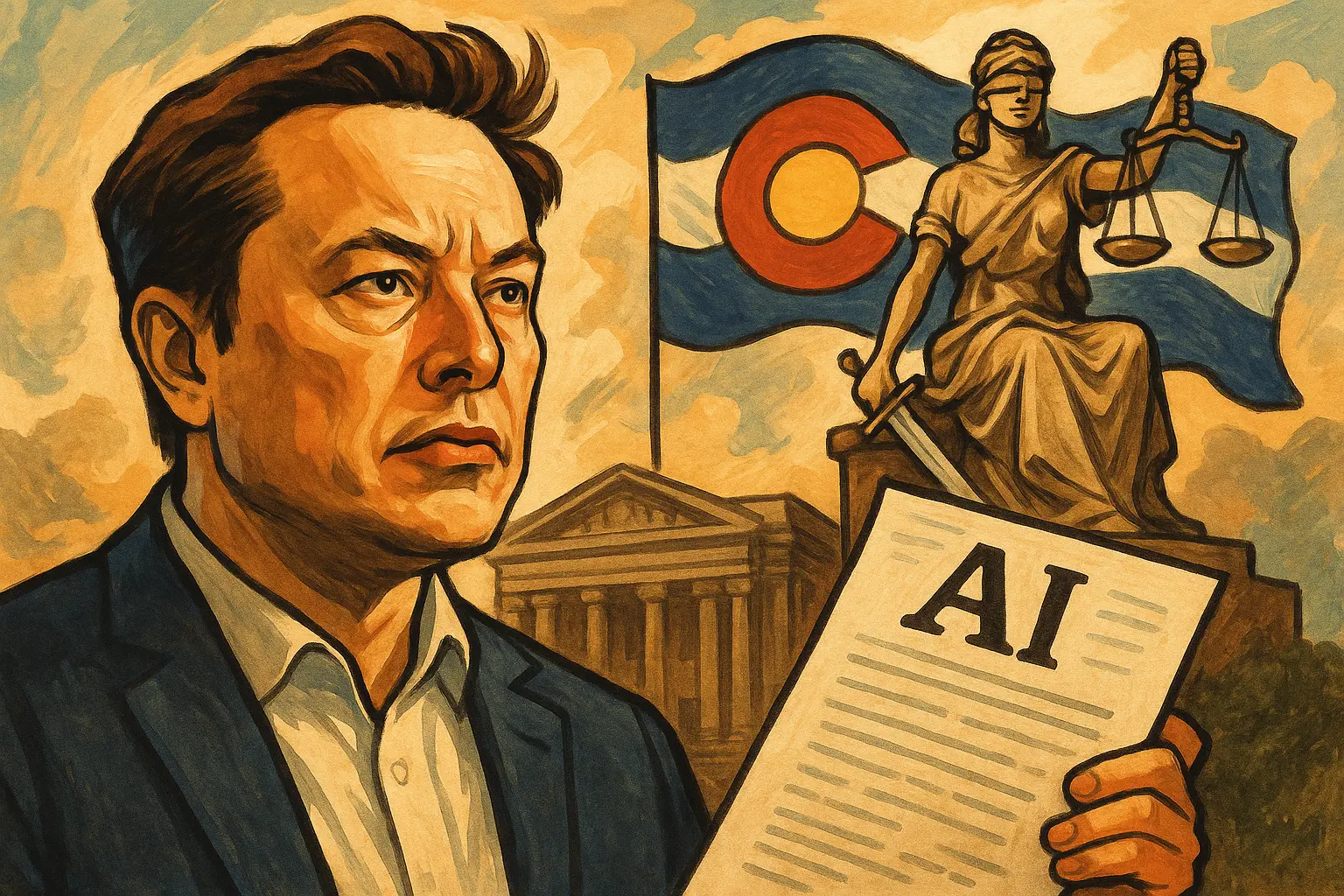
Musk’s artificial intelligence company, xAI, filed a lawsuit with the U.S. District Court in Colorado on Thursday, seeking to block Colorado Senate Bill 24-205 (SB 24-205) from taking effect as scheduled on June 30. The bill is intended to prevent AI systems from creating “algorithmic discrimination” in the employment, housing, and financial services sectors. xAI argues that the regulation forces Grok to output information according to political positions, violating free speech.
xAI’s Constitutional Claims: AI Output Is Protected Speech
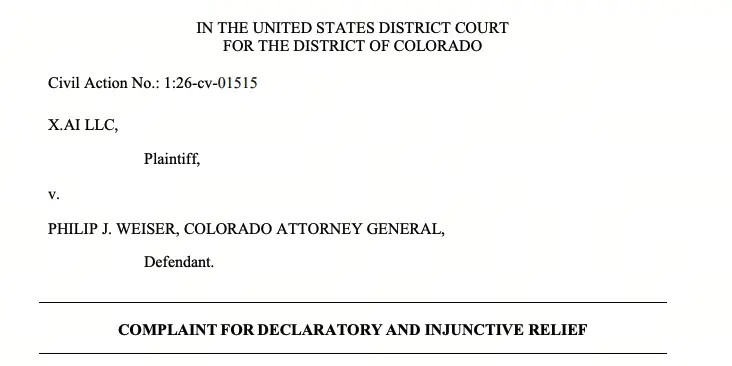 (Source: CourtListener)
In its court filings, xAI clearly states that Colorado has no power to compel changes to xAI’s information output simply because it wants to promote a particular viewpoint on highly politicized issues such as “fairness and equality.” The company also points out that SB 24-205 contains a fundamental logical contradiction: on the one hand, the law claims to eliminate historical discrimination and increase diversity; on the other hand, its internal provisions authorize “differential treatment,” which are moving in opposite directions.
This is not the first time xAI has taken legal action regarding AI regulation. In December 2025, xAI already filed a lawsuit over California’s “Generative AI Training Data Transparency Act,” arguing that California’s information disclosure requirements constitute compelled speech and involve the disclosure of trade secrets, violating the U.S. Constitution’s First and Fifth Amendments. Colorado’s lawsuit is the second federal-level legal action taken by xAI in the field of AI regulation.
Legislative Background and Key Controversies Surrounding SB 24-205
Colorado’s SB 24-205 is one of the first state-level AI anti-discrimination regulations in the United States. It requires developers of high-risk AI systems to take compliance measures to prevent their systems from having an unreasonable discriminatory impact on protected groups. Notably, before Colorado and California pushed forward with AI legislation in succession, there were accusations that Grok had previously made statements related to racism, sexism, and antisemitism; some lawmakers viewed this as one of the bases for advancing AI anti-discrimination rules.
Four Core Legal Claims Raised in xAI’s Lawsuit
Infringement on Free Speech: AI output is speech protected by the First Amendment; the state government cannot compel rules that specify the content of the speech
Embedding Political Viewpoints: The regulation requires Grok to adjust its output based on Colorado’s political positions, constituting government-driven content intervention
Internally Contradictory Logic: The regulation simultaneously claims to eliminate discrimination and authorizes differential treatment, and the internal provisions conflict with each other
Interference With Product Objectives: Forcing changes to the output will undermine Grok’s design intent to “seek the truth to the maximum extent”
White House Position: Promoting a Federal Unified Framework Instead of Patchwork Across States
David Sacks, an AI policy adviser to the White House, has long worked to push states to abandon making their own AI regulatory rules and to establish a single federal AI standard. In March, he publicly said, “With 50 different states regulating AI in 50 different ways, it creates confusion in the regulatory system, making it difficult for innovators to comply.” Sacks currently serves as co-chair of the newly formed Presidential Council of Advisors on Science and Technology, responsible for coordinating the advancement of a nationwide unified AI regulatory framework.
xAI’s lawsuit against Colorado aligns in direction with Sacks’s federal-priority stance, further intensifying the core policy dispute in the United States over whether AI regulatory sovereignty should belong to the federal government or to individual states.
Frequently Asked Questions
What specific AI behavior does Colorado’s SB 24-205 regulate?
SB 24-205 requires that high-risk AI systems deployed in areas such as employment screening, housing applications, and financial services must take measures to prevent unreasonable discriminatory impacts on protected groups; developers must provide the corresponding compliance documents. The regulation is expected to take effect on June 30, 2026.
What progress has there been in xAI’s prior lawsuit against California?
In December 2025, xAI filed a lawsuit against California’s “Generative AI Training Data Transparency Act,” arguing that its information disclosure requirements constitute compelled speech and involve the disclosure of trade secrets, violating the First and Fifth Amendments to the Constitution. As of now, the case is still pending in the United States federal court.
What long-term impact could this lawsuit have on the U.S. AI regulatory landscape?
If the court supports xAI’s First Amendment claims, it could weaken the legal foundation of states’ AI anti-discrimination regulations and clear the way for a unified federal-level AI regulatory framework. The outcome of this case will directly affect the legislative decisions of dozens of states that are considering drafting similar regulations.
Disclaimer: The information on this page may come from third parties and does not represent the views or opinions of Gate. The content displayed on this page is for reference only and does not constitute any financial, investment, or legal advice. Gate does not guarantee the accuracy or completeness of the information and shall not be liable for any losses arising from the use of this information. Virtual asset investments carry high risks and are subject to significant price volatility. You may lose all of your invested principal. Please fully understand the relevant risks and make prudent decisions based on your own financial situation and risk tolerance. For details, please refer to
Disclaimer.
Related Articles
Pi Network founder May 7 discussed human identity verification in the AI era at Consensus 2026
Pi Network founder Nicolas Kokkalis will attend the Consensus 2026 conference in Miami on May 7, joining an expert panel to discuss online human identity verification issues in the age of artificial intelligence (AI). According to the official event schedule, this panel discussion will bring together experts in the fields of identity, privacy, and digital trust.
MarketWhisper24m ago
DeepX and Hyundai Motor Group Develop Low-Power AI Chip Platform for Robots
South Korea's DeepX and Hyundai Motor Group's Robotics Lab are collaborating on a low-power AI computing platform for real-time robotic applications. Utilizing DeepX's DX-M2 chip, the partnership aims to optimize robotics with reduced costs and power consumption, reflecting a trend towards specialized chips in the industry.
GateNews33m ago
Playdate Bans AI-Generated Art, Music, and Text; Coding Assistants Still Allowed
Panic Inc. announced a ban on generative AI tools for art, music, writing, and dialogue in games for its Playdate console. AI coding assistants are allowed with disclosure. This decision follows backlash over an AI-developed game.
GateNews43m ago
Amazon adds a $5 billion investment in Anthropic, and a 10-year AWS agreement locks in $100 billion in compute power
Amazon announced on April 20 that it would invest an additional $5 billion in Anthropic, bringing its cumulative committed investment since 2023 to $13 billion, and leaving room for additional funding tied to future commercial milestones of up to $20 billion. In return, Anthropic has pledged to invest more than $100 billion over the next decade in AWS infrastructure, in exchange for 5 gigawatts of compute resources.
MarketWhisper59m ago
New York state lawmakers propose an “AI dividend” to address layoffs, with Goldman Sachs estimating a monthly loss of 16k jobs
New York state lawmaker and congressional candidate Alex Bores announced an “AI dividend” program on Sunday, aimed at making direct payments to U.S. citizens when artificial intelligence significantly replaces American workers. The program was announced amid findings from a Goldman Sachs report showing that widespread AI adoption has already led to the loss of about 16k jobs per month in the United States, and tech giants such as Amazon, Meta, Intel, and Microsoft have all announced large-scale layoffs in succession.
MarketWhisper1h ago
Tencent QClaw Overseas Version Starts Beta Testing, Japan Offers $700 Token for Early Access
Tencent Computer Manager’s AI agent product QClaw, under the company’s team, announced on April 20 that its overseas version has officially started internal testing. The first batch covers the United States, Canada, Singapore, and South Korea, supporting multiple languages including Chinese, English, French, Spanish, and Korean. During the internal testing period, 40 million Tokens are given away each day, and the first batch of 20,000 slots for “Founding Claw” is also opened on a first-come, first-served basis.
MarketWhisper1h ago


