


#Gate广场四月发帖挑战 Cryptocurrencies are generally halved; what is their current position now?
In April, the cryptocurrency market is at a point that makes people both anxious and conflicted. Bitcoin has fallen from its October 2025 all-time high of $126,080 down to around $70,000, a retracement of nearly 47%. Altcoins are even more brutal—Ethereum dropped to about $2,200, Ripple to $1.33, Solana to $82, and the GMCI30 index tracking the top 30 cryptocurrencies worldwide remains at a low level. Faced with this “halving” market, the most pressing question for investors is: Have we reached the bottom? Is now the time to buy-in, or should we continue to wait and see?
01 Divergence of Bulls and Bears: Where exactly is the market?
The current conflicting signals in the market can be summarized in one sentence—institutions are buying, retail investors are panicking, technicals are signaling a reversal, and macro factors are exerting pressure.
On the bullish side, big players like Goldman Sachs are standing behind. Goldman Sachs analyst James Yaro explicitly stated in a research report in early April that the crypto market “may have already touched the cycle bottom.” His core argument is that after four consecutive months of net outflows, $1.32 billion of institutional funds flowed back into Bitcoin spot ETFs in March, indicating a shift from speculative selling to long-term capital accumulation. Yaro defines the $68,000 to $71,000 range as Bitcoin’s support zone and believes leverage liquidations have largely been completed.
Meanwhile, on-chain data is also signaling a bottom. The MVRV Z-Score is compressing, a metric historically highly correlated with major cycle lows; the 720-day Bitcoin indicator (TBBI) has fallen below 20, also indicating the end of a long-term downtrend. The number of Bitcoins held by accumulation addresses has surged from 2 million at the start of 2024 to 4.37 million on April 7, showing long-term holders are continuing to buy amid market panic.
Bitcoin reserves on exchanges have fallen to a two-year low, with institutions continuously “buying the dip” in panic.
But the bearish voices cannot be ignored either. Veteran trader Peter Brandt pointed out that Bitcoin’s current price structure is incomplete, and the market still needs to go through a downward shakeout. He expects the price to fall below $66k to clear out bullish liquidity before a meaningful rebound can occur.
CryptoQuant analyst oro_crypto also warned that the recent rebound from $66,000 to $72k was entirely driven by futures leverage and lacked spot buying support—an “unfunded water” situation. Some analysts, based on historical cycle patterns, believe it’s still too early. Crypto analyst @CryptoTice_ pointed out that, based on the patterns of the past four halving cycles, the true bottom usually forms between 800 and 950 days after the halving, which points to Q4 2026 rather than the current stage. He emphasized that a real bottom would require a complete collapse of market confidence and participants capitulating, whereas currently, some are still actively buying and expecting a short-term rebound.
02 Macro Environment: Hawkish Fed and Geopolitical Pressures
The macro environment in 2026 is not friendly to cryptocurrencies. The Federal Reserve’s benchmark interest rate remains between 3.50% and 3.75%, with inflation expectations still above the 2% target. March’s CPI rose 3.3% year-over-year, and although core CPI was below the expected 2.7%, market expectations for rate cuts continue to be delayed—Polymarket’s probability of no rate cut in 2026 has surged from about 2.9% in mid-January to 35.9%. More troubling, CME interest rate swaps show an 87.6% chance of holding rates steady in April, but the rate hike expectation has doubled to 12.4% since the beginning of the month.
A new Fed paper even found that since 2021, Bitcoin and Ethereum increasingly track macro signals like U.S. inflation and employment data, showing high correlation with risk assets. After ETF launches, the correlation between Bitcoin and Fed policy has reversed, with institutional investors now pricing in rate changes 6 to 12 months in advance.
On the geopolitical front, the Iran-U.S. talks in Islamabad broke down after 21 hours, the U.S. announced a blockade of the Strait of Hormuz, and Brent crude oil surged to $98 per barrel. Following the news, Bitcoin dropped about 3% within 24 hours to around $70,600. For cryptocurrencies, geopolitical conflicts are now an unavoidable influence—they are no longer “digital gold” safe havens but are highly correlated with risk sentiment. As BTC Markets analysts noted, current geopolitical news is dominating short-term crypto market movements.
03 Technical Analysis: Cup-and-Handle Formation, but Momentum in Doubt
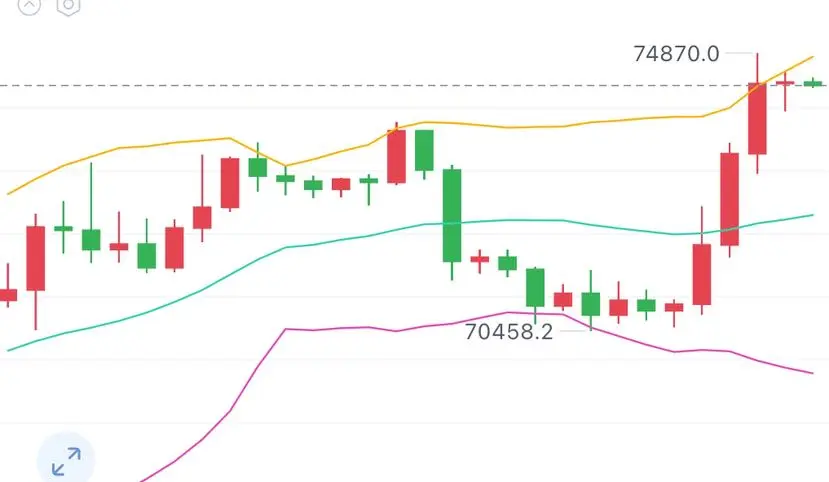
From a technical perspective, Bitcoin’s daily chart is forming a classic cup-and-handle pattern. The neckline is between $73,151 and $73,240. If the price can close above this level, the measured move target is about 11%, potentially reaching around $81,720. However, there are concerns. The RSI (Relative Strength Index) shows a “hidden bearish divergence”—from March 4 to April 9, Bitcoin made lower highs while RSI formed higher highs, suggesting the downtrend may not be over yet, and the current rebound might still need further consolidation.
Key support is testing the 50-day exponential moving average at around $70,700. Resistance is at the $73,750 to $74,400 zone. If the price falls below the 50-day EMA, it could further retrace toward $60,000. The negative funding rate (-6%) and high short positions increase the risk of a short squeeze—once the price breaks resistance, a large number of short positions could be liquidated, pushing for a rapid rebound.
04 Market Liquidity: Stablecoin Inflows and ETF Funds Hit Three-Month Highs
The most recent and notable signals come from market liquidity. During the week of April 6–12, the market saw $2.56 billion in stablecoin inflows, with spot and perpetual contract trading volumes on centralized exchanges both increasing week-over-week. On-chain data shows funds are gradually flowing back from stablecoins into Bitcoin. Institutional inflows are also a positive sign. The U.S. spot Bitcoin ETF recorded a net inflow of $786 million last week, the strongest since February; on April 13, there was a single-day net inflow of $471 million—the largest in about three months. Strategy firms bought 13,927 Bitcoins during this period, worth about $1 billion. The rising share of institutional holdings and CME Bitcoin futures open interest surpassing $66k indicate a shift from retail-driven speculation to a more institutional, structural environment.
05 Institutional Views: Optimism from the Bulls, Caution from the Skeptics
Reviewing recent institutional and analyst opinions, the bullish camp includes: Goldman Sachs, which believes the market may have already hit the cycle bottom; Bernstein maintaining a $150k Bitcoin target by the end of 2026; and Tom Lee of Fundstrat, who estimates Bitcoin could reach $200k to $250k.
But cautious voices also warn investors: Bitf warns April will be a critical month for whether rate expectations can be maintained; several institutional analysts point out that resolving the U.S.-Iran conflict and whether Bitcoin can return to its historical highs are necessary conditions for the next bull run. ZFX Shanhai Securities offers a more moderate view, suggesting Bitcoin is currently in a low-volatility consolidation phase, with short-term sentiment neutral to slightly weak but with potential for a rebound. Multiple perspectives converge on one conclusion: the current position shows characteristics of a bottom zone, but the ultimate direction depends on whether macro variables can improve substantially. As André Dragosch, head of European research at Bitwise, put it, Bitcoin’s risk-reward ratio is “significantly tilted in favor,” but this depends on geopolitical and macroeconomic conditions aligning.
Conclusion: How to navigate the current bottom game? Returning to the initial question: after the widespread halving of cryptocurrencies, is this the bottom?
Objectively, signals supporting the formation of a bottom are increasing—ongoing institutional inflows, accelerated on-chain accumulation, stablecoin fund reflows, and gradually improving technical patterns. But uncertainties are equally prominent—unclear macro rate-cut paths, unresolved geopolitical conflicts, and insufficient short-term momentum for a rebound. For ordinary investors, the following variables are worth continuous monitoring:
Can ETF inflows sustain—this is the most direct indicator of institutional sentiment;
The evolution of U.S.-Iran tensions—geopolitical conflicts are the biggest short-term disruptors;
The Fed’s statements at the April FOMC meeting—interest rate decisions will directly impact risk asset valuations;
Whether Bitcoin can hold above $70,000—this is a key technical signal for a potential bullish reversal.
As many analysts have said, the April 2026 crypto market is in a “test of discipline” phase. The market’s bottom is never a single price point but a range; confirming the bottom is not based on any single indicator but on the resonance of multiple signals.
In April, the cryptocurrency market is at a point that makes people both anxious and conflicted. Bitcoin has fallen from its October 2025 all-time high of $126,080 down to around $70,000, a retracement of nearly 47%. Altcoins are even more brutal—Ethereum dropped to about $2,200, Ripple to $1.33, Solana to $82, and the GMCI30 index tracking the top 30 cryptocurrencies worldwide remains at a low level. Faced with this “halving” market, the most pressing question for investors is: Have we reached the bottom? Is now the time to buy-in, or should we continue to wait and see?
01 Divergence of Bulls and Bears: Where exactly is the market?
The current conflicting signals in the market can be summarized in one sentence—institutions are buying, retail investors are panicking, technicals are signaling a reversal, and macro factors are exerting pressure.
On the bullish side, big players like Goldman Sachs are standing behind. Goldman Sachs analyst James Yaro explicitly stated in a research report in early April that the crypto market “may have already touched the cycle bottom.” His core argument is that after four consecutive months of net outflows, $1.32 billion of institutional funds flowed back into Bitcoin spot ETFs in March, indicating a shift from speculative selling to long-term capital accumulation. Yaro defines the $68,000 to $71,000 range as Bitcoin’s support zone and believes leverage liquidations have largely been completed.
Meanwhile, on-chain data is also signaling a bottom. The MVRV Z-Score is compressing, a metric historically highly correlated with major cycle lows; the 720-day Bitcoin indicator (TBBI) has fallen below 20, also indicating the end of a long-term downtrend. The number of Bitcoins held by accumulation addresses has surged from 2 million at the start of 2024 to 4.37 million on April 7, showing long-term holders are continuing to buy amid market panic.
Bitcoin reserves on exchanges have fallen to a two-year low, with institutions continuously “buying the dip” in panic.
But the bearish voices cannot be ignored either. Veteran trader Peter Brandt pointed out that Bitcoin’s current price structure is incomplete, and the market still needs to go through a downward shakeout. He expects the price to fall below $66k to clear out bullish liquidity before a meaningful rebound can occur.
CryptoQuant analyst oro_crypto also warned that the recent rebound from $66,000 to $72k was entirely driven by futures leverage and lacked spot buying support—an “unfunded water” situation. Some analysts, based on historical cycle patterns, believe it’s still too early. Crypto analyst @CryptoTice_ pointed out that, based on the patterns of the past four halving cycles, the true bottom usually forms between 800 and 950 days after the halving, which points to Q4 2026 rather than the current stage. He emphasized that a real bottom would require a complete collapse of market confidence and participants capitulating, whereas currently, some are still actively buying and expecting a short-term rebound.
02 Macro Environment: Hawkish Fed and Geopolitical Pressures
The macro environment in 2026 is not friendly to cryptocurrencies. The Federal Reserve’s benchmark interest rate remains between 3.50% and 3.75%, with inflation expectations still above the 2% target. March’s CPI rose 3.3% year-over-year, and although core CPI was below the expected 2.7%, market expectations for rate cuts continue to be delayed—Polymarket’s probability of no rate cut in 2026 has surged from about 2.9% in mid-January to 35.9%. More troubling, CME interest rate swaps show an 87.6% chance of holding rates steady in April, but the rate hike expectation has doubled to 12.4% since the beginning of the month.
A new Fed paper even found that since 2021, Bitcoin and Ethereum increasingly track macro signals like U.S. inflation and employment data, showing high correlation with risk assets. After ETF launches, the correlation between Bitcoin and Fed policy has reversed, with institutional investors now pricing in rate changes 6 to 12 months in advance.
On the geopolitical front, the Iran-U.S. talks in Islamabad broke down after 21 hours, the U.S. announced a blockade of the Strait of Hormuz, and Brent crude oil surged to $98 per barrel. Following the news, Bitcoin dropped about 3% within 24 hours to around $70,600. For cryptocurrencies, geopolitical conflicts are now an unavoidable influence—they are no longer “digital gold” safe havens but are highly correlated with risk sentiment. As BTC Markets analysts noted, current geopolitical news is dominating short-term crypto market movements.
03 Technical Analysis: Cup-and-Handle Formation, but Momentum in Doubt
From a technical perspective, Bitcoin’s daily chart is forming a classic cup-and-handle pattern. The neckline is between $73,151 and $73,240. If the price can close above this level, the measured move target is about 11%, potentially reaching around $81,720. However, there are concerns. The RSI (Relative Strength Index) shows a “hidden bearish divergence”—from March 4 to April 9, Bitcoin made lower highs while RSI formed higher highs, suggesting the downtrend may not be over yet, and the current rebound might still need further consolidation.
Key support is testing the 50-day exponential moving average at around $70,700. Resistance is at the $73,750 to $74,400 zone. If the price falls below the 50-day EMA, it could further retrace toward $60,000. The negative funding rate (-6%) and high short positions increase the risk of a short squeeze—once the price breaks resistance, a large number of short positions could be liquidated, pushing for a rapid rebound.
04 Market Liquidity: Stablecoin Inflows and ETF Funds Hit Three-Month Highs
The most recent and notable signals come from market liquidity. During the week of April 6–12, the market saw $2.56 billion in stablecoin inflows, with spot and perpetual contract trading volumes on centralized exchanges both increasing week-over-week. On-chain data shows funds are gradually flowing back from stablecoins into Bitcoin. Institutional inflows are also a positive sign. The U.S. spot Bitcoin ETF recorded a net inflow of $786 million last week, the strongest since February; on April 13, there was a single-day net inflow of $471 million—the largest in about three months. Strategy firms bought 13,927 Bitcoins during this period, worth about $1 billion. The rising share of institutional holdings and CME Bitcoin futures open interest surpassing $66k indicate a shift from retail-driven speculation to a more institutional, structural environment.
05 Institutional Views: Optimism from the Bulls, Caution from the Skeptics
Reviewing recent institutional and analyst opinions, the bullish camp includes: Goldman Sachs, which believes the market may have already hit the cycle bottom; Bernstein maintaining a $150k Bitcoin target by the end of 2026; and Tom Lee of Fundstrat, who estimates Bitcoin could reach $200k to $250k.
But cautious voices also warn investors: Bitf warns April will be a critical month for whether rate expectations can be maintained; several institutional analysts point out that resolving the U.S.-Iran conflict and whether Bitcoin can return to its historical highs are necessary conditions for the next bull run. ZFX Shanhai Securities offers a more moderate view, suggesting Bitcoin is currently in a low-volatility consolidation phase, with short-term sentiment neutral to slightly weak but with potential for a rebound. Multiple perspectives converge on one conclusion: the current position shows characteristics of a bottom zone, but the ultimate direction depends on whether macro variables can improve substantially. As André Dragosch, head of European research at Bitwise, put it, Bitcoin’s risk-reward ratio is “significantly tilted in favor,” but this depends on geopolitical and macroeconomic conditions aligning.
Conclusion: How to navigate the current bottom game? Returning to the initial question: after the widespread halving of cryptocurrencies, is this the bottom?
Objectively, signals supporting the formation of a bottom are increasing—ongoing institutional inflows, accelerated on-chain accumulation, stablecoin fund reflows, and gradually improving technical patterns. But uncertainties are equally prominent—unclear macro rate-cut paths, unresolved geopolitical conflicts, and insufficient short-term momentum for a rebound. For ordinary investors, the following variables are worth continuous monitoring:
Can ETF inflows sustain—this is the most direct indicator of institutional sentiment;
The evolution of U.S.-Iran tensions—geopolitical conflicts are the biggest short-term disruptors;
The Fed’s statements at the April FOMC meeting—interest rate decisions will directly impact risk asset valuations;
Whether Bitcoin can hold above $70,000—this is a key technical signal for a potential bullish reversal.
As many analysts have said, the April 2026 crypto market is in a “test of discipline” phase. The market’s bottom is never a single price point but a range; confirming the bottom is not based on any single indicator but on the resonance of multiple signals.