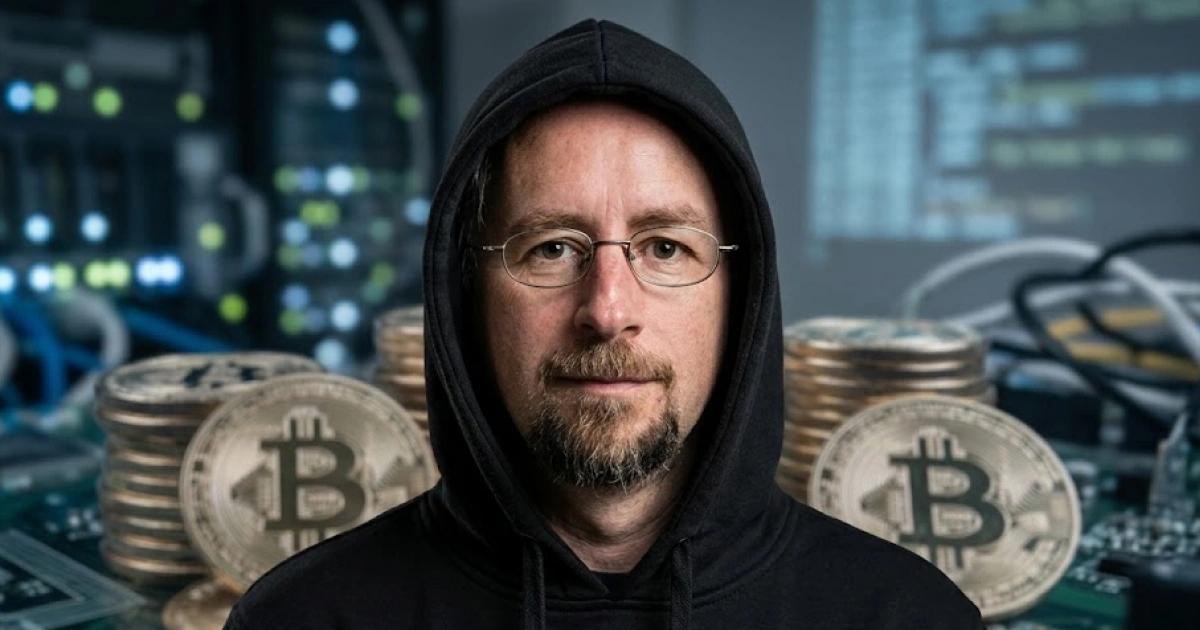
The New York Times referred to Satoshi Nakamoto as a cryptographer, Adam Back, sparking widespread mockery across the crypto community. The person involved has denied it, and experts say the evidence is thin. Before any private keys were used, Nakamoto’s identity—who reportedly held 7.3 billion USD worth of Bitcoin—remains a mystery.
The New York Times: Satoshi Nakamoto is Adam Back
Who exactly is the Bitcoin founder “Satoshi Nakamoto”? For over a decade, it has remained a mystery, but yesterday (4/8) The New York Times claimed it found the answer: Satoshi Nakamoto is British cryptographer Adam Back.
The author of this report is Pulitzer Prize winner John Carreyrou. He claims that after spending 18 months, by comparing historical posts in more than 130k Cypherpunk email forums, he narrowed the scope of investigation to 620 early users, and ultimately concluded that Adam Back is Satoshi Nakamoto.
The report states that Adam Back proposed as early as 1997 the concept of an electronic cash system completely detached from the modern banking framework. It includes five core features—such as a decentralized network and built-in scarcity—far earlier than Bitcoin’s white paper, by 10 years.
In addition, the Hashcash system invented by Adam Back was directly applied to the design of Bitcoin by Satoshi Nakamoto.
In terms of writing style, Carreyrou’s investigation found that Satoshi Nakamoto and Adam Back both use two full-width spaces after periods, prefer British spellings, and also share the same distinctive mistake in the use of hyphens. The two also frequently confuse the usage of “it’s” and “its,” and use the same obscure technical terminology.
When Satoshi Nakamoto was active online, Adam Back happened to disappear from the community. And after Satoshi Nakamoto vanished completely in 2011, Adam Back became active again—so it’s described as a case of “never appearing at the same time.” Moreover, in an in-person interview in El Salvador, Adam Back reportedly made a slip that seemed to acknowledge his identity.
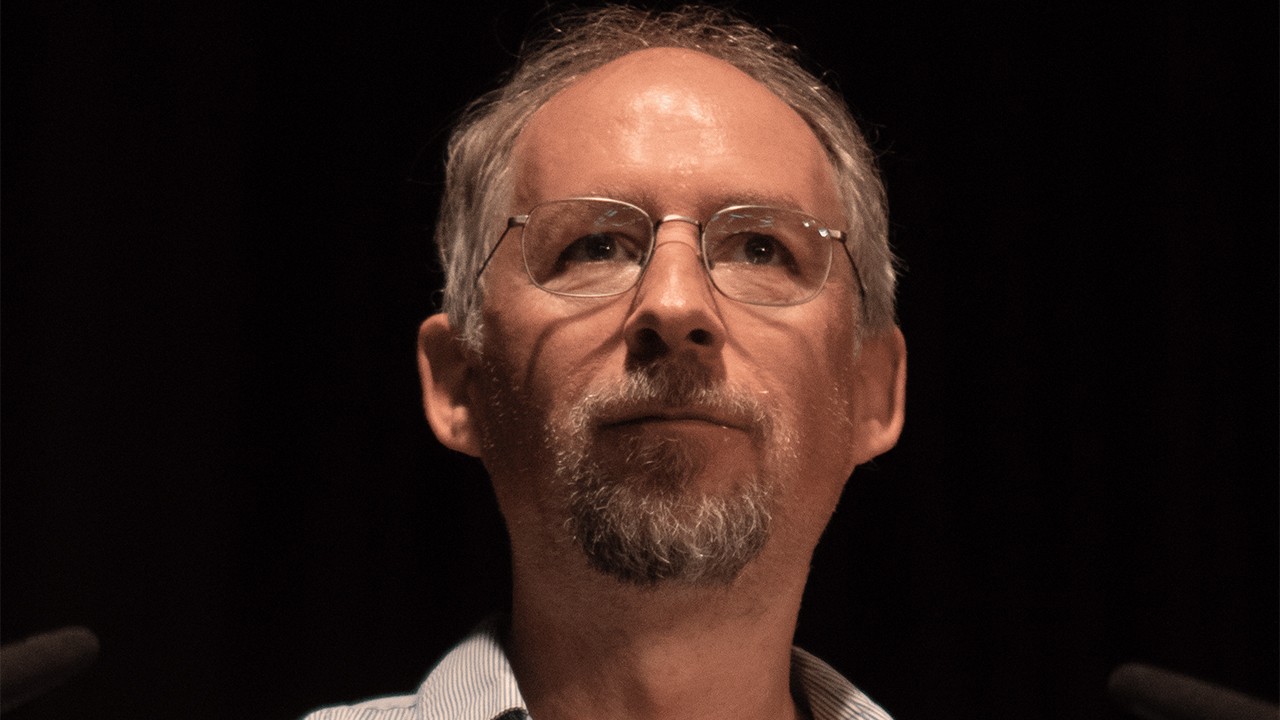
Image source: creativecommons.org British cryptographer, Blockstream CEO Adam Back
Adam Back denies he is Satoshi Nakamoto
In response to The New York Times’ conclusion, Adam Back directly denied it. He said he absolutely has not been hiding his identity, and that every so-called coincidence discovered by outsiders comes entirely from his long-term focus since 1992 on research into cryptography, online privacy, and the applications of electronic cash.
Because he posts an extremely large volume of content on forums about the relevant topics, researchers can easily compare his writing to that of Satoshi Nakamoto, which is a form of confirmation bias in statistics.
Regarding the alleged slip-ups made during the interview, he clarified that his remarks at the time were only meant to explain that in the past he had been very talkative on developer forums. His posting frequency was far higher than that of other people with similar interests, so he was more likely to be identified by similar vocabulary.
Adam Back reiterated that he also does not know who the real identity of Satoshi Nakamoto is, and keeping Satoshi Nakamoto anonymous is very beneficial to the overall development of Bitcoin.
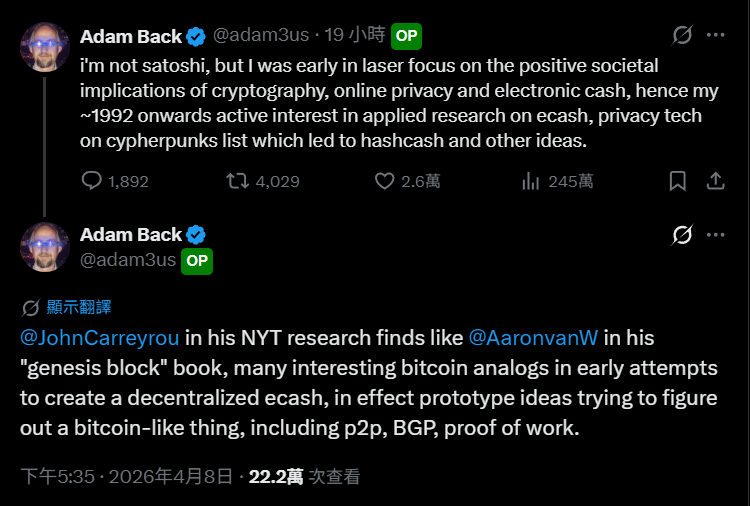
Image source: Adam Back/X Adam Back denies he is Satoshi Nakamoto
Crypto community scoffs at the NYT report
In addition to Adam Back, the crypto community and multiple industry experts also questioned the investigative report.
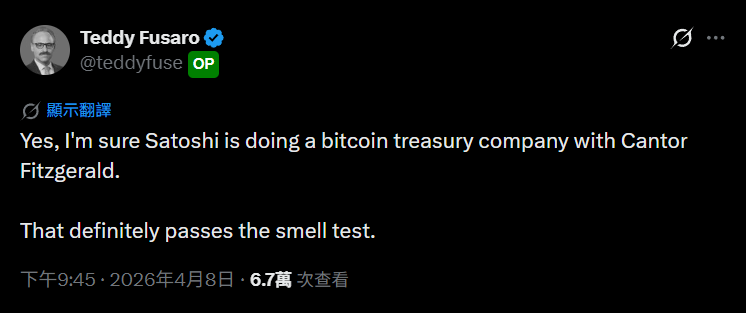
Teddy Fusaro, CEO of crypto asset management firm Bitwise, scoffed at it as well, questioning how Satoshi Nakamoto could possibly go on to partner with the Wall Street firm Cantor Fitzgerald to found a Bitcoin reserve company.
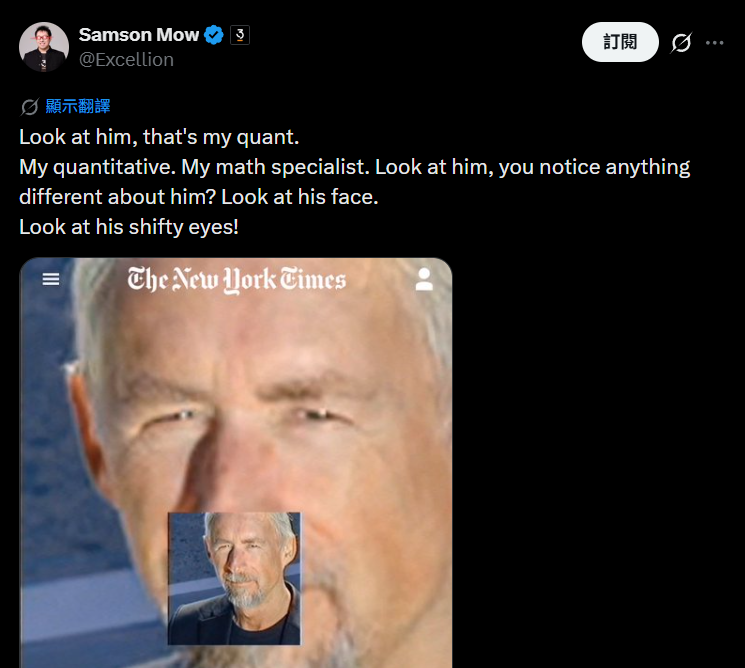
Samson Mow, CEO of Jan3 and a die-hard Bitcoin fan, also quoted a line from “The Big Short” in a post mocking it: “Look at him—that’s my quantitative analyst,” and in a subsequent post wrote: “We’re all Satoshi Nakamoto, except Craig Wright.”
Bloomberg columnist Joe Weisenthal also pointed out that The New York Times’ evidence based on stylistic analysis is quite weak, and even punctuation habits can be changed. Moreover, members of the early Cypherpunk community originally held political viewpoints that were extremely similar to one another regarding internet architecture and privacy, so overlap in text and ideas is completely normal.
Early Bitcoin participant Nicholas Gregory also said that based on past experience interacting privately, he completely does not believe Adam Back is Satoshi Nakamoto. He added that it is very dangerous for the media to constantly try to uncover Satoshi Nakamoto’s identity, which could expose him and his family to personal safety threats.
Blockchain data analytics platform Arkham estimates that Satoshi Nakamoto currently holds about 1.1 million Bitcoins, with a total value as high as 73 billion USD.
More and more “top candidates”—who is Satoshi Nakamoto?
Over the past 17 years, the real identity of Satoshi Nakamoto has been continuously speculated on, giving rise to many popular candidates.
The most frequently mentioned figures include the late cryptographer Hal Finney, the computer scientist Nick Szabo, and the late software engineer Len Sassaman. Hal Finney was the recipient of the very first Bitcoin transaction; he died in 2014 from ALS, while Len Sassaman passed away in 2011.
In October 2024, a documentary released by HBO also tried to solve the mystery, concluding that Satoshi Nakamoto is the Canadian software developer Peter Todd—an assertion similarly strongly denied by the person involved.
- **Related report:**HBO Bitcoin documentary airs! Is Satoshi Nakamoto Peter Todd? The person denies it with this line
No matter how many inferences the media and documentaries make, as long as no one can sign or transfer using the private keys from early blocks, all of the evidence can only be considered circumstantial. Who exactly is this mysterious figure holding 1.1 million Bitcoins? It remains the greatest unresolved mystery in modern technology and finance history.
Further reading:
Satoshi Nakamoto’s payment dream changes course! From Bitcoin to stablecoins—why crypto payments are increasingly becoming a subservient arm of banks?
Disclaimer: The information on this page may come from third parties and does not represent the views or opinions of Gate. The content displayed on this page is for reference only and does not constitute any financial, investment, or legal advice. Gate does not guarantee the accuracy or completeness of the information and shall not be liable for any losses arising from the use of this information. Virtual asset investments carry high risks and are subject to significant price volatility. You may lose all of your invested principal. Please fully understand the relevant risks and make prudent decisions based on your own financial situation and risk tolerance. For details, please refer to
Disclaimer.


