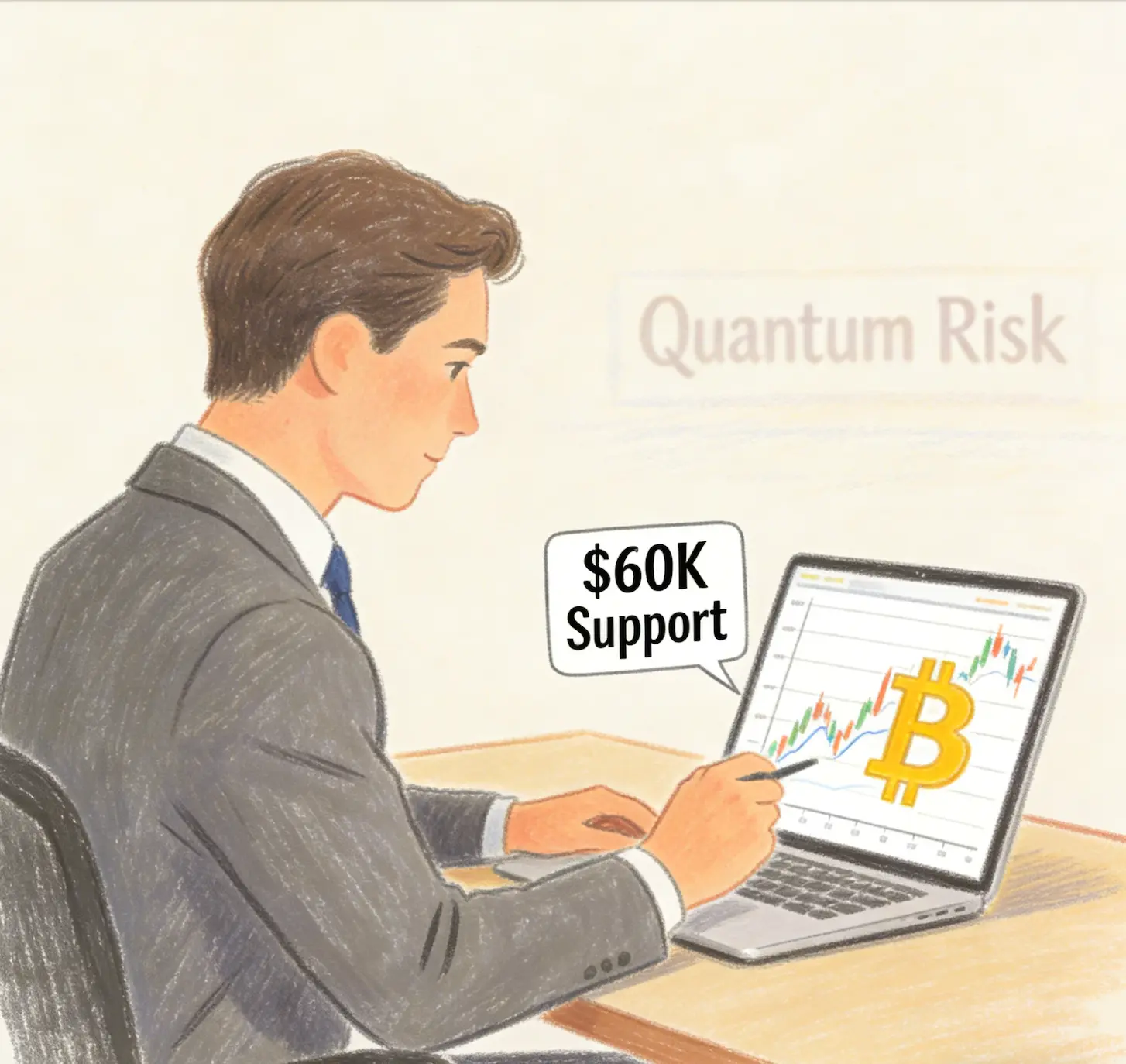
 Strategy (MSTR) executive chairman Michael Saylor stated at a Mizuho event on April 8, 2026 that bitcoin likely bottomed near $60,000 in early February when forced sellers were flushed out, and that the formation of banking credit and digital credit markets built on bitcoin will be the catalyst for the next bull market.
Saylor also dismissed quantum computing risks as “theoretical” and “decades away,” while rejecting recent claims that Adam Back is Satoshi Nakamoto, demanding cryptographic proof via a private key signature.
Bitcoin Bottom Driven by Seller Exhaustion, Not Valuation
Saylor reiterated his long‑held view that bottoms are determined by seller exhaustion rather than valuations. Trend reversals, he added, are driven more by capital structure and liquidity than by investor sentiment. He now sees limited selling pressure amid growing demand from ETF inflows, which are absorbing daily supply, and from companies shifting treasury assets into bitcoin.
Next Catalyst: Banking and Digital Credit on Bitcoin
Saylor believes the next bull market catalyst will be the formation of banking credit and digital credit on top of bitcoin, supporting lending and credit activity beyond simple buy‑and‑hold demand. He cited Strategy’s STRC preferred stock, which carries an 11.5% yield, as an existing form of digital credit. He said Strategy is “stretching” bitcoin “from a non‑yielding asset into a capital markets engine.”
Quantum Threat Overblown, Easily Solvable
On quantum computing, Saylor argued that the threat is theoretical, likely decades away, and even then solvable. His comments follow recent research from Google Quantum AI suggesting that breaking Bitcoin’s encryption might require fewer qubits than previously estimated. Saylor dismissed near‑term concerns.
Saylor Rejects Adam Back as Satoshi, Demands Cryptographic Proof
Responding to a New York Times investigation that used stylometry to suggest Adam Back is Bitcoin’s pseudonymous creator, Saylor said stylometry is “interesting, but not proof.” He pointed to contemporaneous 2008 emails between Satoshi and Back as evidence they were distinct individuals. “Until someone signs with Satoshi’s keys, every theory is just narrative,” he said. Back himself has firmly denied being Satoshi.
Mizuho Maintains Outperform Rating on Strategy
Mizuho retained its outperform rating on Strategy and a $320 price target, suggesting approximately 150% upside from the current share price near $127. Strategy holds 766,970 BTC acquired for roughly $54.57 billion, making it the largest corporate holder globally.
FAQ
What does Michael Saylor believe is the next catalyst for bitcoin’s bull market?
Saylor believes the formation of banking credit and digital credit markets built on bitcoin will drive the next surge, turning bitcoin from a non‑yielding asset into a capital markets engine. He points to Strategy’s STRC preferred stock (11.5% yield) as an example of digital credit.
How does Saylor view the quantum computing threat to bitcoin?
Saylor argues the quantum threat is theoretical, likely decades away, and solvable. He downplays recent research suggesting lower qubit requirements, maintaining that the risk is overblown.
Why does Saylor reject the claim that Adam Back is Satoshi Nakamoto?
Saylor cites contemporaneous 2008 emails between Satoshi and Back as evidence they were separate individuals. He insists that only a signature from Satoshi’s private keys would prove identity, calling stylometry “interesting, but not proof.”
Disclaimer: The information on this page may come from third parties and does not represent the views or opinions of Gate. The content displayed on this page is for reference only and does not constitute any financial, investment, or legal advice. Gate does not guarantee the accuracy or completeness of the information and shall not be liable for any losses arising from the use of this information. Virtual asset investments carry high risks and are subject to significant price volatility. You may lose all of your invested principal. Please fully understand the relevant risks and make prudent decisions based on your own financial situation and risk tolerance. For details, please refer to
Disclaimer.


