Original Title: {10 Big Claude Code Tips I Wish I Knew Sooner}
Original Author: Iron Hammer, AI Analyst
Below are the Claude code tips I’ve learned over more than half a year—tips I constantly wish I had known earlier.
They’ve saved me a huge amount of time, helping me enter a smooth, frictionless state when writing code and content.
The article is divided into three parts:
1. Three Ways to Launch
2. Tips for Use While Running
3. Solving Human–AI Collaboration Efficiency with Supporting Software
All of this is about: helping you stay more focused on programming and other tasks at hand.
I wish someone had sent me this tutorial a few months ago—so I could take fewer detours and get into a smooth workflow:
-
Save this guide and spend 30 minutes this weekend mastering Claude code tips.
-
Send it to anyone who asks, “I think Claude code is hard, but I’ve never tried it.”
Alright—first, let’s start with the simplest way to launch (and yes, launching also has its tricks).
Three Ways to Launch Claude
Simple Launch
Launching Claude is very simple—simple in the command line.
But for friends who don’t like command-line tools, Claude code is actually a visual interface.
How do you do that?
On this website: https://claude.com/download under Claude Desktop, if you follow the steps below, you’ll get a visual Claude.
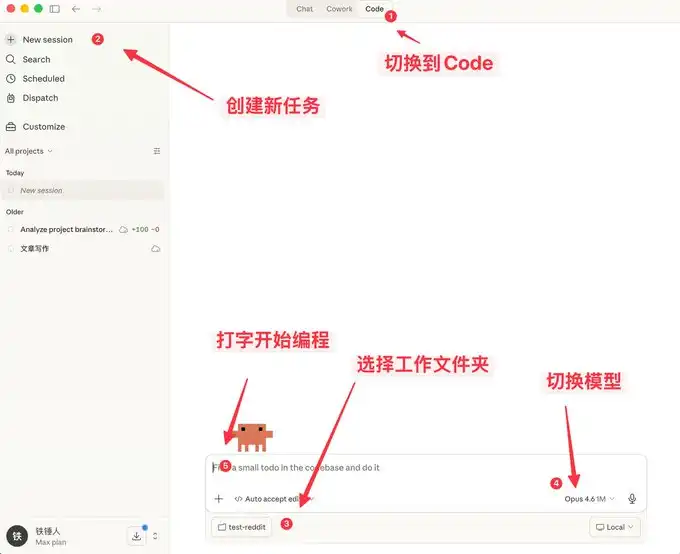
Not only can you chat here, it also includes many features similar to OpenClaw.
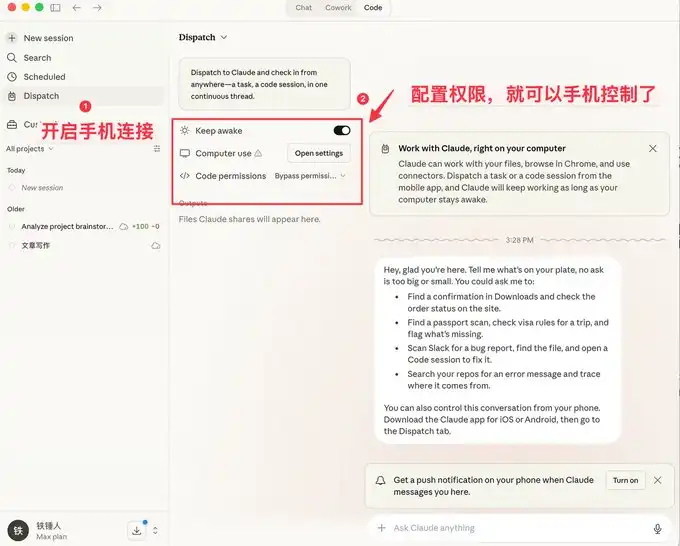
A visual interface is easier for ordinary people to use, but programmers tend to prefer the command-line launch method.
Below are a few commands to speed up startup.
Command-Line Launch
Launch with Specific History
In the process of using Claude code, we often run into situations that require a restart. Each time we restart, we need to respond with the previous context:
I used to always use:
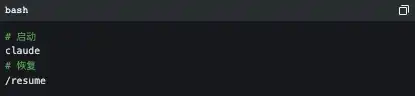
But the official side actually provides quite a few great startup commands:
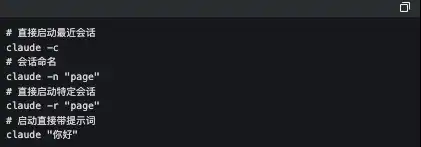
The one I use most frequently here is cluade -c. In just a short command, it has saved me a lot of life.
-p Start in an automated way
Claude Code can be started in a no-UI way. You can simply use the command below:

Worth noting: if you want to use a local subscription Token to automate tasks, currently only this method works.
Below is the famous Obsidian + Claude Code tool. It’s basically someone made an SDK so you can use a local subscription Token like this.
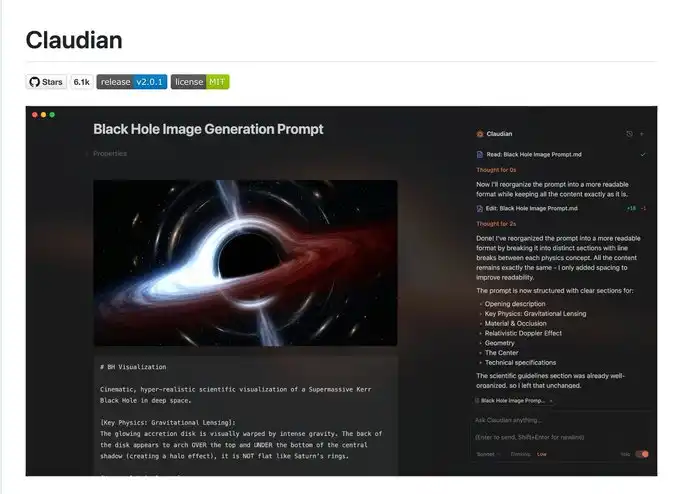
I admit what I said earlier might be a bit complicated. Now let’s talk about a few simple commands during use.
3 Small Tips You Must Know for Running Claude Code
Gracefully Terminate and Roll Back Tasks
When people first start using claude code, they still like to use Ctrl+C to close the current conversation. Who knew that would shut down Claude directly.
The correct approach is to press the Ese key once—this will immediately interrupt the conversation and prevent things from getting worse.
If Claude suddenly goes off the rails, we can press Ese+Ese twice. After that, a list will pop up:
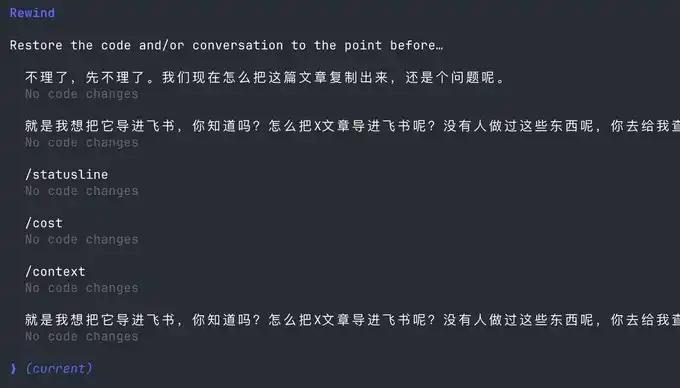
You can use this feature to return to any checkpoint, preventing Claude code from messing up your code.
Don’t Leave Claude to Run Commands
Sometimes we want to run a test command, but to avoid closing the current Claude, we think we must open another command window.
Actually, we can use the ! syntax:

Context Management
As the conversation continues, the more chat history we accumulate, the more tokens each run consumes. At this point, Claude code will run increasingly slowly.
You have two choices: open a new window, or use the** /clear command**
A simple command that clears useless context. It’s like closing 20 chrome tabs in one go.
But what if I don’t want to clear these contexts? Use** /compact to compress it.**
It’s like making claude drink a Red Bull—waking up and boosting cognition.
I hope some of the tips above help you use Claude code more smoothly.
But that’s still not enough—because Claude code is a command-line tool. No matter how many commands you learn, it becomes a cognitive burden.
Fortunately, the community has produced plenty of supporting software to solve the pain points below:
-
There isn’t a mature prompt methodology, so programming efficiency is low
-
Humans type comparatively slowly, leading to low prompt input efficiency
-
During multitasking, people get fragmented and can’t improve productivity
If any of the above is your pain point, keep reading.
Use Supporting Software to Solve Human–AI Collaboration Issues
Now, we gradually realize that humans can’t keep up with the machine’s speed. So to address this problem, a series of software have been created for the community.
First, we need a mature programming methodology:
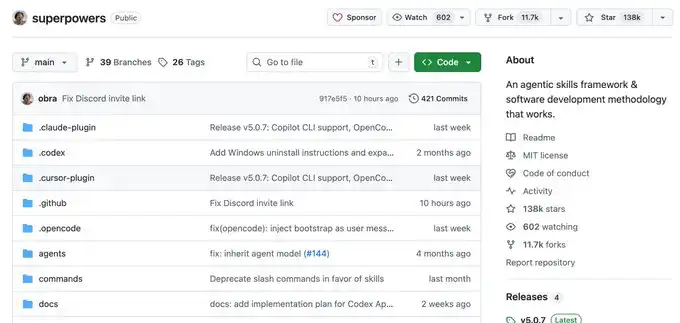
Superpowers
When ordinary people do Vibecoding, there’s no system—do whatever comes to mind. This Skills was summarized by a veteran programmer as a programming workflow.
He packaged top-tier software engineering best practices into a one-click Skills. From requirement breakdown, Spec confirmation, and detailed planning, to TDD test-driven development + automatic Code Review—throughout, it enforces a structured workflow. It enables the AI to output high-quality, maintainable code like a mature engineering team. With a much higher first-pass success rate, you no longer need to repeatedly put out fires.
This project already has 138k Stars. You can go check it out yourselves—I won’t go into details.
Once you have a mature set of programming Skills, you’ll find it requires you to input information frequently. Then you’ll realize typing speed becomes your efficiency bottleneck.
You start wondering: Is there any software that you can whisper to in the office and it converts speech to text, with extremely accurate recognition for both Chinese and English?
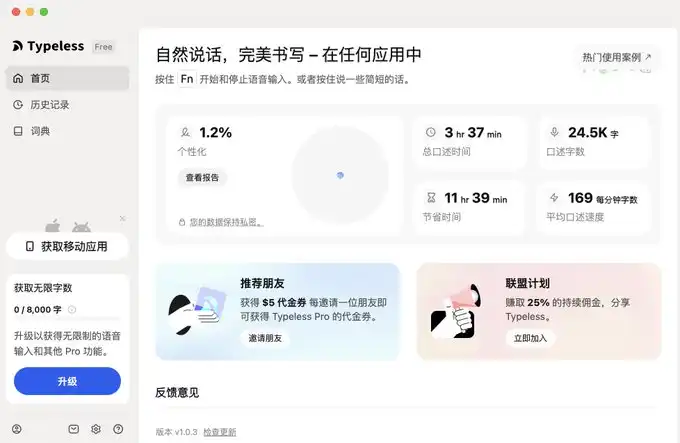
Yes, yes, and there are many—but I only recommend two: typeless and the Doubao input method.
Speech-to-Text Input Software
The advantage of the Doubao input method is speed, then the Chinese/English recognition is also pretty good. Most importantly, it’s free. It’s a bit like the Android system—I’m using it too.
But typeless, besides requiring payment, doesn’t have many downsides—so you can try it.
I’ll put the links below.
typeless is what I recommend because it supports itself: https://www.typeless.com/?via=lxfater
The Doubao input method is still in testing—searching will get you the installer package.
Once we start “mouth-to-text” input, we can provide more context to Claude code. As a result, the first-pass success rate will keep getting higher and higher. At that point, the efficiency bottleneck becomes Claude code’s runtime.
We can run multiple Claude code instances at the same time. Then our bottleneck becomes the problem of human multitasking switching that causes context loss.
Solving Your Attention Switching Problem
First, I recommend a software called Cmux:
It’s a macOS native terminal newly built on Ghostty, designed specifically for running multiple coding agents at the same time: vertical tabs + a smart sidebar, flexible split screens, smart notification highlighting, built-in split-screen in the browser + Socket API.
This is an open-source project: https://github.com/manaflow-ai/cmux
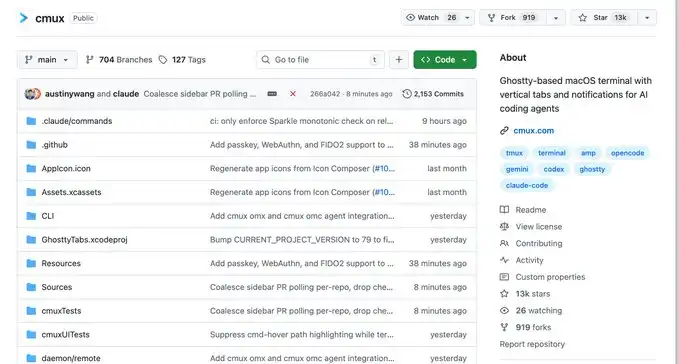
What I like most is the split-screen feature, but once you split the screen, you may not know which window completed the task.
Fortunately, this software directly highlights a specific terminal area, helping you switch to the corresponding window in time.
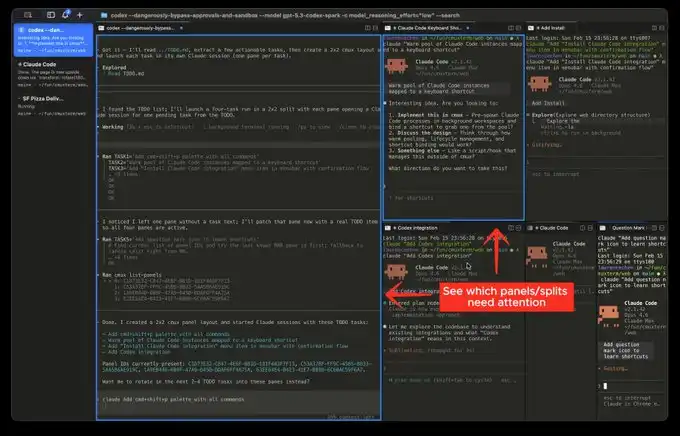
Official website image
But the next piece of software I’m about to introduce will make this kind of switching extremely smooth:
This is the recently popular product: Vibe Island
Is the UI good-looking? Maybe—but the strongest part of this product is that it supports switching among many different tools.
And every time you switch, it automatically “wakes up” the app, brings the window into focus, and then you can just start typing.
In theory, as long as you switch quickly enough and open enough windows, it will continuously push the windows that need to be processed right in front of you. It feels like you’re handling a production pipeline.
Finally
Hope this content helps you. This time it’s more beginner-friendly; for programmers, it’s basically common knowledge.
But I still hope it can help you. If you feel this article helps you!
Original link
Click to learn about Lively BlockBeats hiring positions
Welcome to join the official Lively BlockBeats community:
Telegram subscription group: https://t.me/theblockbeats
Telegram group chat: https://t.me/BlockBeats_App
Twitter official account: https://twitter.com/BlockBeatsAsia


