
Charles Schwab, which manages more than $12 trillion in client assets, released a crypto asset allocation white paper on April 7. This marks a significant shift in Schwab’s stance since 2019, when it characterized cryptocurrencies as “purely speculative activity.” The white paper also warns that regardless of the strategy used—even a small allocation of crypto assets—will bring higher risk concentration to a portfolio than traditional assets.
Two Allocation Frameworks: Choose Between Return-Driven and Risk Budgeting
 (Source: Charles Schwab)
The white paper’s core framework revolves around two complementary methodologies, allowing investors to choose based on their specific circumstances:
Two Crypto Asset Allocation Approaches in Schwab’s Overview
Return-based approach (mean-variance optimization): Determine allocation weights based on expected returns, volatility, and correlations with other assets. The higher the expected return, the larger the recommended allocation; if an investor expects Bitcoin’s annualized return to be below 10%, even an aggressive portfolio may not be recommended for any allocation.
Risk-based approach (risk budgeting): Focus on the proportion of a crypto asset’s risk contribution to the overall portfolio risk, setting crypto assets at 5%, 10%, or 15% of total portfolio risk, according to a quantified risk-capacity limit for the investor.
Fellah Jo said, “No matter which strategy investors use, including crypto assets in a portfolio will result in a higher risk concentration than traditional assets. As the allocation ratio increases—even if the increment is small—portfolio performance will increasingly depend on the performance of crypto assets.”
Specific Allocation Guidance: Differentiated Ratios for Three Risk Profiles
 (Source: Charles Schwab)
Assuming an annualized Bitcoin return rate of 15%, Schwab’s return-based recommendations are as follows: for a conservative portfolio, Bitcoin allocation is about 1%; for a balanced portfolio, about 6.6%; and for an aggressive portfolio, about 8.8%. Because Ethereum is more volatile, the recommended allocation is lower under the same portfolio—0.1% for conservative, 2% for balanced, and 2.5% for aggressive.
Under the risk-based framework, a conservative portfolio allocates about 1.2% to Bitcoin (or about 0.9% to Ethereum), representing 10% of total portfolio risk; in balanced and aggressive portfolios, Bitcoin allocation ranges from 2.8% to 4%, and Ethereum ranges from 2% to 2.9%, achieving a similar risk level.
Schwab added, “For portfolios that have already allocated to traditional assets such as stocks, bonds, and cash, crypto assets can provide a certain degree of diversification benefit.”
High Volatility Is an Inescapable Reality
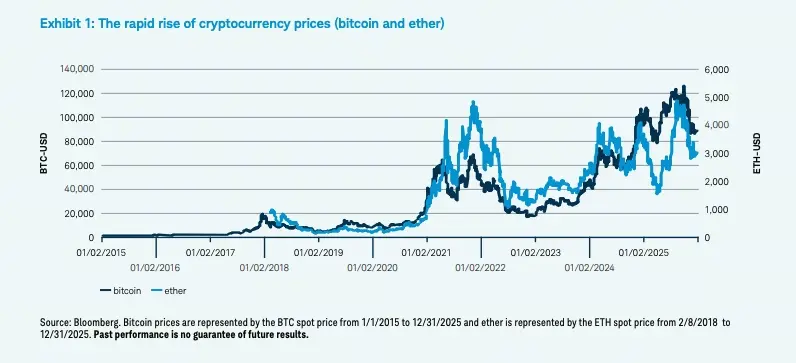
In the white paper, Schwab clearly quantified the volatility characteristics of crypto assets—Bitcoin’s annualized volatility is about 72%, with a maximum drawdown of over 70%; Ethereum’s annualized volatility is close to 98%, with a maximum drawdown of close to 88%. Both far exceed the risk levels of traditional assets such as stocks and bonds. This is also why even a small allocation of 1% to 2% is enough to significantly change the overall portfolio’s risk profile.
It is also worth noting that Schwab has opened a waitlist for the “Schwab Crypto” account, with plans to allow clients to directly buy and sell Bitcoin and Ethereum. For now, Schwab still provides crypto investment channels through ETPs, crypto-related stocks, over-the-counter trading trusts, and futures.
Frequently Asked Questions
What is the maximum recommended Bitcoin allocation ratio in Schwab’s guidance?
Assuming an annualized Bitcoin return rate of 15%, the recommended allocation cap for an aggressive portfolio is about 8.8%. If expected annualized returns are below 10%, even aggressive investors may not be recommended to make any allocation. The final decision depends on each investor’s specific goals and risk tolerance.
Why does even a small crypto investment increase portfolio risk?
Schwab’s research indicates that the high volatility of crypto assets (about 72% annualized for Bitcoin and about 98% for Ethereum) causes them to contribute far more risk to the overall portfolio than traditional assets at the same proportion. Even with a very small allocation, portfolio performance will begin to rely significantly on the performance of crypto assets, and the risk concentration effect will be evident.
How is Schwab currently providing crypto investment access?
Currently, Schwab provides crypto investment opportunities to approved accounts through methods such as ETPs, crypto-related stocks, over-the-counter trading trusts, and futures. Schwab has opened a waitlist for “Schwab Crypto” for direct buy-and-sell accounts and plans to support clients in directly purchasing Bitcoin and Ethereum.
Disclaimer: The information on this page may come from third parties and does not represent the views or opinions of Gate. The content displayed on this page is for reference only and does not constitute any financial, investment, or legal advice. Gate does not guarantee the accuracy or completeness of the information and shall not be liable for any losses arising from the use of this information. Virtual asset investments carry high risks and are subject to significant price volatility. You may lose all of your invested principal. Please fully understand the relevant risks and make prudent decisions based on your own financial situation and risk tolerance. For details, please refer to
Disclaimer.


