OpenAI has released a 13-page policy white paper titled “Industrial Policy for the Intelligence Age,” putting forward a systemic reform plan for the economic order after superintelligence arrives. The core goals cover widely shared prosperity, reducing technology risks, and expanding access to using AI. CEO Sam Altman said that superintelligence is right around the corner.
OpenAI White Paper’s Five Core Policy Proposals
The white paper’s specific proposals cover three major areas: tax system reform, wealth distribution, and labor protections:
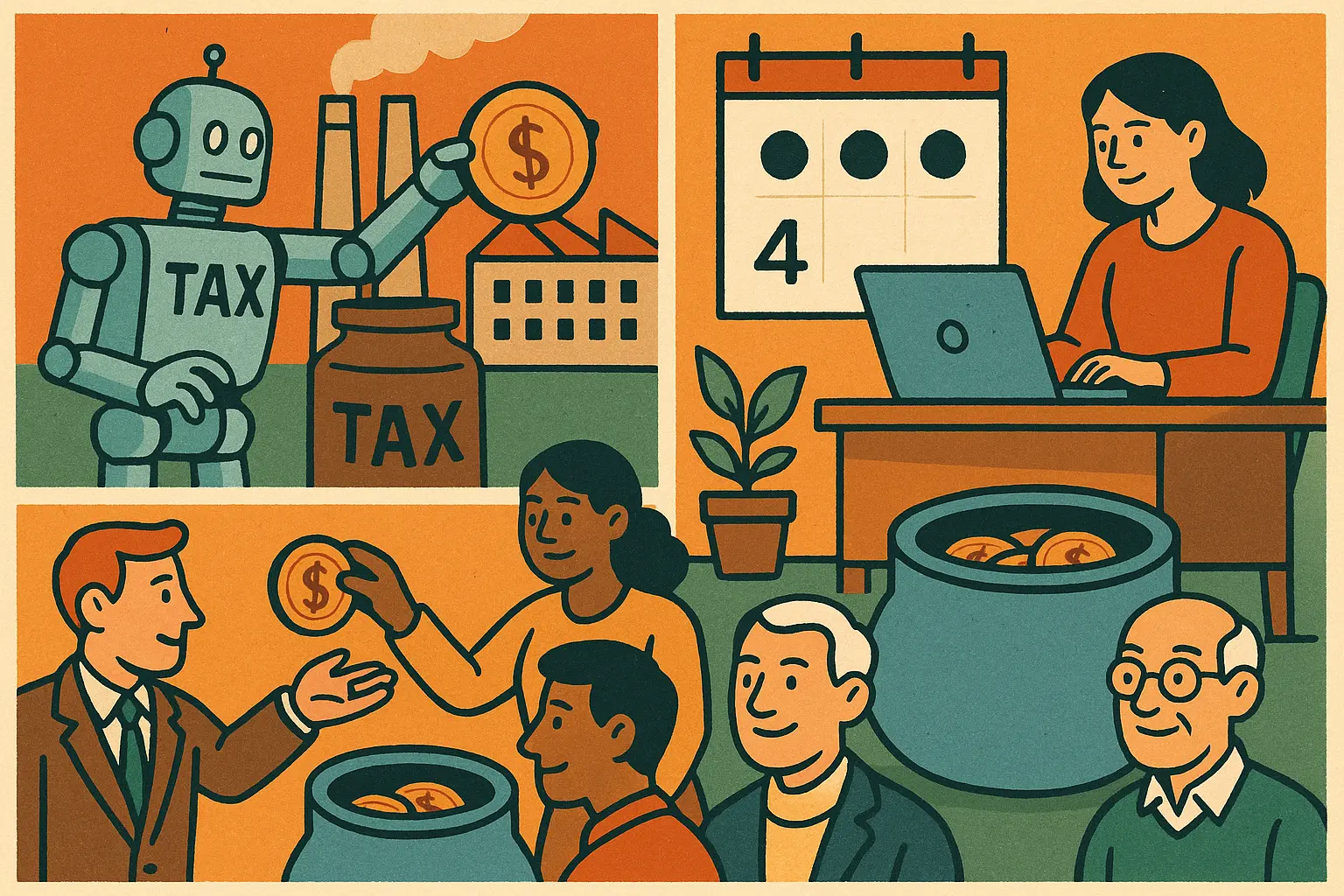
Robot tax (automation labor tax): Replacing human labor with AI will cause the wage tax base to shrink. It recommends shifting toward taxing capital gains and corporate income, and exploring a dedicated tax regime for automated labor
Universal AI Wealth Fund: Modeled on the Alaska Permanent Fund dividend scheme, it would establish a national public wealth fund. Funding would partly come from contributions by AI companies, so that citizens directly hold a share of the AI-driven economic growth
A four-day workweek: It recommends the government trial a 32-hour workweek. Wage levels and output standards would remain unchanged, converting productivity gains into workers’ “efficiency dividends”
An automated safety-net trigger mechanism: When unemployment indicators caused by AI reach a preset threshold, unemployment benefits, wage insurance, and cash assistance would automatically be activated. After the job market recovers, these measures would be gradually withdrawn
Basic normalization of AI usage rights: Position AI eligibility as a “fundamental right to participate in the modern economy,” arguing that the AI dividend should not be concentrated among a few
Universal AI Wealth Fund: Reallocating the economic dividends of the superintelligent era
The design logic of the Universal AI Wealth Fund comes from the public dividend model of the Alaska Permanent Fund. The Alaska state government distributes oil extraction revenues to all residents on a regular basis. OpenAI’s proposal transplant this framework into the superintelligent era, arguing that part of the revenue from AI companies should be used as seed capital. Through a sovereign wealth fund mechanism, ordinary citizens would directly participate in the outcomes of increased AI-driven productivity. The white paper’s core argument is: if AI is supported by society’s accumulated knowledge and public infrastructure, then the wealth it creates should, through institutional design, be returned to society as a whole.
OpenAI Acknowledges the Risk of AI Going Out of Control, Proposes a Government-Coordinated Emergency Response Framework
The white paper does not shy away from potential scenarios of technical loss of control. It clearly states that there are dangerous AI systems that “cannot be easily recalled,” because they have autonomy and self-replication capabilities, and it includes an emergency response plan for uncontrolled AI that requires coordinated government action. Altman warned that a recent AI model achieving major network attacks is “absolutely possible,” using AI to create new types of pathogens is “no longer a theoretical assumption.”
OpenAI also announced that it will launch a supporting research funding program, offering scholarships of up to $100k and API credits of up to $1 million. It will also hold an OpenAI Workshop in Washington in May to advance policy discussions on the issues in the white paper.
Strategic backdrop of the white paper: IPO preparations alongside regulatory expectations
The timing of the white paper release has a clear strategic backdrop. OpenAI is preparing for its first initial public offering (IPO), while the U.S. Congress is simultaneously advancing an AI legislative framework. While its own technology may disrupt the job market, it proactively proposes taxing AI companies and establishing a redistribution mechanism. Outside observers broadly interpret this as having two layers of intent: currying favor with regulators through a proactive posture, and building a “responsible AI” narrative framework for IPO roadshows.
Frequently Asked Questions
What is the “robot tax” proposed by OpenAI?
A robot tax (automation labor tax) is a type of tax levied on companies that replace human labor with AI or automated systems. Its purpose is to make up the social security budget gap caused by the shrinking wage tax base. In the white paper, OpenAI recommends exploring this mechanism and also suggests adjusting the current structure of social security funding sources, which are mainly based on wage taxes.
How would OpenAI’s four-day workweek work?
OpenAI suggests that the government trial a 32-hour workweek. Wage levels would remain unchanged, and output would stay at the original standard. The core logic is to turn productivity gains brought by AI into tangible dividends that workers can feel, rather than merely flowing into corporate profits.
Why did OpenAI release a policy white paper at this time?
The white paper’s release coincides with OpenAI’s IPO preparation period and the U.S. Congress’s AI legislation process. Its proactive proposal of a regulatory framework and redistribution mechanism has been interpreted externally as a forward-looking arrangement in anticipation of potentially mandatory legislation. At the same time, it also constructs a narrative image of “responsible AI companies” ahead of the IPO.
Disclaimer: The information on this page may come from third parties and does not represent the views or opinions of Gate. The content displayed on this page is for reference only and does not constitute any financial, investment, or legal advice. Gate does not guarantee the accuracy or completeness of the information and shall not be liable for any losses arising from the use of this information. Virtual asset investments carry high risks and are subject to significant price volatility. You may lose all of your invested principal. Please fully understand the relevant risks and make prudent decisions based on your own financial situation and risk tolerance. For details, please refer to
Disclaimer.


