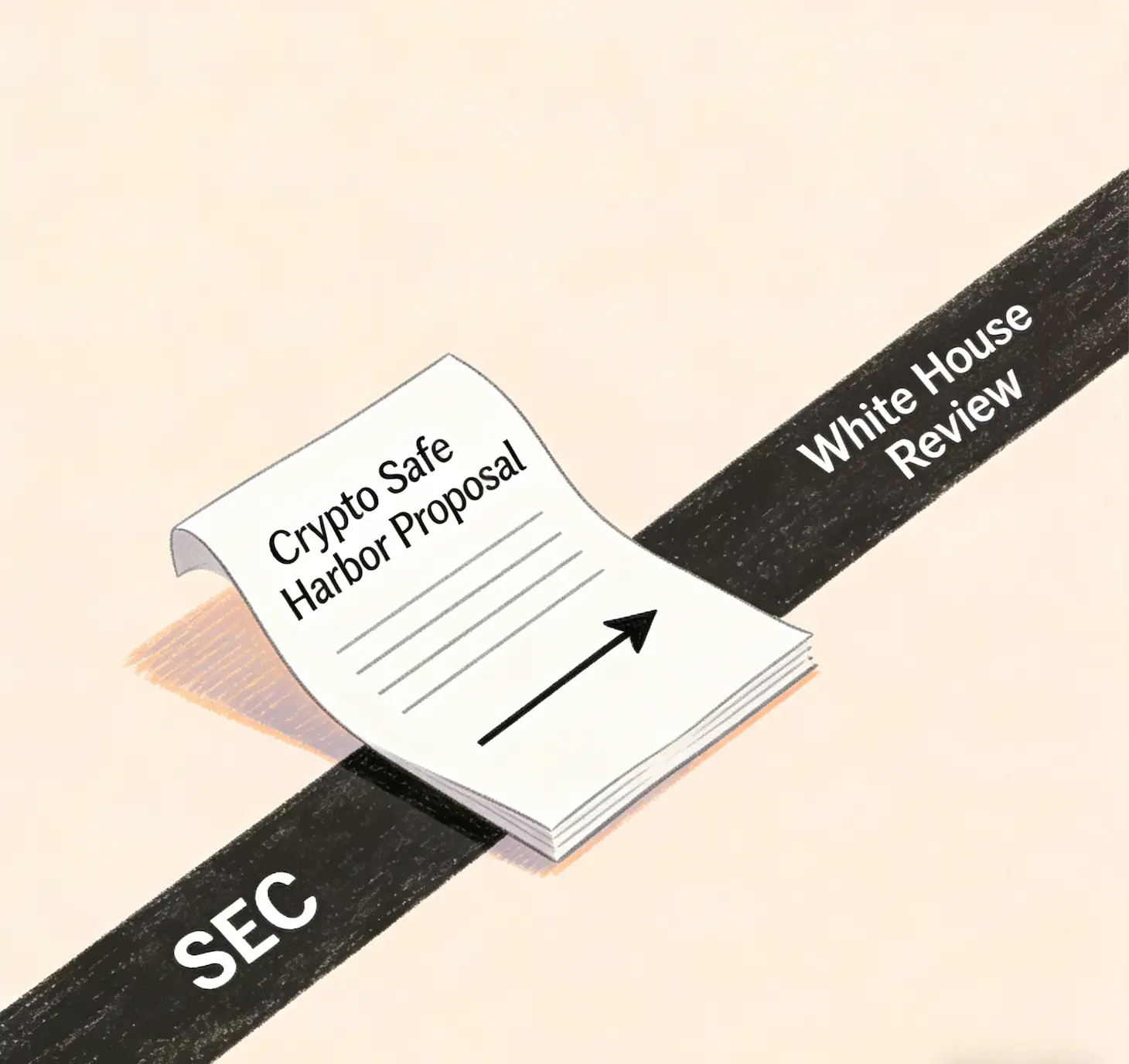
 Securities and Exchange Commission (SEC) Chair Paul Atkins announced on April 6, 2026 that the agency’s proposed safe harbor framework for crypto projects has advanced to the White House Office of Information and Regulatory Affairs (OIRA) for review, with a formal proposal expected “shortly.”
The framework would include a “startup exemption” allowing crypto stakeholders to raise capital during a four-year period with specific disclosures and investor protections, marking a potential shift from the SEC’s prior enforcement-heavy approach.
SEC Safe Harbor Proposal Moves to OIRA for Pre-Publication Review
Speaking at a digital assets summit hosted by Vanderbilt University and the Blockchain Association, Atkins confirmed that the safe harbor proposal is now at OIRA, a division within the Office of Management and Budget that reviews federal regulations before publication in the Federal Register. “We’ll have reg crypto that we’ll be proposing here shortly,” Atkins said. “It’s in fact at OIRA right now, which is the next step before being published.”
The safe harbor concept, first championed by former SEC Commissioner Hester Peirce in 2020, would provide a grace period during which token projects can operate and build decentralized networks without being classified as securities requiring immediate registration. The proposal includes a “startup exemption” allowing projects to raise a defined amount of capital over a four-year period while providing specific disclosures. Atkins also proposed an “investment contract safe harbor” that would pair with the SEC’s March 2026 token taxonomy-based interpretive guidance, which for the first time set out clear parameters for when digital assets would be considered securities.
Regulatory Clarity vs. Legislative Permanence
The regulatory effort comes as lawmakers in Washington work on broader crypto legislation, which has faced several roadblocks over the past year. Atkins argued that a legislative solution is necessary because regulators “need something chiseled in stone,” noting that unlike agency rulemaking, legislation provides a level of permanence less vulnerable to changes in presidential administrations. “We can do a lot regulatorily, but we just have to make sure it takes root and can’t be done away with,” he said.
The current regulatory ambiguity has been a major driver of offshore relocation, with the vast majority of token launches in recent years taking place outside US borders in jurisdictions such as Switzerland, Singapore, and the UAE. A workable safe harbor could reverse some of that capital flight, giving domestic startups a defined runway to build and iterate without the immediate threat of enforcement action.
Innovation Exemption Sparks Debate Between Crypto Advocates and Traditional Finance
Separately, the SEC is working on an innovation exemption that could function as a regulatory sandbox for onchain assets. The idea has sparked debate over the past year between crypto advocates and traditional finance institutions, with critics arguing that broad exemptions would undermine investor protection and market surveillance.
Citadel Securities has urged the SEC to go through formal notice-and-comment rulemaking for any exemption, while the Blockchain Association argued on Monday that traditional rulemaking is not essential, noting that the SEC has previously relied on exemptions and has the authority to do so. Atkins stated at the event that the agency has the authority to pursue an exemption, adding, “We’ll be coming out with our parameters around that innovation exemption. I’m really excited about that. I think there’s a lot to be done in that area.”
Next Steps and Timeline for Final Rule
OIRA review periods typically range from 30 to 90 days, though they can extend longer if agencies request revisions. Once OIRA clears the proposal, the SEC would publish it in the Federal Register, opening a public comment window that usually lasts 30 to 60 days. Only after reviewing that feedback would the SEC vote on a final rule. Even under an optimistic timeline, a finalized safe harbor rule is likely months away.
The specifics of the safe harbor, including the length of the grace period, disclosure requirements, and eligibility criteria, remain unknown. A safe harbor that is too narrow or burdened with onerous reporting requirements may offer little practical relief, while one that is too broad could draw pushback from consumer protection advocates and financial regulators at other agencies.
FAQ
What is the SEC safe harbor proposal for crypto projects?
The SEC safe harbor proposal would allow blockchain projects to launch and operate without immediate securities registration, providing a grace period (typically four years) during which they can build decentralized networks while meeting specific disclosure and investor protection requirements. The framework includes a “startup exemption” for capital raising and is paired with the SEC’s token taxonomy guidance.
What is the current status of the proposal?
The proposal has advanced to the White House Office of Information and Regulatory Affairs (OIRA) for review, which is the step before publication in the Federal Register. SEC Chair Paul Atkins stated that a formal proposal is expected “shortly.” After OIRA review, the proposal will be published for public comment before a final SEC vote.
What is the innovation exemption and why is it debated?
The innovation exemption is a separate SEC initiative that would function as a regulatory sandbox for onchain assets. Crypto advocates argue it would provide flexibility for new projects, while traditional finance institutions like Citadel Securities warn that broad exemptions could undermine investor protection and market surveillance. SEC Chair Atkins has stated the agency has authority to pursue such an exemption.
Disclaimer: The information on this page may come from third parties and does not represent the views or opinions of Gate. The content displayed on this page is for reference only and does not constitute any financial, investment, or legal advice. Gate does not guarantee the accuracy or completeness of the information and shall not be liable for any losses arising from the use of this information. Virtual asset investments carry high risks and are subject to significant price volatility. You may lose all of your invested principal. Please fully understand the relevant risks and make prudent decisions based on your own financial situation and risk tolerance. For details, please refer to
Disclaimer.


