April 2, blockchain monitoring firm PeckShield issued an alert, confirming that HyperEVM appears to have suffered a major downtime event. According to the screenshot it released, the blockchain explorer page shows the latest blocks and transactions have all remained at around one hour ago, and network interactions are experiencing abnormal behavior across the board. However, Hyperliquid’s official status page still shows “All Systems Operational,” creating a clear discrepancy with the actual on-chain situation.
Failure Symptoms: PeckShield Monitoring Data vs. User Feedback
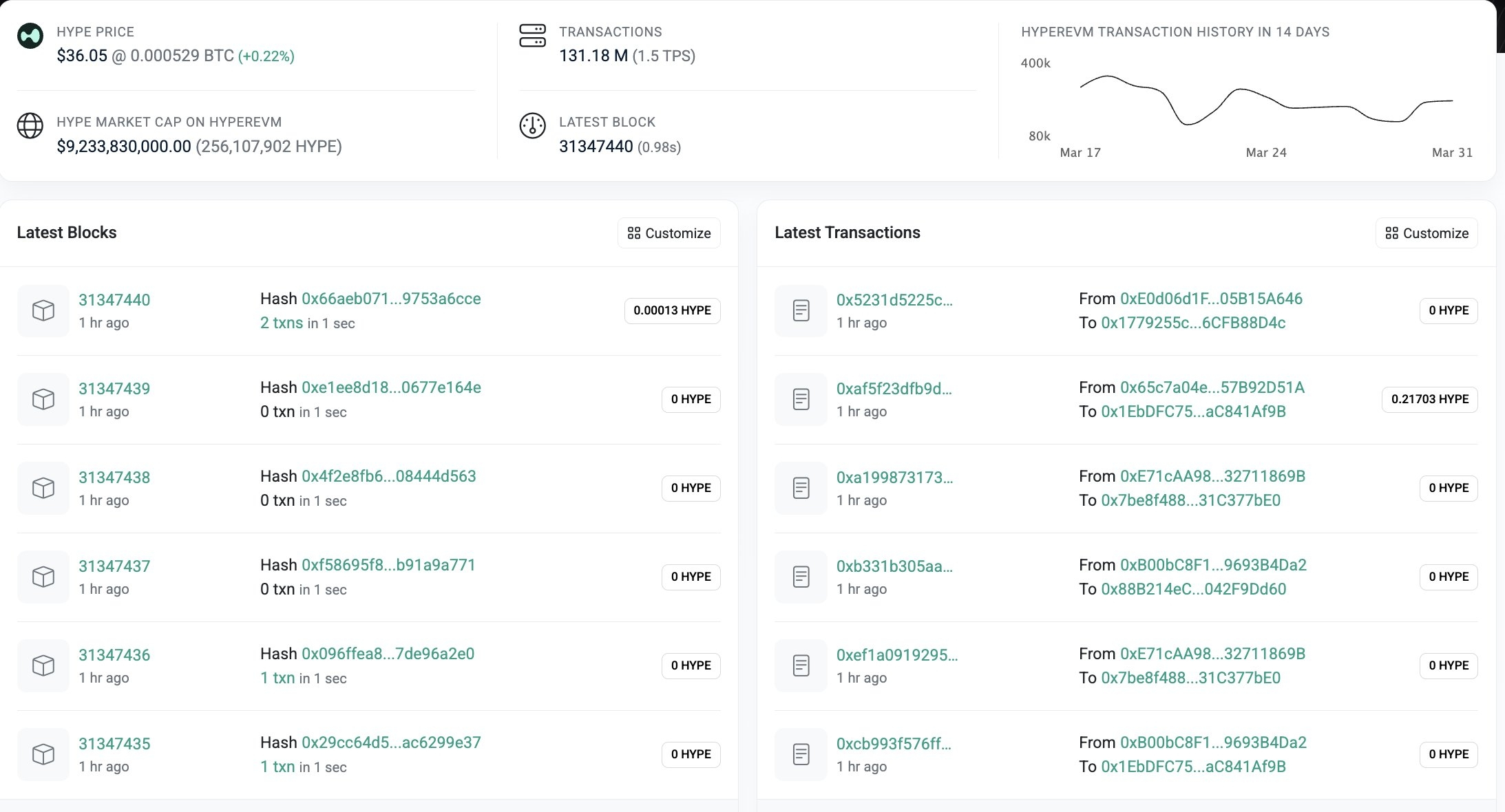 (Source: PeckShield)
PeckShield’s released screenshot shows that the latest blocks and transactions on HyperEVM’s blockchain explorer page have stalled at around one hour ago, meaning the network stopped producing blocks after that point in time. Based on the fundamental operating mechanism of blockchain networks, a halt in block production means that all pending transactions cannot obtain confirmation, and on-chain smart contract interactions are consequently frozen as well.
Discussions on the X platform quickly increased, and the main abnormal phenomena reported by users include:
Transactions cannot be confirmed: Submitted transactions remain in a pending state for a long time and cannot complete on-chain settlement
Smart contract interaction interrupted: DeFi protocols and applications that rely on HyperEVM contracts cannot be called normally
Blockchain explorer stops updating: On-chain data tools stop loading the latest blocks, and the displayed data is seriously out of sync with the actual on-chain state
As of the time of this writing, Hyperliquid’s official team has not issued an official announcement or provided a restoration timeline explanation regarding this HyperEVM downtime incident.
Coverage blind spots in the official status page: Technical layering of L1 and HyperEVM
Hyperliquid’s official status page shows “All Systems Operational,” but this status usually only covers the core L1 base layer and API interfaces, and does not necessarily reflect real-time issues on HyperEVM’s execution layer.
HyperEVM is an independent added layer on top of Hyperliquid’s L1 core matching engine. This means that even if the L1’s basic transaction matching and settlement functions continue to operate normally, HyperEVM’s smart contract execution environment may still experience independent system failures. If the official status page is not updated in real time, it may reflect a technical gap in Hyperliquid’s status monitoring framework coverage for the HyperEVM layer, rather than an intentional concealment of failure information.
Availability Stress Test for the New Mainnet
HyperEVM’s mainnet officially went live in early March 2026. Its design goal is to provide EVM-compatible smart contract capabilities to support Hyperliquid’s high-performance perpetual contracts infrastructure, attracting Ethereum ecosystem developers to deploy DeFi protocols and applications.
This downtime occurred less than one month after the mainnet launch. For users and developers who have already deployed assets or protocols on HyperEVM, it is a direct stress test of the early-stage stability of this new chain’s infrastructure. Major downtime incidents in the initial startup phase of a new public chain typically involve issues related to node configuration, edge cases in the consensus mechanism, or compatibility problems in the smart contract execution environment. The specific causes still await explanations in an official technical announcement.
Frequently Asked Questions
What is HyperEVM, and why is it monitored separately from Hyperliquid L1’s status?
HyperEVM is an EVM-compatible smart contract execution environment deployed on top of Hyperliquid L1, and it officially went live in early March 2026. It allows developers to deploy smart contracts on the Hyperliquid platform using Ethereum ecosystem tools. Since HyperEVM is an added layer independent of the L1 core matching engine, the two’s technical statuses may become separated, and the official status page may not cover HyperEVM’s real-time conditions.
What specific impact does this downtime have on DeFi protocols on HyperEVM?
During the block-production halt, all smart contracts running on HyperEVM cannot execute and confirm new transaction processing. The normal operation of liquidity pools, lending protocols, and any applications that rely on contract calls is affected. Transactions submitted during the downtime will remain in a pending state, waiting to complete confirmation after the network resumes block production.
Why does the Hyperliquid official status page still show normal during the downtime?
Hyperliquid’s official status page primarily monitors the core L1 base layer and API services. HyperEVM, as an upper-layer EVM execution environment, may not be included within the scope of real-time monitoring coverage. This coverage gap leads to a mismatch between the official status display and the actual on-chain situation, highlighting the direction for improving status monitoring mechanisms for the new mainnet.
Disclaimer: The information on this page may come from third parties and does not represent the views or opinions of Gate. The content displayed on this page is for reference only and does not constitute any financial, investment, or legal advice. Gate does not guarantee the accuracy or completeness of the information and shall not be liable for any losses arising from the use of this information. Virtual asset investments carry high risks and are subject to significant price volatility. You may lose all of your invested principal. Please fully understand the relevant risks and make prudent decisions based on your own financial situation and risk tolerance. For details, please refer to
Disclaimer.


