
Onchain monitoring platform Onchain Lens and Lookonchain data show that an address associated with Ethereum co-founder Vitalik Buterin recently completed a series of transactions: it sold Meme coins that were gifted by others in exchange for 14.5 ETH; and it exchanged 197,944 USDC for 157,869 units of the stablecoin ZCHF, which is pegged to the Swiss franc (CHF).
Meme Coin Liquidation Again: Vitalik’s Typical Asset Conversion Pattern
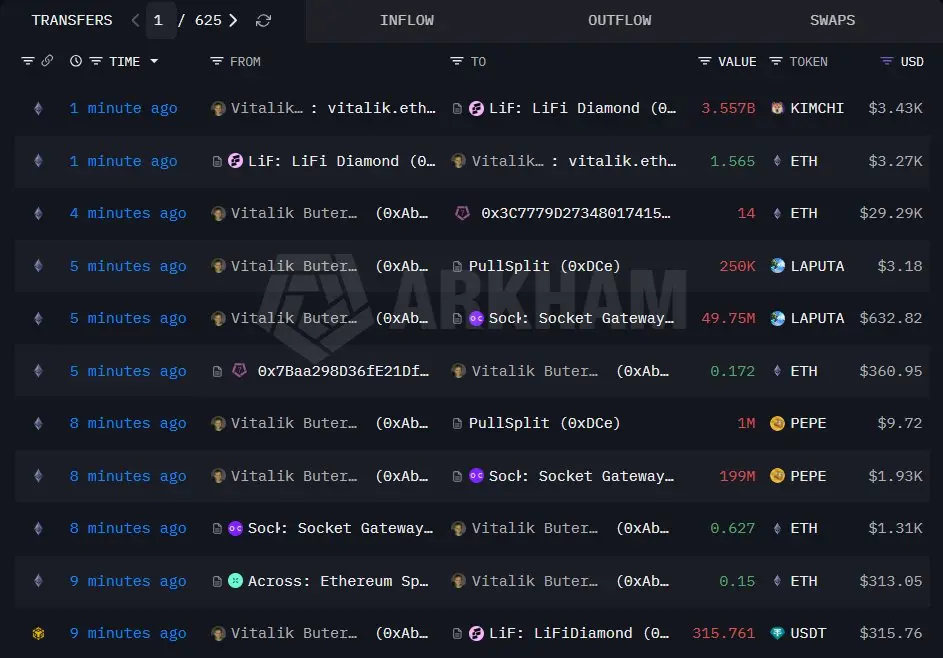 (Source: Arkham)
In Vitalik’s long-term on-chain activity records, regularly selling Meme coins that others have gifted him is a recurring operational pattern. This time, he again cashed out the Meme coins that were airdropped to his address, netting approximately 14.5 ETH.
The logic behind this is often interpreted as follows: Vitalik himself does not actively participate in these Meme coin projects. However, due to his massive community influence, project teams often proactively airdrop tokens to his address in hopes of generating market heat through his token-holding identity. By selling promptly, he both avoids providing implicit endorsement to the Meme coin market and converts the assets he happens to receive into a more direct form of exposure to the Ethereum ecosystem.
Buying ZCHF for Nearly $200,000: Why Choose a Swiss Franc Stablecoin
The most closely watched operation in this case is the conversion of nearly $200,000 worth of USDC into ZCHF. Here are the core features of ZCHF:
Currency peg: 1:1 directly pegged to the Swiss franc, rather than pegged to the US dollar
Regulatory framework: overseen by Swiss financial regulators, and Switzerland has a clearly defined crypto-friendly regulatory environment
Reserve transparency: reserves are verified on a regular basis, providing a verifiable support basis for holders
Main use cases: cross-border payments, hedging US-dollar risk, and portfolio diversification
Current market size: market cap is about $12 million, making it a niche stablecoin rather than a mainstream one
In traditional finance, the Swiss franc is often known as a “safe-haven currency.” When global uncertainty rises, it tends to attract capital inflows. The switch from a US-dollar stablecoin to a Swiss franc stablecoin has been interpreted by some market analysts as a hedge against potential risks of US-dollar depreciation. Others believe it’s only a routine experiment in diversifying investment portfolios at the stablecoin layer.
Railgun Private Transfers: Practicing Financial Privacy, Not Avoiding It
Around the same time, Vitalik transferred 70,000 USDC and 44 ETH privately via the Railgun protocol. Railgun is a privacy-layer protocol built on Ethereum that allows users to move assets without exposing transaction details.
In public blockchains, there are visible records of transfers into the Railgun contract, but the subsequent actual destination cannot be tracked due to privacy protection. Vitalik has long publicly supported the development of privacy technology, believing that financial privacy is a basic component of personal freedom. His use of Railgun is highly consistent with his long-standing position.
Frequently Asked Questions
Why does Vitalik repeatedly sell Meme coins rather than hold them long-term?
Vitalik does not actively invest in or endorse these Meme coins. But due to his enormous influence, a large number of Meme coin project teams continuously airdrop tokens to his address, hoping to create market signals of “Vitalik holding.” Through timely selling, he avoids providing implicit endorsement to these projects, and also prevents his holding behavior from being used for pump-and-dump manipulation—an appropriate move to maintain his personal reputation.
What could be Vitalik’s potential motivation for choosing ZCHF?
Analysts propose two main interpretations: first, a defensive US-dollar hedging move. The Swiss franc’s safe-haven characteristics in an uncertain market environment make it an option for hedging against US-dollar depreciation—especially in the current macro backdrop of the US-Iran conflict and policy uncertainty at the central bank. Second, an exploratory position-building attempt for stablecoin diversification, with a relatively limited test size; this does not rule out a technical exploration of a niche stablecoin ecosystem. On-chain data can only confirm the transaction facts; the motivation still needs to be explained by Vitalik himself.
Does a Railgun private transfer violate the blockchain transparency principle?
Using privacy protocols such as Railgun is exercising on-chain financial privacy rights and does not violate the fundamental design principles of blockchains. Blockchain transparency lies in publicly verifiable protocol rules, not in forcing everyone to publicly reveal every transaction detail. Vitalik has long supported privacy technology in public settings, believing financial privacy is an important foundation for healthy Web3 development. His use of Railgun is a practical demonstration of his existing stance.
Disclaimer: The information on this page may come from third parties and does not represent the views or opinions of Gate. The content displayed on this page is for reference only and does not constitute any financial, investment, or legal advice. Gate does not guarantee the accuracy or completeness of the information and shall not be liable for any losses arising from the use of this information. Virtual asset investments carry high risks and are subject to significant price volatility. You may lose all of your invested principal. Please fully understand the relevant risks and make prudent decisions based on your own financial situation and risk tolerance. For details, please refer to
Disclaimer.


