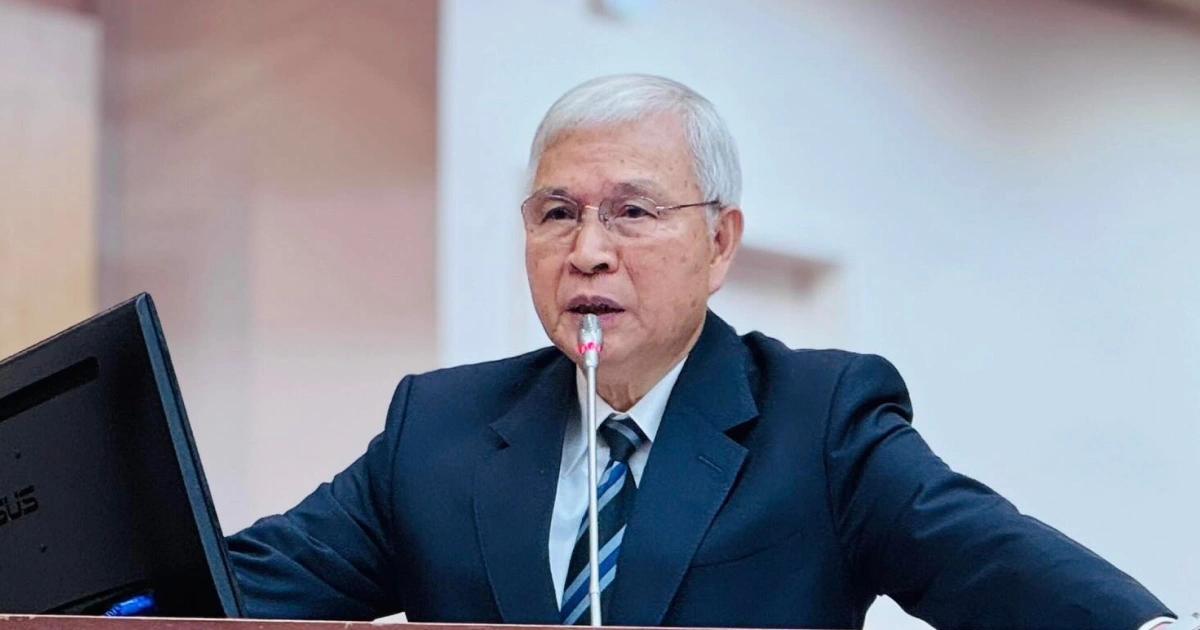
Legislators have proposed including Bitcoin, among other assets, in foreign exchange reserves. Governor Yang Chin-long is cautious about the idea, but said, “Time and space will change.” Although Taiwan holds around $18 million worth of Bitcoin that has been seized, due to volatility risk, it is unlikely to be carried out as a strategic reserve in the near term.
Legislators bring up again the idea of including Bitcoin and stablecoins in Taiwan’s foreign exchange reserves
Legislator Ko Ju- Chun questioned the governor of the Central Bank of the Republic of China, Yang Chin-long, yesterday, again raising the question of whether Bitcoin ($BTC) and stablecoins could become a recommendation for Taiwan to hold as a small portion of its foreign exchange reserves.
He believes that Taiwan is in a special geopolitical environment and may face extreme scenarios such as maritime blockade or full-scale invasion in the future. In these situations, compared with traditional U.S. dollars and gold, Bitcoin has the characteristics of being fully accessible, sovereign-independent, and spendable.
Considering that the central bank may have concerns about Bitcoin’s price volatility and liquidity risks, Ko Ju- Chun further suggested that the government could start with stablecoins that are relatively more price-stable and have higher liquidity, and said they have advantages such as convenient cross-border circulation, fast transfer speed, and the ability to operate instantly in a digital environment.
Ko Ju- Chun argues that the government should take a risk-diversification approach, carefully assess the feasibility of using stablecoins as a small part of a strategic reserve tool, and thereby build innovative thinking to face future risks.

Image source: Ko Ju- Chun Threads Legislator Ko Ju- Chun brings up Bitcoin and stablecoins again for inclusion in Taiwan’s foreign exchange reserves
Yang Chin-long: Current stance unchanged, but time and space will change
In response to Ko Ju- Chun’s proposal, Central Bank Governor Yang Chin-long said during the questioning that the central bank will consider Bitcoin and stablecoins together, but as for the attitude toward using either as a small portion of a foreign exchange reserve strategic buffer, the position has not changed to date.
The central bank’s conclusion in last year’s report was that Bitcoin is currently not suitable to be used as a reserve asset for Taiwan’s central bank. Even though it has potential advantages such as portability in wartime scenarios, concerns remain over extreme price volatility, liquidity risk, cybersecurity and custodial risks, and an immature regulatory framework.
Although Yang Chin-long maintains the existing position, he also added clarification that “time and space will change,” meaning that when circumstances change, the central bank’s decisions must also make the necessary adjustments.
Judging from the context of the questioning content alone, these remarks lean toward cautious language that keeps open the possibility of adjustment. At this stage, the central bank’s willingness to purchase cryptocurrencies as reserves remains quite low.
The central bank’s assessment report establishes stablecoin payment-type standards
On the topic of stablecoins, the central bank last year also issued a report, categorizing stablecoins into three major types based on the source of their reserve assets: “those backed by high-quality assets,” “those backed by crypto assets,” and “algorithmic types without collateral.”
The central bank defines stablecoins as “the digital evolution of a payment-type value storage medium that is close in nature to the existing electronic payment systems,” and believes that the new Taiwan dollar–denominated demand in the crypto market is still small, so stablecoin issuance would have limited impact on the domestic payment system and money supply. If stablecoins denominated in new Taiwan dollars are opened in the future, they would be required to follow the same approach used for electronic payment operators to set aside reserve funds.
- Related report: The central bank explains stablecoins: 1 chart comparing Octopus card, stablecoin—does it directly refute Qu Bo’s stored-value card theory?
Global central bank stances are cautious; Ko Ju- Chun suggests it may be difficult in the short term
The central bank’s report last year also mentioned that globally, as many as 93% of central banks have no intention of holding digital assets. This includes international institutions such as the European Central Bank and the U.S. Federal Reserve, which all take a conservative stance toward holding reserve Bitcoin.
Most opinions hold that Bitcoin lacks intrinsic value and cannot fulfill the role of a central bank reserve asset at this stage.
Taiwan currently has accumulated 210.45 Bitcoins seized through criminal investigations and enforcement, with a total market value of about $18 million. Although this puts Taiwan among the world’s top 10 government holders of Bitcoin, all of these assets come from seizures of financial crimes and illegal cases.
As of now, the Ministry of Justice has not announced whether it will convert or hold the seized Bitcoins, nor has it established a plan to incorporate them into national strategic reserves.
In the absence of concrete precedents internationally, and given that Taiwan’s central bank stance is clearly conservative, legislators’ suggestion to include Bitcoin or stablecoins in official foreign exchange reserves may be unlikely to happen in the near term. And the phrase “time and space will change” is only cautious language that keeps open the possibility of adjustment.
The dream of Taiwan’s strategic reserves of Bitcoin and stablecoins still needs to return to the fundamentals of foreign exchange reserves, the central bank’s core responsibilities, and how well international cases can be adapted—and we will see whether it becomes a “plus factor” in the national financial system or a misunderstood technological narrative.
- Related discussion: Ko Ju- Chun brings up Bitcoin strategic reserves again! The central bank promises to provide an assessment report, but does Taiwan really need reserves?
Disclaimer: The information on this page may come from third parties and does not represent the views or opinions of Gate. The content displayed on this page is for reference only and does not constitute any financial, investment, or legal advice. Gate does not guarantee the accuracy or completeness of the information and shall not be liable for any losses arising from the use of this information. Virtual asset investments carry high risks and are subject to significant price volatility. You may lose all of your invested principal. Please fully understand the relevant risks and make prudent decisions based on your own financial situation and risk tolerance. For details, please refer to
Disclaimer.


