
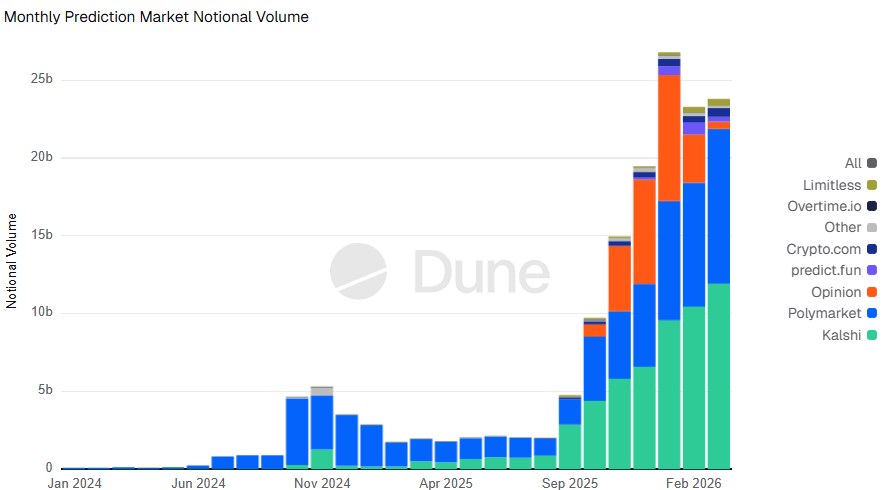
According to on-chain data from Dune, the nominal monthly trading volume in the prediction market for March has reached approximately $23.9 billion, with the number of trades surpassing 191 million, showing an annual growth rate of up to 2,838%. A report released by blockchain intelligence company TRM Labs on Friday pointed out that this round of growth is driven by three main factors: improved access conditions, a clearer regulatory environment, and the mainstream platforms like Google Finance starting to report prediction market odds in real-time.
Geopolitical Themes Replace Crypto: A Fundamental Shift in Trading Structure
 (Source: Dune)
The analysis from TRM Labs reveals a significant evolution in the content structure of prediction markets. In the past, cryptocurrency-related topics were the most active trading themes on the platform; now, geopolitical events, the trajectory of U.S. politics, and macroeconomic decisions have fully taken over the dominant share of trading volume, while cryptocurrency-related contracts have significantly shrunk in their overall activity share.
TRM Labs noted, “Geopolitical events, U.S. politics, and macroeconomic decisions account for the majority of trading volume. Although cryptocurrency-related themes are still prevalent, they now constitute a smaller proportion of overall trading activity.”
As of this Monday, the top five contracts by trading volume on Polymarket revolve around the nominations of the two major parties for the 2028 U.S. presidential election, as well as significant political issues like whether Israeli Prime Minister Benjamin Netanyahu can continue to hold office before the end of 2026.
It is worth noting that while the nominal trading volume in March reached a high, it is still approximately 12% lower than the historical peak in January, indicating a slight drop after the political peak in the U.S. earlier this year.
Mainstreaming Progress: Google Finance Integration Accelerates Industry Penetration
One of the most significant structural changes in the prediction market by 2026 is its deep integration with mainstream media ecosystems. Google Finance has begun displaying real-time prediction market odds in search results and financial pages, and several mainstream media organizations are also citing it as a real-time polling alternative for geopolitical and election results, marking the first time prediction markets have entered the public eye.
TRM Labs stated in the report, “These markets have the potential to evolve from speculative platforms into core infrastructures for real-time information aggregation and risk pricing, complementing traditional forecasting tools and, in some cases, even competing with them.”
From an underlying structure perspective, major prediction market platforms rely on cryptocurrency chains and stablecoins for settlement, making them one of the important use cases for decentralized finance (DeFi) in real-world applications.
Regulatory Pressure and Compliance Challenges: The Biggest Variable for Growth Momentum
In March 2026, while the prediction market industry is expanding rapidly, it faces a new round of intense regulatory shocks:
· Kalshi and Polymarket announced the introduction of trading safeguards on the same day to respond to allegations of insider trading and market manipulation.
· A bipartisan bill in the U.S. proposes to ban trading on event contracts deemed “casino-style gambling.”
· A Nevada court has temporarily prohibited Kalshi from conducting business in the state.
· Contracts related to Iran are under ongoing industry scrutiny due to potential asymmetric trading linked to the timing of airstrikes.
TRM Labs clearly pointed out that the continued growth of prediction markets depends on how effectively the fundamental challenges of market integrity and susceptibility to manipulation are addressed. If the industry cannot establish a clear compliance framework, regulatory resistance may impose substantial constraints on platform expansion in the short term.
Frequently Asked Questions
Why did trading volume in prediction markets experience explosive growth in 2026?
According to TRM Labs and Dune data, three main factors are driving this round of growth: improved access conditions allowing more users to enter the market directly through mainstream platforms; a gradually clearer regulatory environment in the U.S. and Europe; and mainstream platforms like Google Finance starting to report odds in real-time, significantly enhancing the industry’s social visibility and user base.
What is the core difference between prediction markets and traditional polls or analyst forecasts?
The odds in prediction markets are formed in real-time through the buying and selling behaviors of real funds, rather than through surveys or subjective judgments. This theoretically allows them to more accurately reflect the collective expectations of market participants, and in some studies, their historical accuracy in forecasting geopolitical events and election outcomes is considered superior to traditional polling methods.
What are the main regulatory risks facing prediction markets like Polymarket?
The core risks are concentrated in two dimensions: first, the risk of insider trading, where holders of non-public information may profit ahead of contracts; second, compliance issues with gambling laws, as several state and federal lawmakers in the U.S. are considering bringing event contract trading under gambling regulatory frameworks. Maintaining market activity under compliance is currently the most critical challenge facing the industry.
Disclaimer: The information on this page may come from third parties and does not represent the views or opinions of Gate. The content displayed on this page is for reference only and does not constitute any financial, investment, or legal advice. Gate does not guarantee the accuracy or completeness of the information and shall not be liable for any losses arising from the use of this information. Virtual asset investments carry high risks and are subject to significant price volatility. You may lose all of your invested principal. Please fully understand the relevant risks and make prudent decisions based on your own financial situation and risk tolerance. For details, please refer to
Disclaimer.


