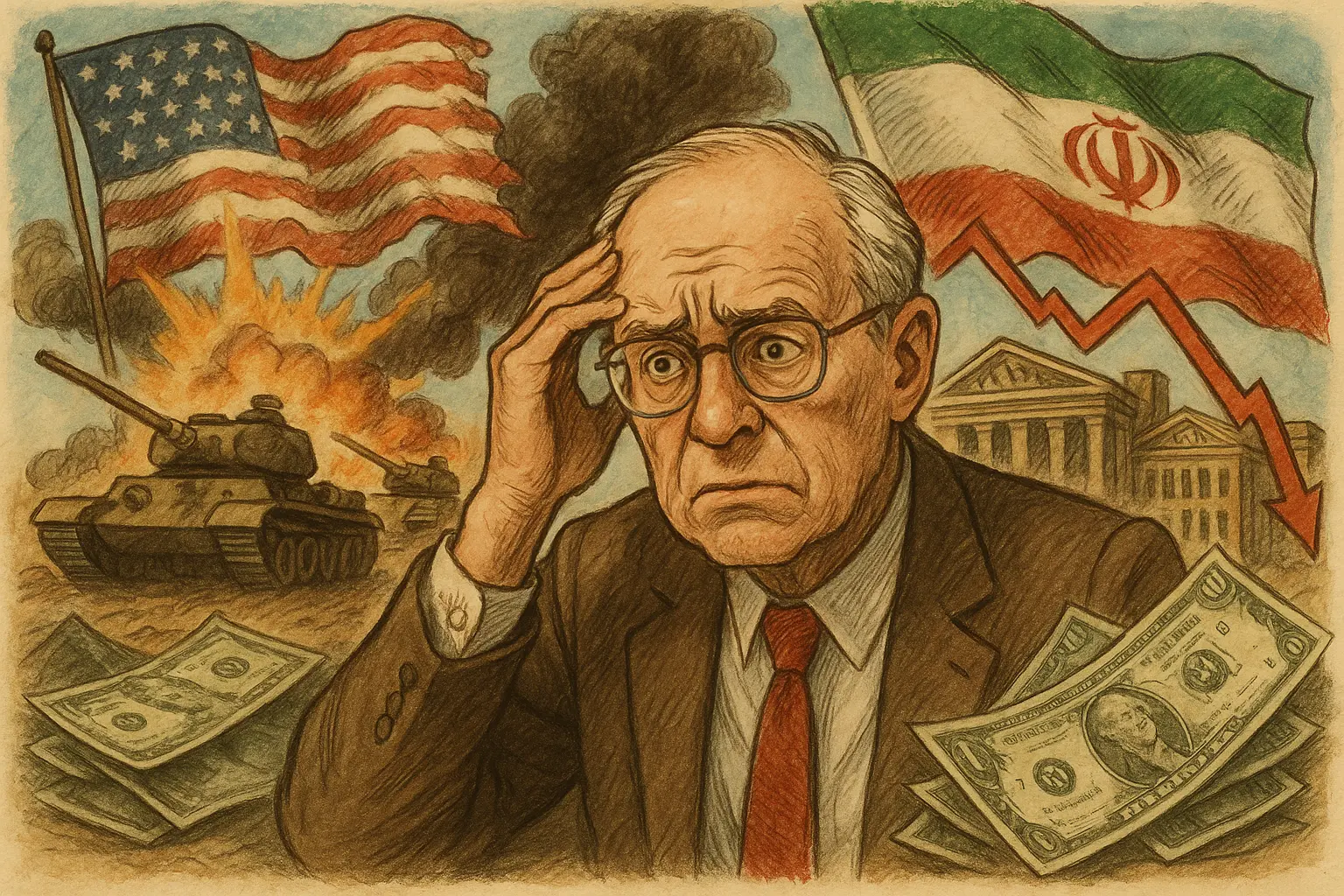
Steve Hanke, a professor of applied economics at Johns Hopkins University, stated in an interview that the actual situation of the United States in the Iran conflict is much more fragile than official claims, with Iran winning a war of attrition. The U.S. government’s own consolidated financial statements show that the federal government holds assets of about $6 trillion, with liabilities on the balance sheet reaching nearly $48 trillion; when including off-balance-sheet liabilities such as Social Security and Medicare, the total rises to about $136 trillion.
The U.S. Losing the War in Iran: Hanke’s Military and Geopolitical Assessment
The core of Hanke’s assessment is that the “decapitation” strategy has been declared a failure. U.S. and Israeli intelligence assessments had predicted that the regime would collapse within days after the assassination of Iran’s supreme leader, but this prediction was completely off. “The strategies and objectives of Israel and the United States have failed,” Hanke stated clearly.
Iran has mobilized over 1 million troops and continues to control the Strait of Hormuz. Hanke pointed out that the throughput in the strait has decreased by about 95%, yet Iran has maintained its oil exports during the war, selling crude oil at higher prices and lower discounts through tankers departing from the strait. Since the war began, the Iranian rial has appreciated by 6%, and although the inflation rate remains high at 67%, it has noticeably dropped from above 80%.
Hanke Reveals the Battlefield Situation and Global Chain Reactions
Strait of Hormuz: Throughput has decreased by about 95%, and Iran is in complete control, with Trump having been “driven into a corner.”
Iranian Oil Exports: Increased during the war, with higher prices and lower discounts.
Russia Benefits the Most: The major filler for blocked goods such as oil, fertilizers, and helium, expected to mitigate sanctions in exchange for market access.
Philippines: Has declared a national energy emergency.
New Zealand: Distributing fuel subsidies to approximately 150,000 households each week.
Taiwan: Sourcing helium for chip manufacturing from Russia due to the Gulf blockade.
U.S. Fiscal Bankruptcy: The Asset-Liability Gap Revealed by Consolidated Financial Statements
Hanke, along with former U.S. Comptroller General Dave Walker, co-authored an article in Fortune magazine, directly citing the federal government’s consolidated financial statements for analysis. As of September 30, 2025, the federal government’s assets are about $6 trillion, with liabilities on the balance sheet nearing $48 trillion; if including off-balance-sheet liabilities such as Social Security and Medicare, the total liabilities will rise to about $136 trillion.
Hanke stated, “Assets slightly exceed $6 trillion, but liabilities are nearly $48 trillion, which means you are already insolvent. And the data is deteriorating sharply.” The bond market has reacted to this, with the yield on 10-year Treasury bonds continuously rising, reflecting investors’ structural concerns about the fiscal deficit. Hanke noted that rising yields increase the opportunity cost of holding gold, but he maintains a price target of $6,000 to $7,000 for gold in this cycle.
His proposed solutions include: establishing a congressional committee to address the existing debt, and drafting a constitutional amendment referencing Switzerland’s 2001 “debt brake” mechanism, setting a growth cap on spending equal to the real GDP growth rate, and requiring fiscal balance over the economic cycle.
Frequently Asked Questions
What data does Hanke base his claim of “U.S. fiscal bankruptcy” on?
Hanke cites the consolidated financial statements published by the U.S. federal government itself. As of September 30, 2025, federal assets are about $6 trillion, with liabilities on the balance sheet nearing $48 trillion; when including off-balance-sheet liabilities like Social Security and Medicare, the total exceeds about $136 trillion, far surpassing asset size, technically fitting the definition of “insolvency.”
What are the real impacts of the blockade of the Strait of Hormuz on global markets?
Hanke pointed out that throughput in the Strait of Hormuz has decreased by about 95%, leading to Asian spot oil prices being higher than futures prices, with WTI crude nearing $100 per barrel. The Philippines has declared an energy emergency, New Zealand has initiated fuel subsidies, and Taiwan’s helium supply chain for chip manufacturing has shifted to Russia, causing systemic shocks to global supply chains.
What is Hanke’s latest outlook on gold, and what does fiscal bankruptcy mean for the crypto market?
Hanke maintains a target of $6,000 to $7,000 for gold in this cycle, but noted that recent gold prices have come under pressure due to rising Treasury bond yields, which is a function of opportunity cost. The long-term structural implications of U.S. fiscal bankruptcy mean that fiat currency credit continues to erode, which is often viewed as a positive backdrop for anti-inflation assets like Bitcoin in the medium to long term.
Disclaimer: The information on this page may come from third parties and does not represent the views or opinions of Gate. The content displayed on this page is for reference only and does not constitute any financial, investment, or legal advice. Gate does not guarantee the accuracy or completeness of the information and shall not be liable for any losses arising from the use of this information. Virtual asset investments carry high risks and are subject to significant price volatility. You may lose all of your invested principal. Please fully understand the relevant risks and make prudent decisions based on your own financial situation and risk tolerance. For details, please refer to
Disclaimer.


