On March 26, Shield AI, a military AI company, announced that it had completed a $2.0 billion funding round. Its valuation jumped from $5.3 billion a year earlier to $12.7 billion, a 140% increase. The lead investors were not Silicon Valley venture capital firms, but global PE giant Advent International and the security and resilience investment arm of JPMorgan Chase—together investing $1.5 billion in equity financing. According to a report by Bloomberg, Blackstone injected an additional $500 million in preferred stock and committed to $250 million in delayed drawdown of loan facilities.
A $2.0 billion funding round in itself is not what matters. What matters is who is writing this check. This is a slice of how the capital structure in defense technology is shifting.
If you put Shield AI and Anduril—another company in the same track—on the same timeline, the trend becomes clear immediately. In October 2023, Shield AI’s Series F valuation was $2.7 billion. Anduril’s Series E valuation at the end of 2022 was about $8.5 billion. By March 2026, Shield AI rose to $12.7 billion, while, according to TechBuzz AI, Anduril is seeking a new round of financing at a $60 billion valuation. In a period of just over two years, both companies completed valuation jumps of more than 4x.
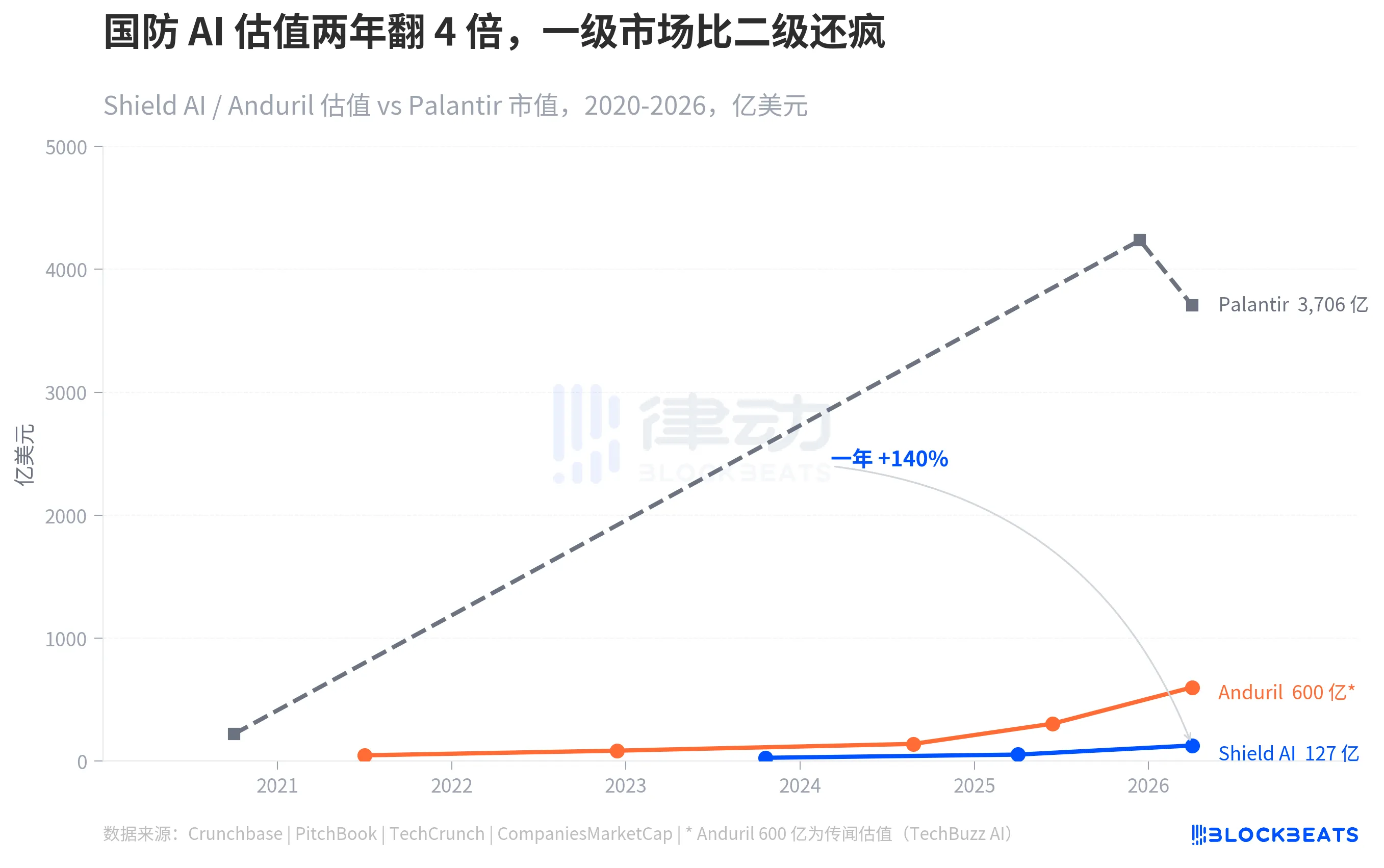
The slope of this curve became noticeably steeper in 2025. Based on estimates by Sacra, Anduril’s 2025 revenue will reach $2.1 billion, up 110% year over year, and its 2026 revenue forecast is $4.3 billion. Shield AI has not disclosed revenue, but according to Tracxn data, its cumulative funding has already exceeded $3.0 billion. Valuation growth is far outpacing revenue growth, indicating that the market’s pricing for defense AI companies has shifted to a “platform expectations” model: not valuing by current revenue, but by the position it can secure in future military procurement systems.
As a point of reference, Palantir—the only publicly listed company in the defense AI space—had a market cap of about $22 billion at its September 2020 IPO. According to its Q4 earnings report, Palantir’s Q4 2025 revenue reached $1.41 billion, up 70% year over year, and its FY2026 full-year revenue guidance is $7.18 billion to $7.20 billion. By the end of 2025, its market cap ballooned to more than $420 billion. The primary and secondary markets are telling the same story—only the valuation curve in the primary market is steeper than the one after Palantir went public.
Driving the valuation surge is not just capital expectations. Shield AI has deployed product lines: the already-in-service MQ-35 V-BAT vertical takeoff and landing reconnaissance unmanned aircraft, and the next-generation autonomous fighter X-BAT, announced in October 2025. According to DroneXL, the X-BAT unit price is about $27 million—less than one quarter of the F-35—its range reaches 2,300 miles, it does not require a runway (it can take off from a trailer), and it plans for mass production in 2029.
In February 2026, Shield AI’s core AI engine, Hivemind, was selected by the U.S. Air Force to provide mission autonomy for Anduril’s Fury unmanned drone (serial number YFQ-44A) in the Collaborative Combat Aircraft (CCA) program, according to The Defense Post. Flight demonstrations are expected to take place within the next few months. In the same round of financing, Shield AI also acquired the flight simulation software company Aechelon Technology. Aechelon’s simulation technology had previously been used to train U.S. military pilots; after the acquisition is completed, Shield AI holds all three links: training data generation, autonomous flight algorithms, and a hardware platform.
But what truly makes the valuation curve steeper is a structural change in the source of funds. Shield AI’s earlier rounds were led by venture capital and strategic investors such as Andreessen Horowitz and L3Harris. In this round, the lead investors switched to PE giant Advent International and JPMorgan Chase, while Blackstone provided preferred stock and debt financing. This is not an isolated case.
According to a report by Bisnow, the U.S. Army has awarded data center construction contracts for two military bases to Carlyle and CyrusOne, a company affiliated with KKR. Each project is worth $2.0 billion, with leases lasting up to 50 years. According to S&P Global data, in just the first two and a half months of 2025, the total deal value for PE/VC in the global aerospace and defense sector already reached $4.27 billion, with 83% flowing into North America. PE giants are no longer only making financial investments in the military sector—they are starting to treat defense infrastructure as a long-term asset class for allocation.
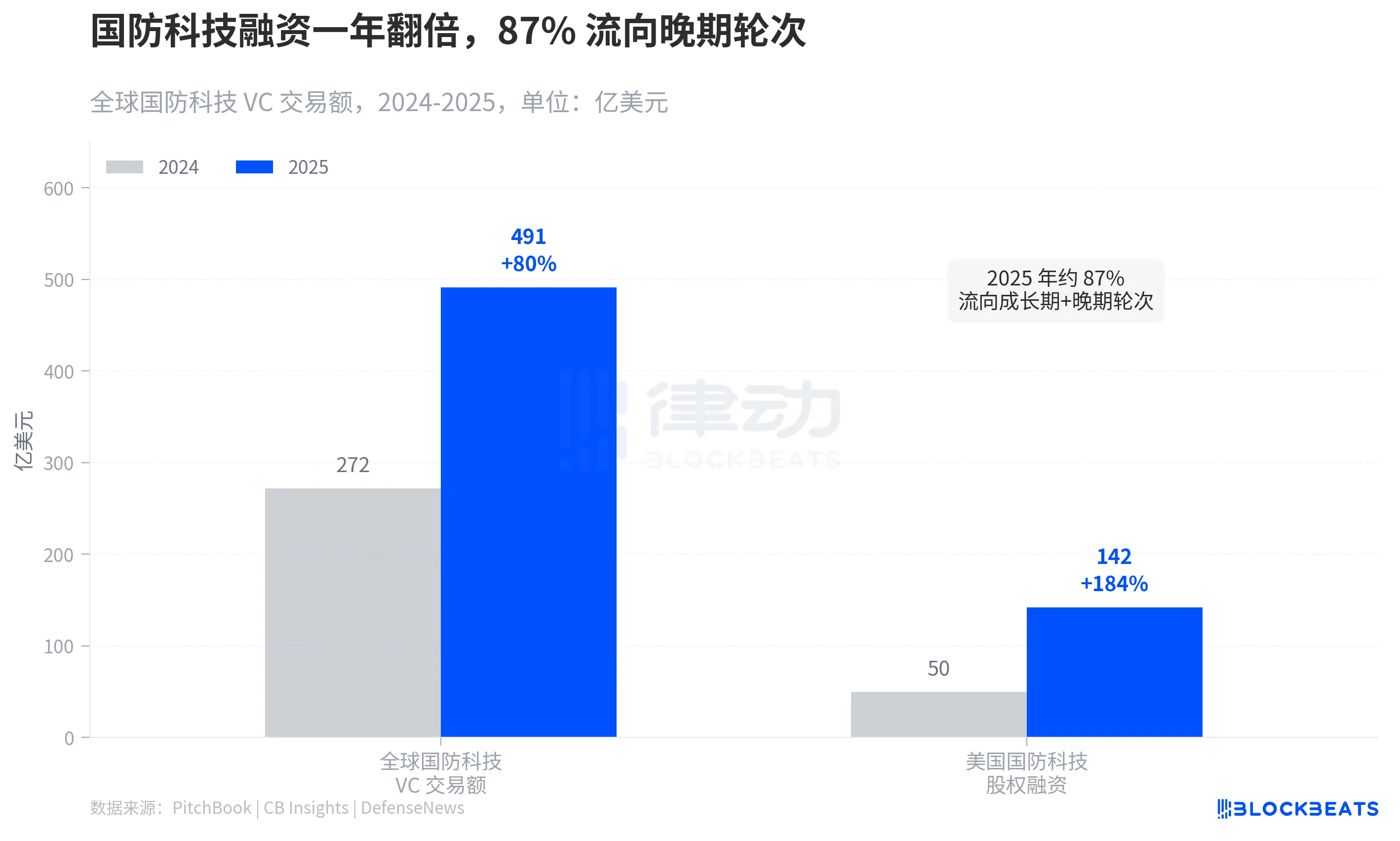
According to PitchBook data, in 2025 global defense tech VC deal value reached $49.1 billion, nearly doubling from $27.2 billion in 2024. DefenseNews reports that U.S. domestic defense tech equity financing surged from $5.0 billion in 2024 to $14.2 billion—an increase of nearly 3x. Of this, about 87% of the capital flowed to growth-stage and late-stage rounds. Funds are no longer going to experimental prototypes, but to companies that are preparing mass production and deliveries. JPMorgan Chase estimates that since 2021, global defense tech has cumulatively absorbed about $130 billion in venture capital.
Behind the influx of these funds is a clear buyer signal.
Per the U.S. Department of Defense FY2026 budget request, the Pentagon for the first time set up a separate budget line for AI and autonomous systems, totaling $13.4 billion. Of this, airborne unmanned drones take $9.4 billion—more than 70%. Seaborne autonomous platforms take $1.7 billion, software and cross-domain integration takes $1.2 billion, and underwater systems take $730 million. This is the AI-specific allocation carved out of the Pentagon’s total FY2026 budget of $1.01 trillion. Previously, the U.S. military had never treated AI and autonomous systems as an independent budget category.
In an AI strategy memorandum released by Defense Secretary Pete Hegseth in January 2026, he clearly stated that the U.S. military will become an “AI-prioritized combat force,” and listed seven FY2026 priority projects, including autonomous drone swarm systems and an AI-driven kill chain execution system.
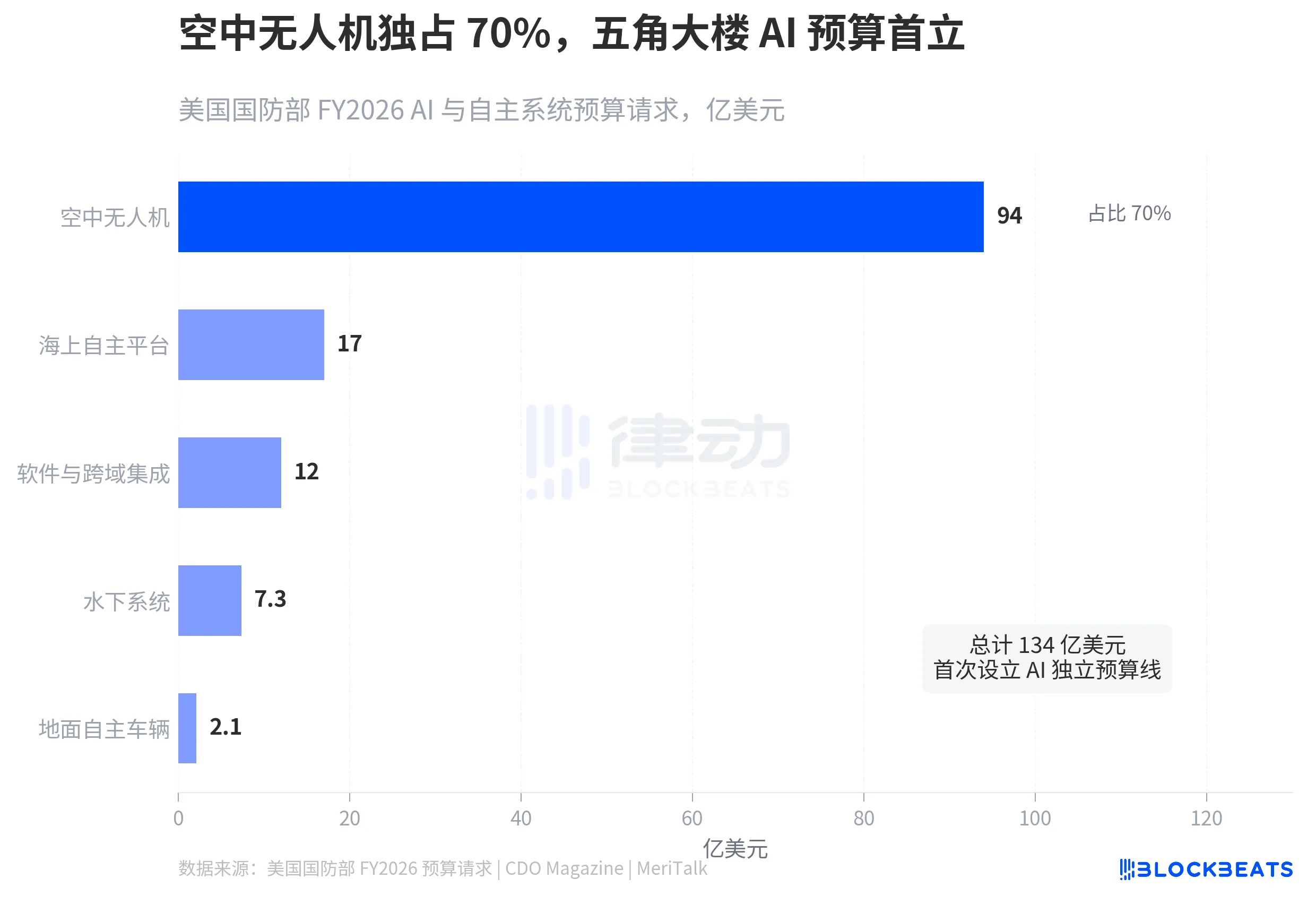
The $9.4 billion air drone budget lines up precisely with the core product lines of Shield AI and Anduril. The Pentagon is not “exploring” military applications of AI—it is purchasing. The Air Force’s CCA program plans to make its first mass-production decisions in FY2026.
When the Pentagon uses a $13.4 billion budget to place orders for AI drones, and when PE uses 50-year leases to operate military bases as infrastructure, the capital logic in defense technology has already switched from a venture-capital-style betting track to infrastructure-level asset allocation.
Click to learn more about the job openings from Luyun BlockBeats
Welcome to join the official Luyun BlockBeats community:
Telegram subscription group: https://t.me/theblockbeats
Telegram discussion group: https://t.me/BlockBeats_App
Twitter official account: https://twitter.com/BlockBeatsAsia
Disclaimer: The information on this page may come from third parties and does not represent the views or opinions of Gate. The content displayed on this page is for reference only and does not constitute any financial, investment, or legal advice. Gate does not guarantee the accuracy or completeness of the information and shall not be liable for any losses arising from the use of this information. Virtual asset investments carry high risks and are subject to significant price volatility. You may lose all of your invested principal. Please fully understand the relevant risks and make prudent decisions based on your own financial situation and risk tolerance. For details, please refer to
Disclaimer.


