
Members of the Ethereum Foundation officially launched the “Post-Quantum Ethereum” resource center this Tuesday, announcing the formation of a dedicated post-quantum security team. The plan is to implement quantum-safe solutions at the protocol layer by 2029, followed by advancing upgrades at the execution layer. The team pointed out that quantum computing currently does not pose an immediate threat to cryptocurrencies, but given the complexity of the upgrade process involving multiple coordinated efforts, early preparation is necessary.
Why Quantum Computing Is a Long-Term Security Issue for Ethereum
Once quantum computers reach sufficient computational power, existing elliptic curve cryptography (ECC) could theoretically be broken, directly threatening private key security and wallet protection mechanisms. Galaxy Digital analyst Will Owens noted that the primary risk is concentrated on wallets with exposed public keys; meanwhile, Charles Edwards of Capriole Investments believes that, in the long run, all crypto assets face quantum threats.
The post-quantum team emphasizes that the real challenge of the upgrade is not algorithm selection but the complexity of implementation itself: “Migrating a decentralized global protocol requires years of coordination, engineering design, and formal verification. This work must begin before the threat becomes imminent.” Ethereum currently safeguards billions of dollars in assets, and any delay in upgrades could create a significant security exposure window once quantum technology matures.
SNARK Architecture and Three-Phase Upgrade Roadmap
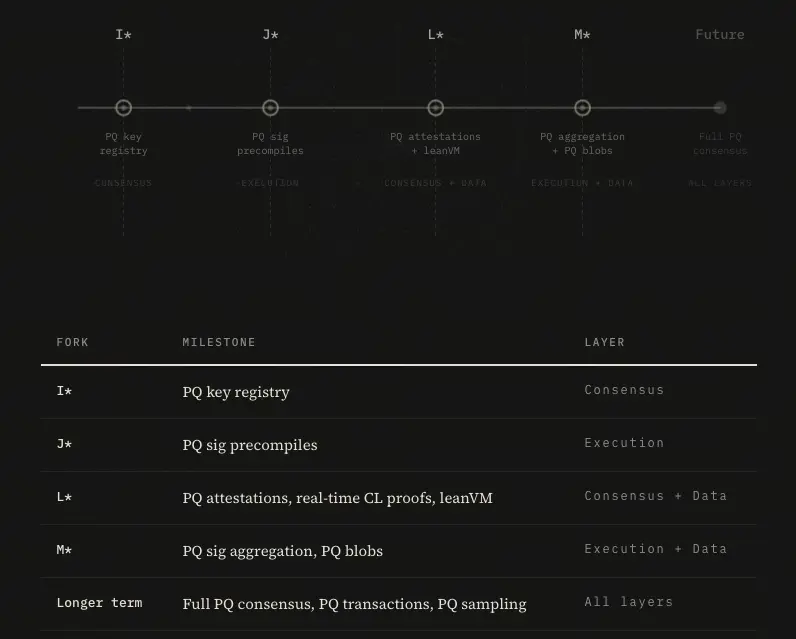
(Source: Ethereum Post-Quantum Security Team)
The post-quantum team plans to integrate SNARK (Succinct Non-Interactive Argument of Knowledge) technology as the core approach for quantum-safe signatures, addressing issues where some quantum-secure signature schemes require large computational resources, leading to increased bandwidth and storage demands that impact network performance. The upgrade will cover three core technical layers of Ethereum:
Consensus Layer: Post-quantum modifications to validator signatures and block confirmation mechanisms
Execution Layer: Quantum-safe upgrades to smart contract execution environments and transaction signatures, to be implemented after protocol layer deployment
Data Layer: Reinforcement measures related to data availability and storage security
In terms of asset protection priority, standard Ethereum wallets are the primary target due to their concentration of the largest value holdings, followed by high-value operational wallets associated with cryptocurrency exchanges, cross-chain bridges, and custody solutions.
Major Challenge: How to Complete Upgrades Without Network Disruption
The post-quantum team states that algorithm selection is just the starting point. More complex issues include securely upgrading hundreds of millions of existing accounts, ensuring the migration process does not introduce new vulnerabilities, avoiding creating new attack surfaces, maintaining current performance levels, and coordinating ecosystem-wide adoption. This series of engineering and coordination challenges forms the core rationale for “initiating now and completing the first phase by 2029.”
Frequently Asked Questions
Q: How significant is the current threat of quantum computers to Ethereum?
The post-quantum Ethereum team clearly states that there is no imminent quantum threat at present. Current quantum computers lack the computational power to break the cryptographic mechanisms used by Ethereum. However, due to the long-term complexity of the upgrade process, early deployment is considered a necessary preventative measure.
Q: Why does the post-quantum upgrade take several years to complete?
Ethereum is a decentralized global protocol. Security upgrades require cross-layer coordination across consensus, execution, and data layers, involving the migration of hundreds of millions of accounts and the adoption of changes across the global ecosystem. Each step requires rigorous formal verification to ensure the upgrade process itself does not introduce new security vulnerabilities.
Q: How does SNARK address the performance issues of quantum-safe signatures?
Some quantum-safe signature schemes are computationally more complex than current mechanisms, potentially significantly increasing network bandwidth and storage requirements. SNARKs use zero-knowledge proofs to compress computational overhead, enabling quantum-safe protection while minimizing performance impact.
Disclaimer: The information on this page may come from third parties and does not represent the views or opinions of Gate. The content displayed on this page is for reference only and does not constitute any financial, investment, or legal advice. Gate does not guarantee the accuracy or completeness of the information and shall not be liable for any losses arising from the use of this information. Virtual asset investments carry high risks and are subject to significant price volatility. You may lose all of your invested principal. Please fully understand the relevant risks and make prudent decisions based on your own financial situation and risk tolerance. For details, please refer to
Disclaimer.
Related Articles
SharpLink Earns 470 ETH in Staking Rewards Last Week
Gate News message, April 21 — SharpLink, an Ethereum treasury company, earned 470 ETH in staking rewards last week, bringing its cumulative staking rewards to 17,850 ETH.
GateNews29m ago
Ethereum Open Interest Falls $2B as Derivative Trading Stalls
Gate News message, April 21 — Ethereum's derivatives market saw a significant deleveraging event over the past week, with traders closing over $2 billion in futures positions. ETH open interest fell to $12.4 billion, according to Coinglass, marking the second major capitulation event in 30 days. ETH
GateNews59m ago
Ethereum Drops Below $2,300, Down 0.64% Intraday
Gate News message, April 21 — Ethereum (ETH) fell below $2,300 intraday, declining 0.64% over the course of the day.
GateNews2h ago
Eightco Holdings Discloses $336M in Total Assets, Including 283.5M WLD and 11,068 ETH
Gate News message, April 21 — Eightco Holdings, a Nasdaq-listed company, disclosed an updated portfolio with total assets valued at approximately $336 million, according to PRNewswire. The holdings include 283,452,700 WLD tokens, 11,068 ETH, a $90 million
GateNews2h ago
Startale Expands to Abu Dhabi to Scale Regulated Blockchain Infrastructure
Startale Group, the global crypto infrastructure company behind Japan’s largest public Astar Network chain, is taking one of the world’s fastest-growing state-backed crypto ecosystems in
Abu Dhabi
The company was selected as one of 27 firms from more than 2,400 global applicants for the Hub71
DailyCoin3h ago
Altcoins Surge Back Above $1.3T as Markets Rally After Greenland Crisis Resolution
On January 22, altcoins rebounded nearly 10% to $1.39 trillion due to eased global tensions, with Ethereum leading gains. Despite some volatility, the combined market cap stabilized at $1.32 trillion as other altcoins also showed modest recovery.
Coinpedia3h ago


