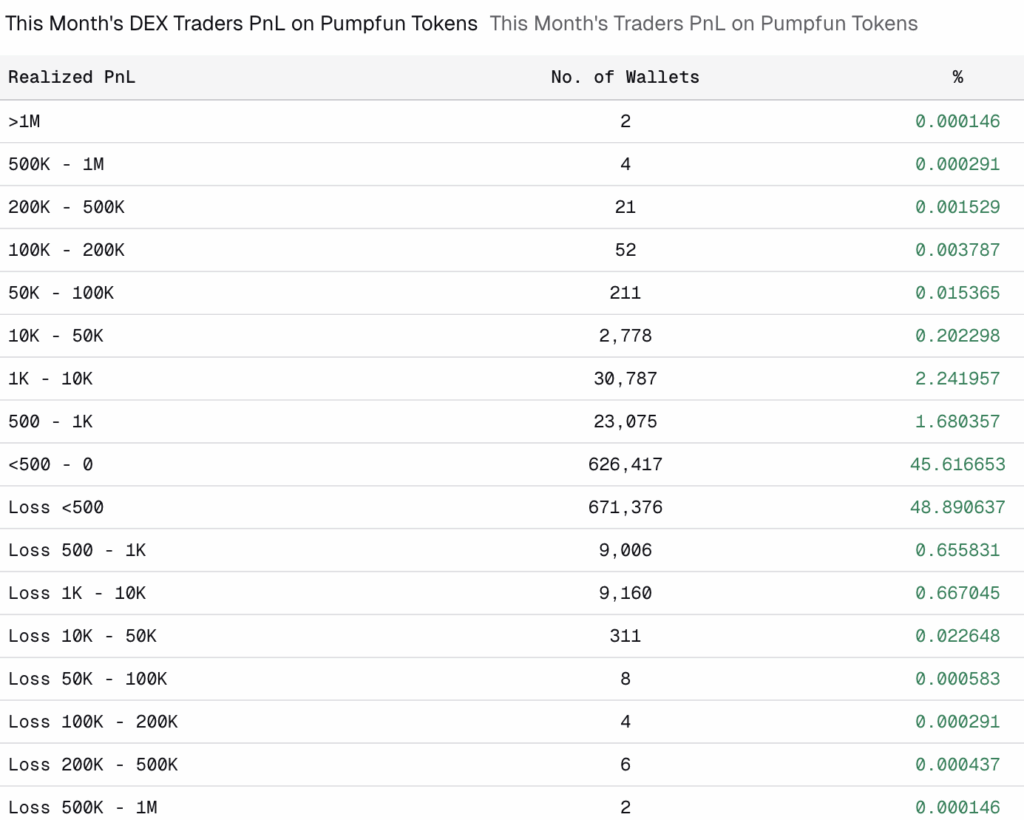
According to on-chain data from Dune analyst @oladee, over the past month, 50.6% of crypto wallets that traded tokens on the decentralized market Pump.fun recorded losses. Meanwhile, data from on-chain analytics firm Dethective shows that the top 250 Pump.fun token deployers have collectively extracted $79 million from buyers over the past six months.
Dune Data Interpretation: Highly Asymmetric Profit Distribution Structure
 (Source: Dune)
@oladee’s data reveals an extremely concentrated profit distribution in the Pump.fun token market. Behind the overall pessimistic performance, there are extreme cases: in the past month, two wallets profited over $1 million each from trading Pump.fun tokens, while another two wallets lost between $500,000 and $1 million.
Additionally, an important premise for data interpretation is that the statistics are based on wallet counts, not individual traders. A single trader can create multiple wallets as needed, so the actual number of affected individuals may differ from the total number of wallets shown.
Asymmetric Mechanism of the Top Deployers Extracting $79 Million
Dethective’s analysis further exposes structural issues within the Pump.fun ecosystem.
Key Data of the Top 250 Pump.fun Deployers
- Token issuance scale: The top 250 wallets have issued approximately 194,000 different tokens over the past six months.
- Total withdrawals: They have collectively extracted $79 million from buyers participating in token trading.
- Rare high-market-cap tokens: Only about 10 tokens among the 250 wallets have a market cap exceeding $5 million, indicating that most issued tokens lack lasting market value.
- Data note: Dethective explicitly states that these 250 wallets do not necessarily represent 250 different individuals; they should be viewed as a collection of wallet addresses.
This structure clearly demonstrates a “winner-takes-all” logic: a small number of top deployers systematically extract value from a large group of retail participants through mass token issuance and rapid circulation, without needing to develop projects with long-term viability.
$PUMP Token Falls 80%, No Update 258 Days After Airdrop Promise
Pump.fun platform itself is also under pressure. Its token, $PUMP, has fallen approximately 80% from its all-time high of $0.008819 set in September 2025. The platform publicly announced an airdrop “imminent” 258 days ago but has not provided any progress updates since, leading to growing dissatisfaction within the community.
Recent strategic adjustments have failed to quell criticism. Pump.fun announced an automated buyback system via third-party AI agents, shifting focus to AI trading, but user reactions on X (Twitter) have been largely negative—many users explicitly demand the platform fulfill its long-standing airdrop promise rather than push new features. The broader market environment adds additional pressure: the crypto bear market persists, Kraken has delayed its IPO plans, OpenSea postponed the $SEA token issuance, and overall market confidence has yet to recover significantly.
Disclaimer: The information on this page may come from third parties and does not represent the views or opinions of Gate. The content displayed on this page is for reference only and does not constitute any financial, investment, or legal advice. Gate does not guarantee the accuracy or completeness of the information and shall not be liable for any losses arising from the use of this information. Virtual asset investments carry high risks and are subject to significant price volatility. You may lose all of your invested principal. Please fully understand the relevant risks and make prudent decisions based on your own financial situation and risk tolerance. For details, please refer to
Disclaimer.


