What is the long-awaited killer app in the cryptocurrency industry? Aleo believes it’s not buying coffee with Bitcoin, not DeFi yields, and not NFTs, but rather the integration of crypto with AI agent payments.
AI Agents Drive Demand for Crypto Payments, Privacy Protection Becomes Key
Privacy-focused blockchain project Aleo recently stated that AI agents are now capable of performing complex tasks. With open-source project OpenClaw demonstrating that agents can independently handle scheduling and shopping tasks, the trend of agents entering economic activities is inevitable.
To enable these digital entities to have economic productivity, the payment mechanism becomes a core element. Traditional financial systems cannot issue corporate credit cards to non-human entities, and high transaction fees make micro-payments difficult. Cryptocurrency, with its 24/7 operation and low transaction costs, becomes an ideal backbone for agent economies.
So, what is the long-awaited killer app in the crypto industry? Aleo believes it’s not using Bitcoin to buy coffee, not DeFi yields, and not NFTs, but rather the integration of crypto with AI agent payments.

Image source: Aleo
Despite the huge demand for payments, privacy concerns are the biggest worry. Currently, mainstream public blockchains lack native privacy protections, and all transaction records are transparent and public.
Research indicates that large language models (LLMs) have powerful de-anonymization capabilities, able to link anonymous on-chain transactions to real identities with high accuracy. If the consumption patterns and collaborators of AI agents are exposed, it could lead to leaks of corporate trade secrets.
Therefore, Aleo emphasizes the need for blockchain infrastructure with cryptographic privacy protections, using zero-knowledge proof technology to hide transaction amounts and addresses, ensuring the safe development of agent economies.
Tech Giants and Exchanges Race to Build AI Payment Protocols
Seeing the payment potential of AI agents, cloud infrastructure giants and crypto exchanges have already begun laying out related technologies.
Coinbase launched the x402 protocol last year, reapplying the early web standard HTTP 402 to the blockchain space, enabling AI agents to automatically pay for app access or digital content fees via Ethereum and stablecoins without human intervention.
To promote the adoption of the x402 protocol, cloud service provider Cloudflare and Coinbase established the x402 Foundation to jointly develop the underlying standards for machine-to-machine payments.
- Introduction to x402 Protocol: What is x402? The future of payments revolution you should know behind the x402 meme coin hype
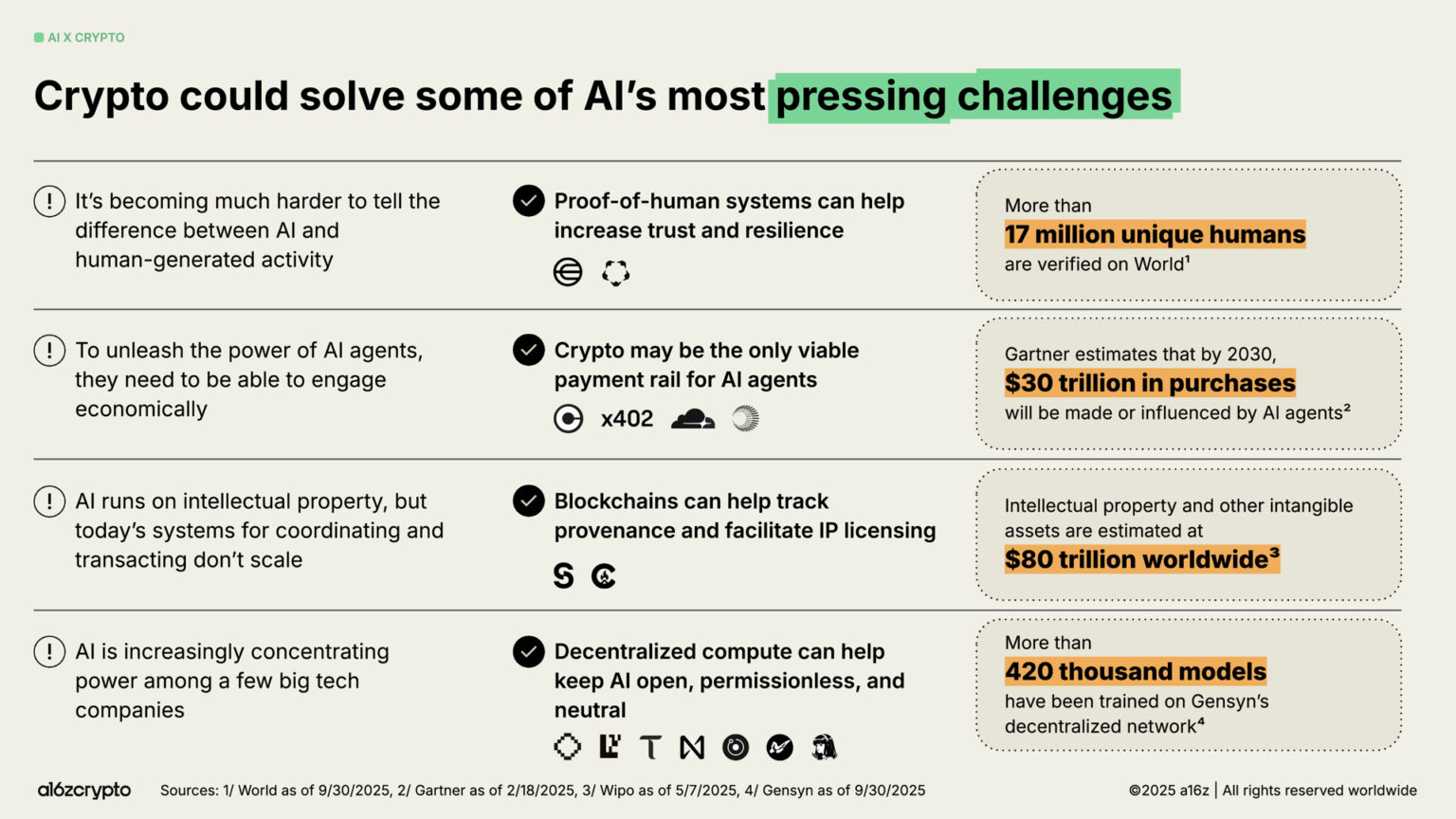
Image source: a16z crypto
a16z crypto predicts that by 2030, the scale of autonomous transactions driven by AI could reach $30 trillion.
Stablecoins as the Foundation for AI Agent Payments
Cloudflare also announced last year the launch of the USD stablecoin NET Dollar, focusing on micro-payments for AI agents. CEO Matthew Prince stated that future online business models will be based on pay-per-use and fragmented rewards.
Meanwhile, Coinbase CEO Brian Armstrong said that the x402 protocol is a significant leap forward, empowering AI agents with the ability to autonomously transfer value, breaking free from the traditional information-only framework. This may mark the true beginning of the integration between crypto and AI.
Additionally, Visa partnered with Cloudflare to launch the Trusted Agent Protocol, establishing a secure framework for AI commerce, while Google introduced the AP2 protocol. Major players are competing to set AI commerce standards.
- Related News: Visa Trusted Agent Protocol: Using crypto signatures to ensure safe AI agents
Public Blockchains Are Not Idle: Cardano Adopts Privacy Stablecoins
To prepare for the future era of AI agent payments, major blockchain projects are accelerating ecosystem upgrades to meet privacy and compliance needs.
Cardano founder Charles Hoskinson recently announced at the CoinDesk Consensus Summit that his development team, Input Output Global, is working on the privacy sidechain project Midnight, scheduled to launch by the end of March.
Midnight primarily uses zero-knowledge proof technology to provide selective disclosure features, allowing users to maintain privacy in daily transactions while still being able to provide data to authorized parties or regulators when necessary, satisfying legal requirements.
To further improve the payment environment, Hoskinson also announced a partnership with cross-chain protocol LayerZero to bring Aleo’s product USDCx to the Cardano blockchain. USDCx is a privacy-protected stablecoin, and this cross-chain integration significantly expands the application scope of privacy stablecoins.
From protocol layer to public chain, the tech and crypto industries are actively building infrastructure that combines privacy protection with efficient payments,迎接人工智慧代理人帶來的龐大經濟變革。
Further Reading:
Stock prices soar 30%! Circle’s revenue hits $770 million, up 77% year-over-year; AI agent payments become the future engine
Disclaimer: The information on this page may come from third parties and does not represent the views or opinions of Gate. The content displayed on this page is for reference only and does not constitute any financial, investment, or legal advice. Gate does not guarantee the accuracy or completeness of the information and shall not be liable for any losses arising from the use of this information. Virtual asset investments carry high risks and are subject to significant price volatility. You may lose all of your invested principal. Please fully understand the relevant risks and make prudent decisions based on your own financial situation and risk tolerance. For details, please refer to
Disclaimer.


