
A team of analysts led by Nikolaos Panigirtzoglou, Managing Director at JPMorgan Chase, reported on Wednesday that the trading volume of Hyperliquid’s WTI crude oil perpetual futures contract (CL-USDC) experienced a sharp increase, with daily trading volume reaching approximately $1.7 billion in mid-March. Open interest rose to about $300 million, making it the third-largest product by trading volume on Hyperliquid.
Geopolitical Conflicts as Triggers: Why Hyperliquid Oil Contracts See a Sudden Surge in Trading Volume
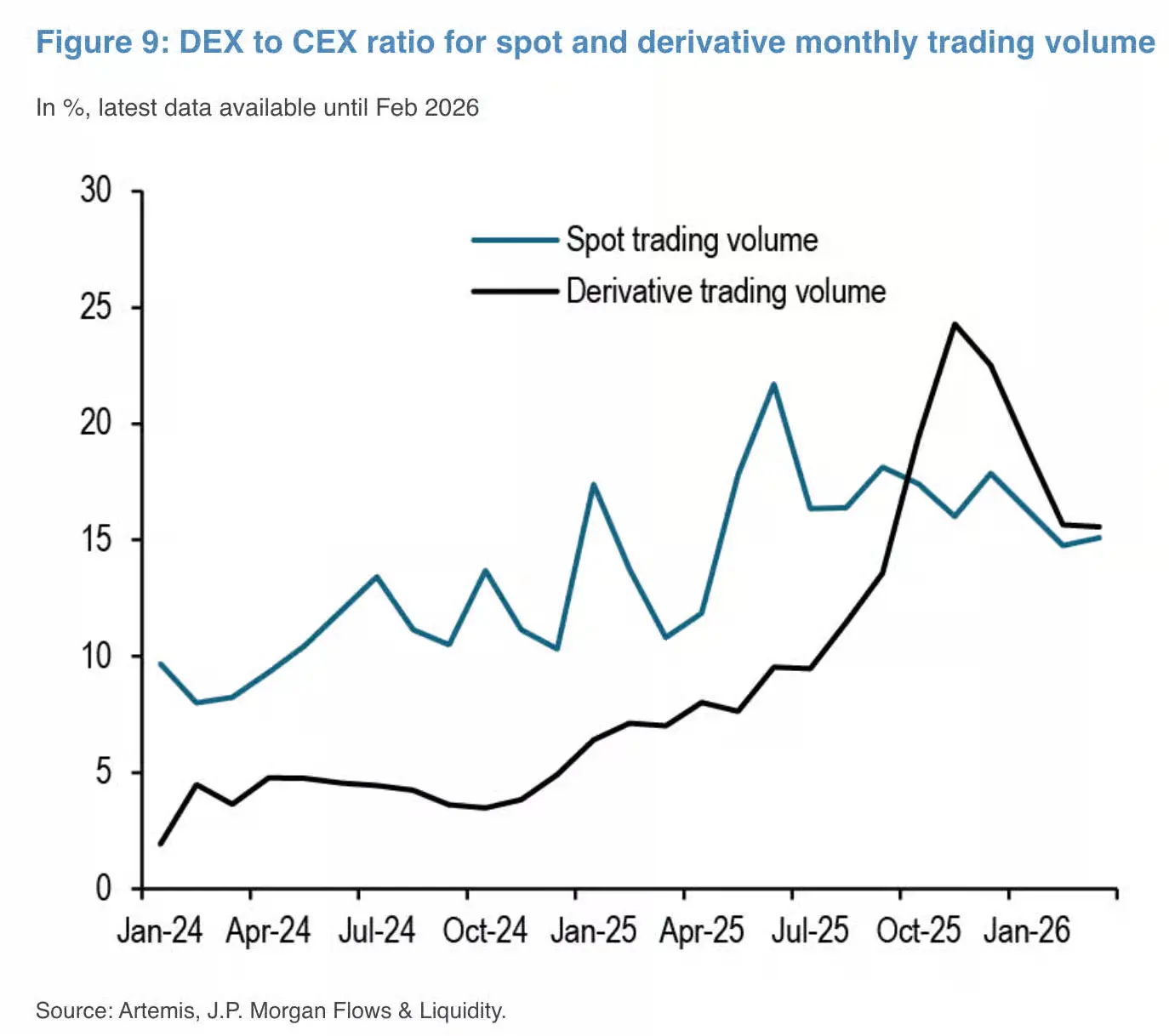
(Source: JPMorgan Chase)
Traditional commodity exchanges are closed during weekends and outside trading hours, which prevents them from reflecting the impact of sudden geopolitical events on oil prices in real time. When the Iran crisis escalated over the weekend, traders were unable to hedge oil risks through conventional channels like CME and turned to Hyperliquid’s 24/7 perpetual futures contracts.
The CL-USDC contract uses USDC stablecoin as collateral, offering up to 20x leverage. Compared to traditional futures margin requirements, it has lower barriers, providing traders seeking oil exposure with immediate entry options. JPMorgan analysts note that the demand for asset exposure during traditional market closures is a key driver behind the continuous growth in Hyperliquid’s trading volume.
Hyperliquid’s Technical Advantages: Three Key Features Attracting Professional Traders
JPMorgan’s report highlights Hyperliquid’s technical differentiation from most DEXs:
- On-Chain Limit Order Book: Provides precise pricing, narrower bid-ask spreads, and order types familiar to traditional traders, unlike the AMM models used by many DEXs.
- Sub-Second Final Trade Confirmation: Execution speeds are close to those of centralized exchanges (CEX), meeting the needs of algorithmic and high-frequency trading strategies.
- Portfolio Margin Mechanism: Allows unified risk management across multiple positions, significantly improving capital efficiency—typically a feature only available on advanced CEX platforms.
Analysts believe these technical features position DEXs as “professional trading venues” connecting traditional markets with crypto markets, which is a core advantage enabling Hyperliquid to continue capturing derivatives market share from CEXs.
Traditional Exchanges’ Response: The Accelerating Wave of 24/7 Trading Sweeps Mainstream Financial Markets
JPMorgan analysts state that the trend of DEXs gaining market share in crypto derivatives continues and may further expand into other asset classes beyond commodities. In response, traditional exchanges are also deploying around-the-clock trading capabilities: CME Group plans to launch 24/7 crypto futures and options on May 29; Nasdaq is advancing a 23-hour trading day for stocks, expected to be implemented in late 2026, and has received SEC approval to trade some tokenized securities; Cboe Global Markets has proposed near five-day, 24-hour stock trading services.
However, JPMorgan analysts point out that most traditional exchanges mainly focus on standardized derivatives and have not yet offered the high-leverage perpetual futures structures common on DEXs like Hyperliquid. There remains a significant gap in product flexibility and structure between the two.
Frequently Asked Questions
Q: What type of exchange is Hyperliquid?
Hyperliquid is a decentralized exchange built on its own Layer 1 blockchain, centered around an on-chain limit order book architecture, supporting perpetual futures trading. The platform offers various contracts, including cryptocurrencies and commodities, with sub-second trade confirmation and a portfolio margin mechanism.
Q: Why do non-crypto investors choose Hyperliquid to trade oil?
Traditional commodity exchanges are closed during weekends and outside trading hours, making it impossible to hedge sudden risks in real time. Hyperliquid provides 24/7 perpetual futures contracts, allowing traders to gain exposure to oil and other commodities at any time, serving as an essential supplement during traditional market closures.
Q: Can traditional exchanges replace Hyperliquid’s 24/7 functionality?
Currently, most traditional exchanges mainly offer standardized contracts and have not yet provided the high-leverage perpetual futures structures typical of DEXs like Hyperliquid. While CME Group and Nasdaq are working to extend trading hours, their product structures and flexibility still differ significantly. JPMorgan believes DEXs still have considerable growth potential.
Disclaimer: The information on this page may come from third parties and does not represent the views or opinions of Gate. The content displayed on this page is for reference only and does not constitute any financial, investment, or legal advice. Gate does not guarantee the accuracy or completeness of the information and shall not be liable for any losses arising from the use of this information. Virtual asset investments carry high risks and are subject to significant price volatility. You may lose all of your invested principal. Please fully understand the relevant risks and make prudent decisions based on your own financial situation and risk tolerance. For details, please refer to
Disclaimer.
Related Articles
ETH 15-minute up 0.65%: Strengthening spot buy orders and short covering in sync push prices higher
2026-04-13 14:30 to 2026-04-13 14:45 (UTC), ETH price return +0.65%. The price range is 2210.74 to 2227.48 USDT, with a range amplitude of 0.76%. During this period, market volatility intensified, attention increased rapidly, and investors were highly sensitive to the short-term trading trend performance.
The main driving force behind this unusual move is stronger spot-market buy orders, along with the exchange’s ongoing net outflows of ETH. Over the past 24 hours, net outflows from exchanges reached -5,576.54 ETH, and exchange holdings saw a net decrease over 30 days of 1,050
GateNews1h ago
BTC 15-minute rise of 0.86%: A rebound driven by a convergence of short liquidations and inflows into ETFs
2026-04-13 13:45 to 2026-04-13 14:00 (UTC), the BTC price fluctuated within the 70945.9 to 71699.9 USDT range. Within 15 minutes, it recorded a notable gain of +0.86%, with a swing of 1.06%. Market attention has surged, short-term volatility has clearly intensified, and on-chain large transfers, spot, and derivatives trading volumes have expanded in sync, indicating that the activity level of funds by major players is at one of the highest points of the year.
The main driving force behind this anomaly is that BTC has been probing the 72000–73500 USDT range with a large amount of leverage shorts
GateNews1h ago
XRP perpetual futures open interest drops to 1.5 billion coins, derivatives leverage continues to contract
Gate News message. On April 13, on X, the on-chain analytics platform Glassnode said that after a dramatic deleveraging in early October 2025, the open interest (OI) of XRP perpetual futures contracts fell sharply from 7 billion coins to 2 billion coins, a decline of 71%. Since then, market positions have been further compressed, with OI dropping another ~25% to 1.5 billion coins. The current market has not yet rebuilt speculative positions, indicating that derivatives traders overall are still staying cautious and risk appetite has not clearly recovered.
GateNews2h ago
Bitcoin retreats to $71k, spot ETF net inflows of nearly $1 billion last week
Bitcoin and Ethereum prices were holding steady around April 13, and the overall crypto market weakened. Oil prices rebounded, influenced by the situation in the Middle East. Bitcoin ETF funds worth nearly $1 billion flowed in, but addresses still in unrealized losses remain in the majority, and open interest in futures contracts fell significantly.
GateNews2h ago
Bitcoin’s Bearish Breakdown Signifies Collapse of Futures-Led Rally
Bitcoin is experiencing significant volatility following a futures-driven market rally that has collapsed, leading to major price corrections and a drop in Open Interest. The market is now vulnerable to further downturns due to a lack of spot demand, indicating structural weaknesses.
BlockChainReporter2h ago
Gate Stock Zone launches 5 Pre-IPO perpetual contracts from OpenAI, Anthropic, and others on April 13, offering 1–10x leverage trading
Gate News message, according to a Gate official announcement on April 13, 2026
The Gate Stock Trading Zone will be available for the pre-market trading of five USDT-settled perpetual contract order books—OPENAI, ANTHROPIC, ANDURIL, KALSHI, and POLYMARKET—starting on April 13, 2026 at 20:00 (UTC+8). It supports 1x to 10x leverage for long and short positions.
OpenAI is an artificial intelligence research laboratory that has developed products such as ChatGPT and DALL·E. It is currently in the Pre-IPO stage. Anthropic is a large-model company founded by former core members of OpenAI, focusing on secure and reliable AI. Anduril Industries is an AI and autonomous defense technology company co-founded by Palmer Luckey, the founder of Oculus. Kalshi is a prediction market exchange regulated by the U.S. CFTC. Polymarket is the world’s largest decentralized prediction market.
All contracts calculate prices using a valuation unit of $1 billion. For example, when a company’s valuation is $800 billion, the unit price is $800.
GateAnnouncement4h ago


