


macd meaning
What Is the MACD (Moving Average Convergence Divergence)?
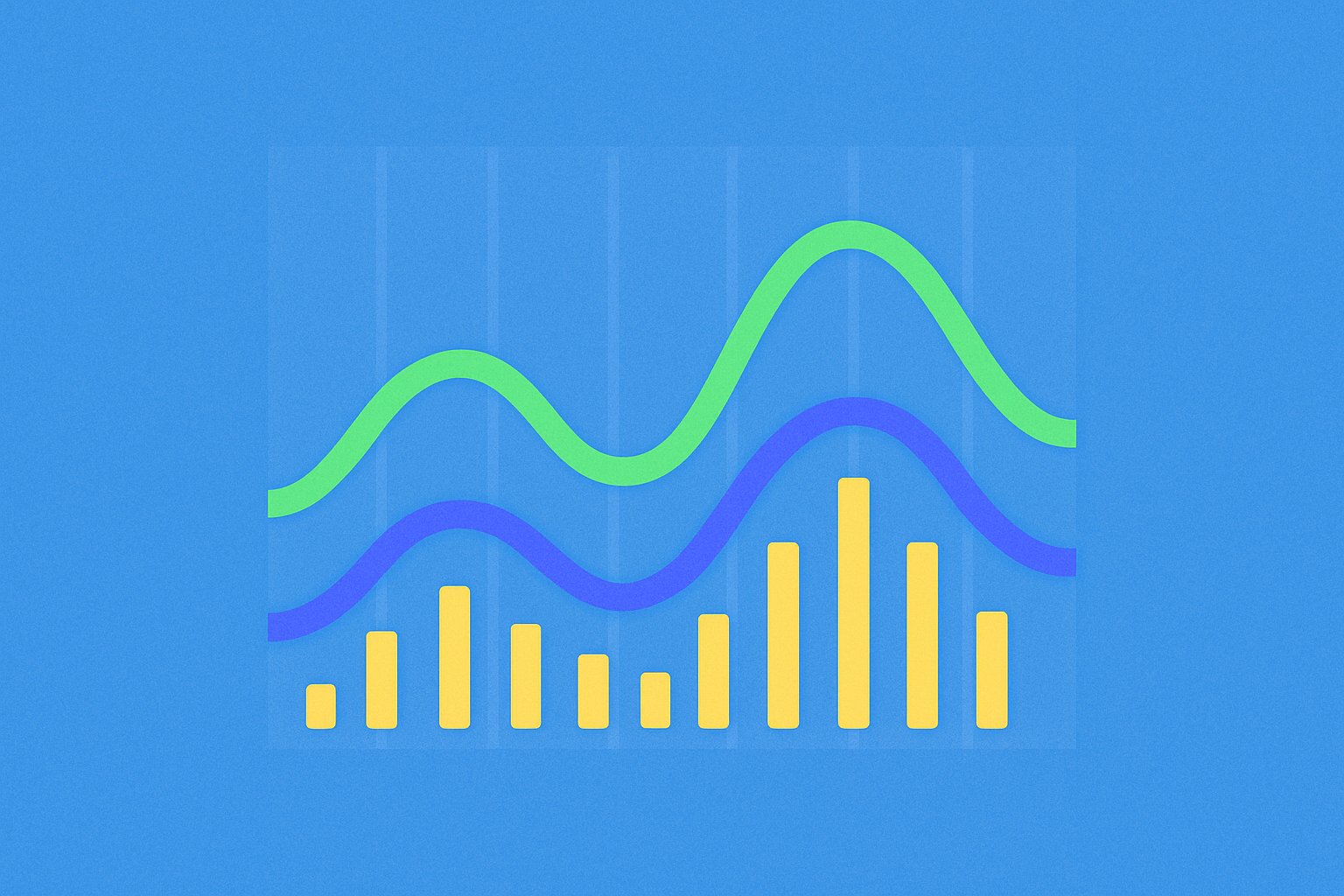
The Moving Average Convergence Divergence (MACD) is a chart indicator designed to measure price “momentum” and the strength of a trend. It compares two moving averages that give greater weight to recent prices, then visualizes their difference as a line and histogram.
Think of it as two cars racing on a track: one reacts more quickly to changes in speed (the fast line), while the other responds more slowly (the slow line). The changing distance between them signals whether the market is accelerating or decelerating.
What Are the Components of MACD?
MACD consists of three main components: the MACD line (DIF), the signal line (DEA), and the histogram. The MACD line shows the difference between the fast and slow moving averages, the signal line is a smoothed average of the MACD line, and the histogram displays the distance between the MACD line and the signal line.
Key definitions:
- Fast and Slow Lines: Two price averages calculated using Exponential Moving Averages (EMAs). The fast line places more emphasis on recent candlestick data, while the slow line is smoother.
- DIF: The result of subtracting the slow line from the fast line, reflecting both the direction and magnitude of current momentum.
- DEA: A further smoothed average of the DIF, making swings more readable.
How Does MACD Work?
MACD is based on Exponential Moving Averages (EMAs). An EMA is a type of average that assigns higher weight to recent prices, allowing it to respond more quickly to market changes.
The process involves two steps:
- Calculate two EMAs—one with a shorter period (fast line) and one with a longer period (slow line).
- Subtract the slow EMA from the fast EMA to get the DIF, then apply another EMA to the DIF to produce the DEA. The histogram visualizes the distance between DIF and DEA; a larger distance indicates stronger momentum.
Common settings use periods of 12 and 26 for the fast and slow EMAs, respectively, and 9 for smoothing the DEA. The “12, 26, 9” configuration is widely adopted based on traditional market experience.
How Is MACD Used in Trading?
MACD is typically used to analyze three aspects: trend direction, momentum strength, and potential reversal points. The core idea is to observe crossovers between DIF and DEA and changes in the histogram’s size.
Typical uses include:
- Crossover Signals: When DIF crosses above DEA, it signals increasing bullish momentum; when it crosses below, bearish momentum. Early crossovers in a trend are generally more reliable.
- Histogram Changes: Growing histogram bars indicate strengthening momentum; shrinking bars suggest weakening momentum. A transition from negative to positive often aligns with price rebounds; positive to negative often correlates with pullbacks.
- Divergence Observation: When prices hit new highs but DIF or the histogram does not, it may indicate waning upward momentum; similarly, new lows without corresponding momentum weakness could signal a potential rebound. Divergence is not a guaranteed turning point but serves as a risk warning.
On Gate’s candlestick charts, you can combine MACD with support/resistance levels and trading volume to avoid relying solely on one indicator. Always set stop-losses and manage your position size when real capital is at risk.
How Is MACD Adapted for Crypto Markets?
MACD remains effective in crypto markets but requires adjustment for 24/7 trading and higher volatility. The default “12, 26, 9” parameters are a good starting point, but different coins and timeframes may require tweaks.
Adaptation tips:
- Timeframe Selection: On 1-hour or 4-hour charts, MACD filters noise effectively; on ultra-short intervals like 1 minute, signals can become frequent and noisy.
- Parameter Tuning: For highly volatile tokens, consider extending periods (e.g., 13, 30, 9) for greater stability; for less volatile coins, shorter periods increase sensitivity.
- Indicator Combinations: Use MACD alongside volume, moving average trends, or price patterns (such as breakouts) to improve decision reliability.
How Does MACD Differ from a Simple Moving Average?
MACD focuses on “momentum differences,” while a moving average simply displays “average price.” MACD is akin to comparing two cars’ speed difference; a moving average is like checking a team’s average pace.
Key differences:
- Response Speed: EMAs react faster to recent data than simple moving averages (SMAs); MACD inherits this “faster” characteristic.
- Information Depth: MACD provides three dimensions—DIF, DEA, and histogram—while moving averages are typically displayed as a single line with less depth.
- Usage Purpose: MACD is used for identifying momentum shifts and turning points, while moving averages are mainly for observing trends and support/resistance zones.
Common Misconceptions and Risks with MACD
MACD is not a predictive tool—it describes current momentum. In ranging markets, crossover signals may frequently fail. It should be used alongside trend analysis and risk management.
Common misconceptions include:
- Relying Heavily on a Single Crossover: Crossovers are common in weak trends or sideways markets; always confirm with price breakouts and volume.
- Ignoring Timeframe Differences: The same indicator can mean different things on different timeframes—shorter periods are more sensitive but noisier; longer periods are steadier but slower.
- Failing to Set Stop-Losses and Manage Positions: No indicator is infallible. Always exercise independent judgment when managing capital by pre-setting stop-losses and scaling into or out of positions.
How Do You Set Up and Use MACD on Gate?
To view and use MACD on Gate, follow these steps:
- Open your desired trading pair and switch to the candlestick chart interface. Use the advanced chart mode for full indicator access.
- Click “Indicators” or “Technical Indicators” and find “MACD/Moving Average Convergence Divergence” in the list. Add it to your chart.
- In the parameter settings panel, enter “12, 26, 9” or any values you wish to test, then apply them.
- Observe crossovers between DIF and DEA, histogram expansion or contraction, and combine these with key price levels (previous highs/lows, trendlines) and volume for analysis.
- Create a trading plan: set entry points, stop-losses, and take-profit targets. Adjust dynamically based on changes in the histogram and crossovers during execution. Always control your position size and risk exposure.
MACD Summary & Learning Path
MACD uses two moving averages with an emphasis on recent data to gauge momentum, presenting clues about trends and turning points through its trio of DIF, DEA, and histogram. It is widely used in both crypto and traditional markets but works best when combined with price structure analysis, trading volume, and trendlines. Start with the default parameters “12, 26, 9” on Gate’s 4-hour or daily charts for practice—record how crossovers and histogram changes correspond to price action. Gradually fine-tune parameters and timeframes to build a strategy that fits your trading style. Always remember—MACD is an auxiliary tool, not a guarantee of returns; risk management should always come first.
FAQ
What Is the Signal Line in MACD and What Does It Do?
The signal line is an auxiliary line in MACD—typically a 9-period exponential moving average of the MACD line itself. When the MACD line crosses above the signal line, it generates a buy signal; when it crosses below, it’s a sell signal. The signal line helps traders identify potential trend reversals with greater accuracy.
What Mistakes Do Beginners Often Make with the MACD Indicator?
Common pitfalls include over-relying on a single indicator for decisions, ignoring trends in the histogram, or frequent trading during sideways markets leading to losses. Some mistakenly believe MACD can precisely predict tops or bottoms—in reality, it’s a lagging indicator that should be combined with price action and other tools. Beginners are advised to first practice on paper trading accounts to experience its behavior in various market conditions.
How Should You Adjust MACD Parameters for Crypto’s 24/7 Trading Environment?
Crypto markets are volatile and never close; traditional stock settings (12, 26, 9) may lag in fast-moving conditions. Many traders adjust parameters based on their timeframe—(5, 13, 5) for short-term trades, (8, 17, 9) for medium-term trades, with default settings for longer timeframes. Use Gate’s technical analysis tools to backtest various combinations and find what best matches your trading style.
When Is the MACD Histogram Most Worth Watching?
The histogram deserves attention at turning points—when it shifts from shrinking to growing or from positive to negative (or vice versa). These often signal momentum reversals. Rapid histogram expansion means momentum is surging; shrinking suggests weakening momentum. Color changes (usually red/green or other schemes) also provide cues—combine these with price levels and support/resistance for best results.
Why Are MACD Signals Sometimes Clear but Often Unreliable?
This usually depends on market phases—in strong trends, MACD performs well; in sideways or choppy markets it can produce false signals. High crypto volatility amplifies this effect—especially during major news events or sharp shifts in sentiment. The solution is to identify whether you are in a trending or ranging market—raise your trading timeframe or reduce frequency during sideways conditions to avoid overusing this indicator where it is less effective.
Related Articles

Exploring 8 Major DEX Aggregators: Engines Driving Efficiency and Liquidity in the Crypto Market

What Is Copy Trading And How To Use It?
