What Is Dogecoin (DOGE)?
Dogecoin (DOGE) is a Proof of Work (PoW) blockchain token that utilizes the Scrypt algorithm. Originally inspired by an internet meme, Dogecoin was designed to offer a lighthearted, accessible way for users to make small payments and tips. Its block time is approximately one minute, and the network typically features low transaction fees, making it ideal for fast, low-value transfers.
Unlike many cryptocurrencies with fixed maximum supplies, Dogecoin has no upper supply limit. Its issuance follows a fixed annual increase, causing the inflation rate to decline gradually over time. The strong community culture and widespread meme status are key drivers of Dogecoin’s brand recognition and network effect.
Current Price, Market Cap, and Circulating Supply of Dogecoin (DOGE)
As of January 22, 2026 (according to the provided market snapshot), Dogecoin’s price is approximately $0.126370. The circulating supply stands at 168,376,333,126.579102 DOGE, with a total supply of 168,420,003,126.579010 DOGE and no maximum supply cap. At this price level, the circulating market capitalization is about $21,283,235,795.11, and the fully diluted market capitalization is also about $21,283,235,795.11.
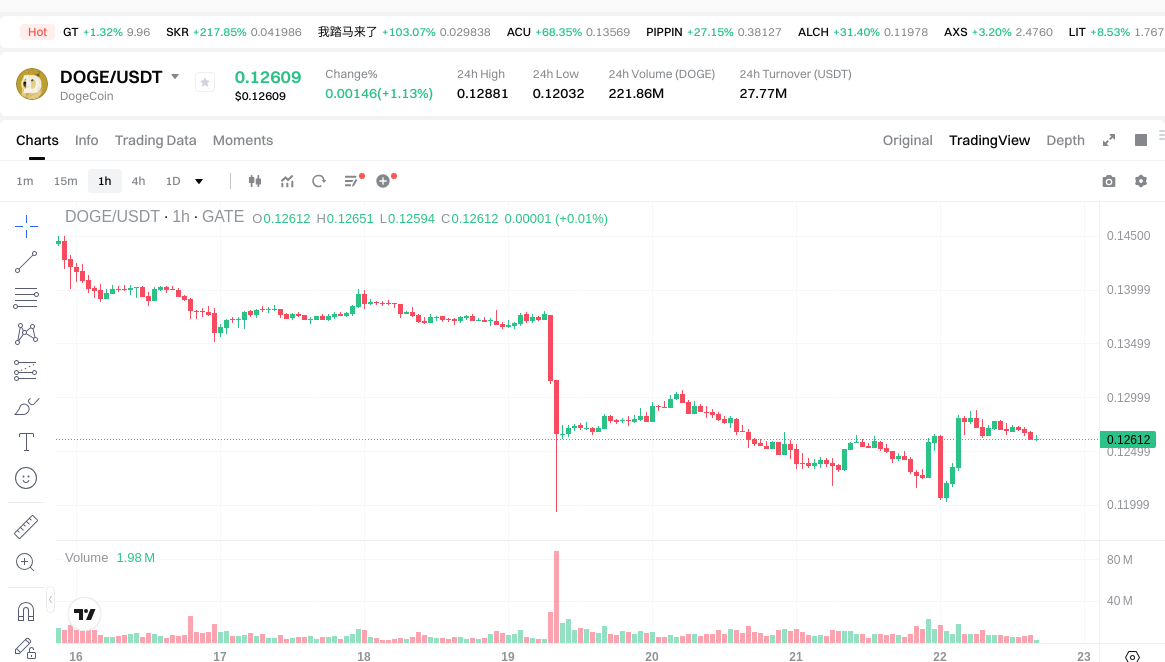
View DOGE/USDT Price
In terms of short-term performance: the 1-hour price change is around -0.36%, 24-hour change about 0.95%, 7-day change approximately -12.54%, and 30-day change around -3.36%. The 24-hour trading volume is about $27,837,957.44, with Dogecoin representing roughly 0.65% of the total crypto market cap.
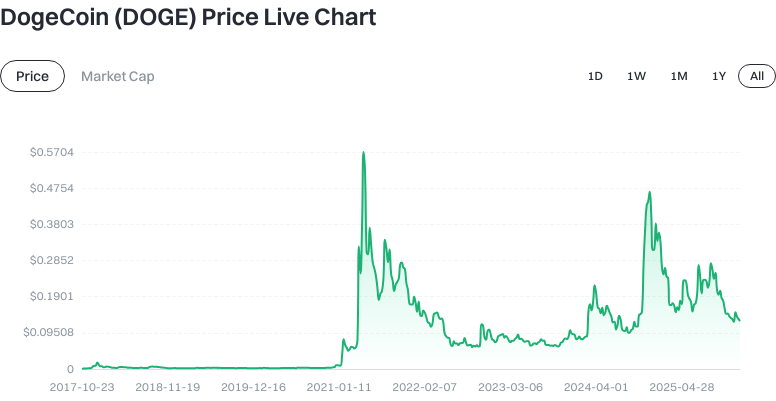
View Latest DOGE Price Data
Terminology: Circulating Market Cap = Price × Circulating Supply; Fully Diluted Market Cap = Price × Total Supply. For assets without a fixed cap, the fully diluted market cap is an estimate based on current supply but should be considered alongside the issuance mechanism for long-term evaluation.
Who Created Dogecoin (DOGE) and When?
Dogecoin was launched in December 2013 by Billy Markus and Jackson Palmer, drawing inspiration from the popular Shiba Inu meme. According to public sources and community records, its mainnet went live in December 2013. The coin quickly gained traction due to its fun culture and friendly community, making it a popular choice for early social tipping and charitable fundraising in the crypto space.
Over time, Dogecoin evolved from its initial meme-based image to a focus on lightweight payments. Community-driven donations, tipping, and charity activities have further reinforced its brand identity and network effect.
How Does Dogecoin (DOGE) Work?
Dogecoin operates on a Proof of Work (PoW) consensus mechanism. In PoW, miners compete to solve cryptographic hash puzzles in order to validate blocks and earn block rewards (What Is PoW?). DOGE uses the Scrypt algorithm, which is optimized for memory-intensive computations—unlike Bitcoin’s SHA-256 algorithm.
Since 2014, Dogecoin has supported merged mining with Litecoin. This means that miners can simultaneously mine Litecoin and validate Dogecoin blocks, improving network security by sharing hash power. Merged mining reduces the risks associated with fluctuating independent hash rates on DOGE.
Dogecoin’s average block time is around one minute. It currently uses a fixed block reward system, with approximately five billion new DOGE minted annually—so the overall supply keeps increasing. However, as the base grows larger, the inflation rate declines year by year. Transaction fees on the network are usually low, making DOGE suitable for microtransactions and high-frequency usage.
What Can You Do With Dogecoin (DOGE)?
- Social Tipping and Content Creator Rewards: Users can quickly send small amounts to creators on community platforms with low costs and near-instant settlement.
- Everyday Small Payments and Wallet Transfers: The fast block times and low fees make DOGE well-suited for peer-to-peer settlements, charity donations, or micro-merchant payments.
- Trading Pair or Asset Bridge Tool: Some users leverage DOGE for asset swaps or transferring funds within platforms—choosing the appropriate network and considering transaction fees helps improve capital efficiency.
What Is the Long-Term Value Proposition of Dogecoin (DOGE)?
From a network effect perspective, Dogecoin boasts strong brand recognition and high community engagement. Its “easy-to-use, beginner-friendly” reputation helps attract new users. If social platforms further integrate tipping and micro-payment features using DOGE, demand could see an uptick.
On the supply side, annual fixed issuance causes absolute supply growth but relative inflation to decline as total supply increases—consistent with its “no cap but decreasing inflation” profile. Key value metrics include: number of active addresses and transactions, merged mining participation and network security, transaction fees and confirmation delays, merchant and platform adoption rates, and activity in development tools and ecosystem.
Dogecoin’s future also hinges on broader payment acceptance, community governance developments, and infrastructure maturity. Over the long term, actual usage intensity and network health are crucial factors influencing value.
What Are the Main Risks and Regulatory Considerations for Dogecoin (DOGE)?
- Supply & Inflation Risk: With no max supply limit, DOGE faces ongoing dilution pressure; price appreciation relies on increased usage and demand.
- Volatility & Liquidity Fluctuations: Brand-driven social media buzz can amplify price swings over short periods.
View Latest DOGE Price Data
- Hash Power & Security: Dependence on merged mining means network security is linked to external chain ecosystems—shifts in hash power require ongoing monitoring.
- Custody & Private Key Security: Holding assets on exchanges means relying on custodial solutions; prioritize account security and platform risk management. For self-custody, securely store your private key or recovery phrase to prevent phishing or hardware loss.
- Regulatory Compliance: Regulatory requirements for crypto assets vary by jurisdiction—consider KYC (Know Your Customer), anti-money laundering (AML), and tax reporting obligations relevant to your location.
How Can I Buy and Safely Store Dogecoin (DOGE) on Gate?
- Register and Complete Identity Verification: Sign up at gate.com, bind your email/phone number, complete KYC verification, and enable two-factor authentication for both login and withdrawals.
- Deposit Funds or Purchase Stablecoins: Use fiat channels to deposit funds or buy USDT or other stablecoins as a trading base. Pay attention to deposit limits and fee notices.
- Spot Trade DOGE: Go to the spot trading section and choose the DOGE/USDT pair. You can place a “market order” for quick execution or set a “limit order” for your preferred price. Check quantity and price before placing orders to manage slippage and capital allocation.
- Safe Storage & Withdrawals: If you choose custodial storage on Gate, enable Google Authenticator, withdrawal whitelist, anti-phishing codes, and layered risk controls. For self-custody, withdraw to a non-custodial wallet supporting DOGE via the “Dogecoin Mainnet (DOGE)” network—test with a small amount first before larger transfers and store your recovery phrase offline securely.
How Does Dogecoin (DOGE) Compare to Bitcoin (BTC)?
- Positioning: Dogecoin focuses on ease-of-use for micro-payments and tipping; Bitcoin emphasizes censorship resistance and scarcity as a store of value.
- Supply Mechanism: DOGE has no max supply; annual fixed issuance leads to decreasing inflation over time. BTC has a capped supply of 21 million with halving events reducing issuance—a more scarce model.
- Consensus & Algorithm: Both use Proof of Work; DOGE uses Scrypt with merged mining alongside Litecoin while BTC uses SHA-256 with an independent mining ecosystem.
- Performance & Fees: DOGE has ~1 minute block times with generally low fees—suited for frequent micro-payments; BTC has ~10 minute blocks with fees more sensitive to network congestion.
- Ecosystem Role: BTC serves as crypto’s main benchmark for pricing and risk reference with robust infrastructure; DOGE’s strength lies in viral branding and community engagement—mainly in social tipping and small-value payments.
Summary of Dogecoin (DOGE)
Dogecoin is a Scrypt-based Proof of Work cryptocurrency known for fast blocks and low fees—originating from meme culture but evolving into a strong community network effect asset. Its annual fixed issuance means there’s no supply cap; long-term value depends on adoption growth, ecosystem support, and network security. As of January 22, 2026 market data, DOGE maintains significant scale and liquidity but displays notable short-term volatility. To track future potential, monitor metrics such as user activity, hash rate trends, transaction costs, merchant/platform support, development tools activity, etc. For participation via Gate, follow stepwise onboarding/trading practices with strict account security and compliance; for self-custody use secure phrase management and test transfers before larger withdrawals.
FAQ
Will Dogecoin Become a Mainstream Payment Tool?
Dogecoin’s potential as a payment tool depends on broader adoption and technical development. Some merchants already accept DOGE payments; however, compared to traditional payment methods it faces challenges like higher volatility and relatively slow confirmations. If these issues are addressed alongside greater ecosystem integration, its payment use case could expand—but mainstream competition remains unlikely in the short term.
Dogecoin boasts one of the most active communities in crypto—a distinct advantage that fuels ecosystem development, market momentum, and user growth. However, high community activity can also amplify price volatility; investors should approach community-driven price swings rationally rather than chase hype blindly.
Will Technical Upgrades Improve Dogecoin’s Outlook?
While Dogecoin’s technical foundation is relatively simple, ongoing development efforts aim to enhance speed, reduce fees, and boost privacy—improvements that could increase utility. However, its development pace lags behind competitors like Ethereum; this may limit long-term competitiveness so tracking official development roadmaps is recommended.
How Does the Macro Environment Affect Dogecoin’s Prospects?
As a risk asset, Dogecoin is highly sensitive to macroeconomic conditions. During recessions or monetary tightening phases investors tend to reduce exposure to high-risk assets—potentially pressuring DOGE’s price. Conversely, in periods of ample liquidity or increased risk appetite DOGE may attract more attention—but these cycles also heighten volatility risk for investors.
How Can I Seize Investment Opportunities in Dogecoin on Gate?
Gate offers spot trading and derivatives for Dogecoin—suiting various risk preferences. Beginners are advised to start with spot trading while learning basic analysis before exploring other products. Always set stop-losses/take-profits; avoid excessive leverage; monitor project news and market trends regularly to optimize strategy.
Glossary of Key Dogecoin (DOGE) Terms
- Proof of Work (PoW): The consensus mechanism used by Dogecoin where miners solve mathematical problems to validate transactions and secure the network.
- Mining: The process where miners use computational power to participate in PoW consensus—validating blocks in exchange for DOGE rewards.
- Blockchain: A distributed ledger recording all DOGE transactions via linked data blocks—ensuring transparency and immutability.
- Transaction Confirmation: The process where DOGE transactions are included in blocks by miners and verified by the network; more confirmations mean higher security.
- Wallet: A tool for storing/managing DOGE private keys/public keys; used for sending/receiving/holding Dogecoin assets.
- Liquidity: Measures how actively DOGE trades in markets—the higher the liquidity, the easier it is to buy or sell quickly.
Further Reading & References on Dogecoin (DOGE)
-
Official Website / Whitepaper:
-
Development / Documentation:
-
Leading Media / Research: