


Bitcoin Symbol

What Is Bitcoin?
Bitcoin is a decentralized digital currency built on blockchain technology, represented by the symbol BTC. It operates via a peer-to-peer (P2P) network, enabling users to transfer value directly without the need for central intermediaries like banks. All transactions are recorded by global nodes on a time-sequenced blockchain, ensuring transparency and immutability. Security is maintained through the Proof of Work (PoW) consensus mechanism and miners’ computational power, with a maximum total supply capped at 21 million BTC.
Bitcoin emphasizes verifiable scarcity and censorship-resistant settlement, serving both as a store of value and a means for cross-border payments. With ongoing development of scaling solutions, such as layer-2 networks, the user experience for small payments is continually improving.
What Are the Current Price, Market Cap, and Circulating Supply of Bitcoin (BTC)?
As of December 26, 2025 (based on referenced market data):
- Latest Price: $88,698.90
- Circulating Supply: 19,967,181 BTC
- Total Supply: 19,967,181 BTC; Max Supply: 21,000,000 BTC
- Market Capitalization: $1,771,066,990,800.90; Fully Diluted Market Cap: $1,771,066,990,800.90
- Market Dominance: 55.2%
- Price Change: 1 hour -0.60%, 24 hours +1.09%, 7 days +2.08%, 30 days +1.83%
- 24-Hour Trading Volume: $814,261,208.93
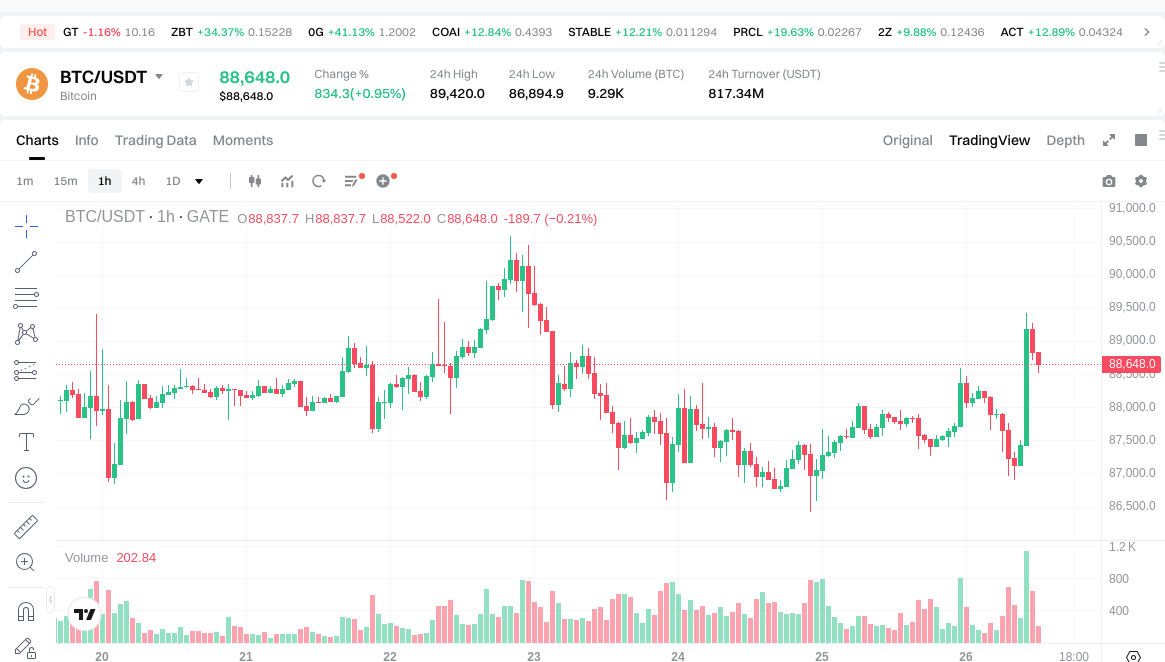
View the BTC USDT price
These figures show that BTC’s circulating supply is approaching its limit, with the market strongly pricing in its scarcity. However, short-term volatility persists—users should assess their risk tolerance before participating.

Who Created Bitcoin (BTC) and When?
Bitcoin was introduced in 2008 by an individual or group using the pseudonym Satoshi Nakamoto via a whitepaper proposing an electronic cash system without third-party intermediaries. In January 2009, the genesis block was mined, marking the launch of the Bitcoin network.
Satoshi Nakamoto led early development and discussions before gradually stepping back and handing over maintenance to the open-source community. Since then, Bitcoin has seen several key upgrades—such as Segregated Witness (SegWit) and Taproot—to enhance usability and scripting capabilities while preserving protocol stability and conservatism.
How Does Bitcoin (BTC) Work?
Bitcoin achieves consensus through Proof of Work (PoW). Miners use specialized hardware to compute hashes—fixed-length cryptographic summaries of data—competing to earn the right to add new blocks of transactions to the ledger. The winner receives block rewards and transaction fees.
Each block is mined approximately every 10 minutes. The network adjusts mining difficulty every 2,016 blocks to keep block intervals stable. Block rewards are halved roughly every four years until the total supply nears the 21 million BTC cap. Network nodes validate blocks and transactions against consensus rules, ensuring a consistent global ledger.
What Can You Do With Bitcoin (BTC)?
As a store of value, Bitcoin’s fixed supply and global liquidity give it properties akin to “digital gold,” making it popular for long-term holding and hedging against fiat currency devaluation.
For cross-border transfers, users can settle transactions directly on-chain without traditional intermediaries—a transparent and traceable method suitable for large payments. For everyday microtransactions, layer-2 solutions such as the Lightning Network (a payment channel network built atop the main chain) enable faster and lower-cost transfers.
Additionally, Bitcoin serves as a “pricing anchor” in the crypto market—it is the main denomination and reserve asset for many other cryptocurrencies.
What Wallets and Scaling Solutions Exist in the Bitcoin (BTC) Ecosystem?
Wallets are tools for managing private keys and signing transactions. Non-custodial wallets require users to safeguard their own private keys or mnemonic phrases (backup phrases composed of common words), offering high security but greater responsibility for beginners. Custodial wallets are managed by platforms—easy to use but carry platform risk.
Key scaling solutions include:
- Segregated Witness (SegWit), which optimizes transaction structure and lowers fees.
- Taproot, enabling more efficient and private complex transactions.
- Layer-2 payment networks (such as Lightning Network), providing fast off-chain settlement for high-frequency micropayments.
For newcomers, it’s advisable to start with small amounts, practice backup and recovery procedures, and gradually increase asset holdings as you gain experience.
What Are the Main Risks and Regulatory Considerations for Bitcoin (BTC)?
Price Volatility: Bitcoin prices are heavily influenced by macroeconomic trends, liquidity, and market sentiment. Short-term price swings can be significant.
Regulation & Compliance: Crypto asset regulations differ by region and may affect trading, taxation, and compliance requirements. Always understand your local laws and tax obligations before participating.
Custody & Private Keys: Losing or exposing your private key means irreversible loss of assets. With non-custodial wallets, securely back up your mnemonic phrase and beware of phishing links or malicious software.
Network & Fees: During periods of high network congestion, on-chain transaction fees can rise and confirmations may be delayed. When transferring across platforms, always verify network types to avoid losses from sending assets to incompatible chains.
Platform & Counterparty Risk: All platforms carry operational, risk management, and technical risks—diversify holdings and apply robust security settings.
What Is the Long-Term Value Proposition of Bitcoin (BTC)?
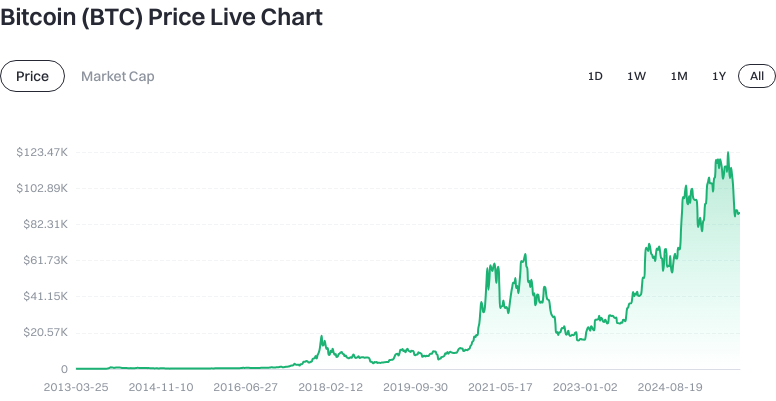
Scarcity: A fixed supply cap of 21 million BTC makes issuance predictable, with halving events reinforcing expectations of scarcity.
Security: PoW and globally distributed hash power provide high attack costs—ensuring censorship resistance and network reliability over time.
Network Effects: As one of the largest cryptocurrencies by market cap and liquidity, BTC’s leading role in pricing and settlement further strengthens its acceptance and liquidity.
Macro Narrative: In a globalized and digitized world, Bitcoin’s cross-border nature and verifiable scarcity make it an attractive component in diversified asset allocation strategies.
How Do I Buy and Securely Store Bitcoin (BTC) on Gate?
Step 1: Register & Complete KYC Sign up at gate.com with a strong password and enable two-factor authentication. Complete identity verification (KYC) as prompted to unlock account features and withdrawal limits.
Step 2: Deposit or Buy USDT Choose your preferred deposit method on the Funds page—either fiat channels or crypto deposits. If using fiat channels, complete payment to fund your account; if you already hold USDT, transfer it from your personal wallet or another platform to your Gate account.
Step 3: Spot Purchase BTC Go to the “Spot Trading” page, search for “BTC,” and select a trading pair (e.g., BTC/USDT). Choose between a market order (executed at current market price) or limit order (set your desired price), confirm quantity, then place your order.
Step 4: Withdraw to Non-Custodial Wallet & Configure Security For long-term storage, go to “Withdraw,” select “Bitcoin Mainnet,” paste your wallet address, set miner fees, and submit. After receipt, back up your mnemonic phrase, set a wallet password and anti-phishing phrase; use cold/hot wallet separation and test with small transfers to build strong security habits.
Tip: Withdrawals incur on-chain miner fees plus platform withdrawal fees—always double-check address and network details before transferring assets.
How Is Bitcoin (BTC) Different from Ethereum (ETH)?
Purpose & Vision: Bitcoin focuses on being a decentralized store of value and settlement layer; Ethereum aims to be a programmable smart contract platform supporting decentralized applications.
Consensus Mechanism: Bitcoin uses PoW for security through energy expenditure; Ethereum transitioned to Proof of Stake (PoS) in 2022—validators secure the network via staking with lower energy consumption.
Functionality & Scalability: Bitcoin’s main chain scripts are simple and robust; complex logic is mainly achieved through layer-2 or external protocols. Ethereum natively supports smart contracts and various layer-2 rollup solutions for higher throughput.
Monetary Policy: Bitcoin has a fixed supply cap of 21 million; Ethereum’s supply is not fixed but mechanisms like EIP-1559 fee burning can lower net issuance at times.
Fees & User Experience: On-chain fees for Bitcoin can rise during congestion—micropayments rely on layer-2 networks. Ethereum’s mainnet fees also spike at peak times but are mitigated by layer-2 solutions.
Rather than competing directly, each serves a unique purpose—Bitcoin as “digital gold,” Ethereum as a programmable decentralized computation platform.
Summary on Bitcoin (BTC)
Bitcoin utilizes decentralized PoW consensus and a fixed monetary supply policy to deliver verifiable scarcity and global settlement capabilities. It has established itself as a key store of value and cross-border payment asset. Current data shows its circulating supply is nearing its limit but market volatility persists. Beginners can purchase BTC step-by-step on Gate while prioritizing security best practices: start with small test transfers, back up mnemonic phrases, enable two-factor authentication, separate hot/cold wallets. For portfolio allocation, manage position sizes prudently, diversify risk exposure, and always consider local compliance and tax requirements for safer participation.
FAQ
What Is the Symbol for Bitcoin?
The official symbol for Bitcoin is ₿ (the ₿ in ₿TC), pronounced “Bitcoin sign.” Designed by the Bitcoin community, it resembles a B with two vertical strokes. In daily use you’ll also see “BTC”—both denote Bitcoin.
How Can I Type the ₿ Symbol on My Computer?
Typing ₿ varies by system: on Windows you can use Alt codes; on Mac you can access it via special character input methods. The easiest way is simply to copy-paste ₿ or use Unicode U+20BF in documents. Most exchanges and wallet apps now support it natively—manual input is rarely needed.
Why Was a Special Symbol Designed for Bitcoin?
A dedicated symbol helps establish Bitcoin’s identity in international commerce—just as $ stands for USD or € for Euro, ₿ makes Bitcoin more formal and authoritative. It was recognized in the Unicode Standard in 2015—affirming Bitcoin’s status as a global store of value.
What’s the Difference Between BTC and ₿?
BTC is Bitcoin’s currency code (like a ticker symbol), used in exchanges, data reports, etc.; ₿ is the currency symbol used when denoting amounts (e.g., ₿0.5 means half a bitcoin). Both refer to the same asset—on platforms like Gate you’ll generally see BTC displayed.
Do Other Cryptocurrencies Have Their Own Symbols?
Yes—major cryptocurrencies have their own symbols or codes. Ethereum uses Ⓔ or ETH; Litecoin uses Ł; but only Bitcoin’s ₿ has been officially recognized by Unicode. Most crypto symbols remain under community discussion without widespread international adoption like Bitcoin’s sign.
Glossary of Key Bitcoin (BTC) Terms
- Proof of Work: A consensus mechanism where miners solve complex mathematical puzzles to validate transactions and generate new blocks.
- Mining: The process where miners compete using computational power to add blocks to the blockchain in exchange for bitcoin rewards and transaction fees.
- Blockchain: A distributed ledger made up of cryptographically linked blocks recording all historical bitcoin transactions.
- Hash: A fixed-length string derived from cryptographic computation on data—used to verify block integrity.
- Private Key: A cryptographic key used to sign transactions and prove ownership of assets; must be stored securely by its holder.
- Difficulty Adjustment: Automatic recalibration of mining difficulty every 2,016 blocks to maintain an average block time of 10 minutes.
Further Reading & References on Bitcoin (BTC)
-
Official Website / Whitepaper:
-
Development / Documentation:
-
Authoritative Media / Research:
Related Articles

In-depth Explanation of Yala: Building a Modular DeFi Yield Aggregator with $YU Stablecoin as a Medium
BTC and Projects in The BRC-20 Ecosystem
