Blockchain payment company Ripple is executing a stock buyback program valued at up to $750 million, lifting the company's total valuation to around $50 billion. The buyback will proceed via a tender offer, enabling select investors and employees to sell their holdings. This move also highlights Ripple's capital strategy and long-term positioning in the private market.
2026-03-24 16:46:42
The Across community has recently put forward a governance proposal to consider converting pipeline ACX tokens into a traditional corporate equity structure. If passed, ACX holders will have the option to exchange their tokens for shares in the newly formed AcrossCo or sell their tokens at a premium for USDC. The proposal remains under community discussion and will proceed only after a formal governance vote.
2026-03-24 16:45:33
The article explains why traditional banks, ACH, and credit cards are impractical in a high-frequency, micro-transactional, cross-border agent economy that lacks human endorsement. Combining early case studies such as OpenClaw, agent activity on Solana, and the x402 protocol, it presents the investment thesis that AI Agents will, over the long term, boost on-chain activity and value capture.
2026-03-24 16:44:27
This article analyzes Arbitrum Offchain Labs' response, as well as the growing trend of L2 ecosystems decoupling from Ethereum. It identifies the critical pain point that the state tree and VM together constitute 80% of the proof bottleneck. The article also anticipates that the Glamsterdam/Hegota upgrade will become a pivotal battleground.
2026-03-24 16:43:14
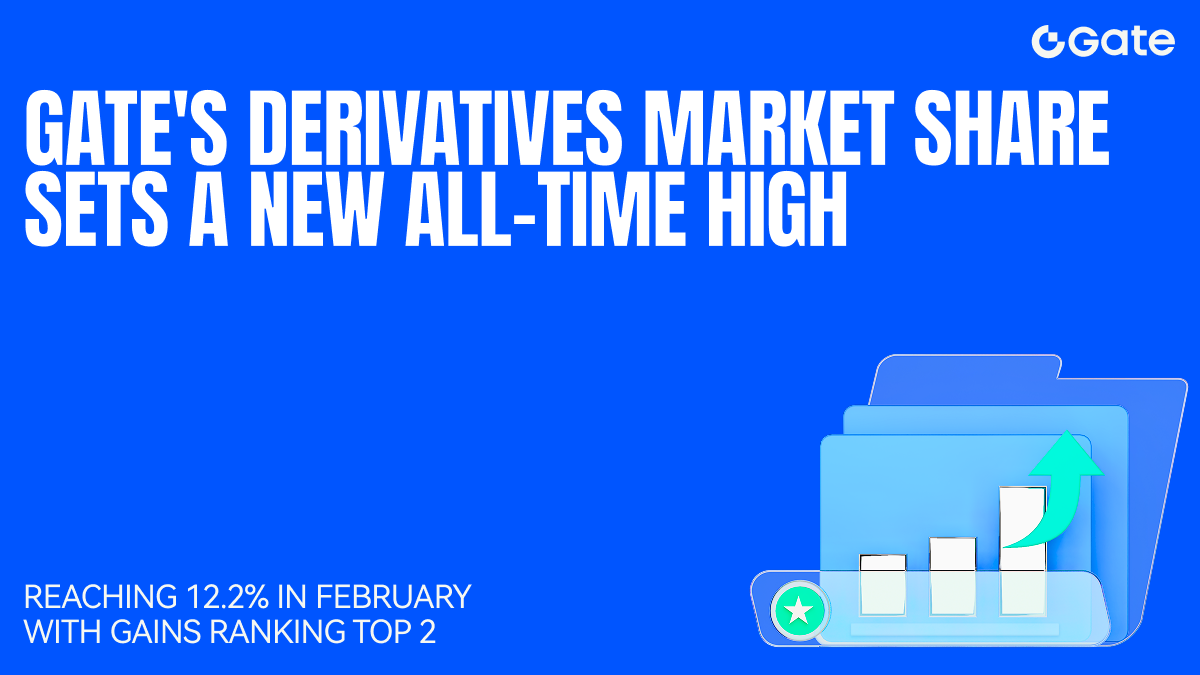
According to the latest exchange report from CoinDesk Data, Gate continued to expand its derivatives trading activity in February 2026, with its market share rising to 12.2%, marking a new all-time high. The exchange's derivatives market share increased by 0.95%, ranking among the fastest-growing globally.
2026-03-24 16:42:02
CoinDesk’s latest exchange report shows that in February 2026, Gate further expanded its derivatives trading volume, raising its market share to 12.2%—a record high. The increase in derivatives market share reached 0.95%, placing Gate among the world’s top two exchanges.
2026-03-24 16:40:54
The article compares technologies that genuinely improve reality—such as Starlink, open-source local large models, Signal, and Community Notes—pointing out that relying solely on decentralized finance and speculative applications is far from sufficient to address structural risks like government and corporate surveillance, warfare, and information warfare. It criticizes the posture of only discussing finance and self-encircling as overly hollow.
2026-03-24 16:39:49
In 2026, as Middle East conflicts intensified, gold ETFs attracted substantial inflows, while Bitcoin ETFs recorded net outflows of $2.6 billion. This article examines how gold derives its insurance value from a stockpile of 219,000 tons, multi-faceted demand, and the London Bullion Market Association’s (LBMA) multi-trillion-dollar clearing depth. In contrast, four key hurdles continue to impose a maturity discount on Bitcoin ETFs.
2026-03-24 16:38:30
This article examines the duopoly formed by Polymarket and Kalshi, exploring both crypto-native platforms like Opinion.trade and compliant distribution channels such as Interactive Brokers. It highlights how prediction markets are evolving from simple betting tools into a foundational global truth layer.
2026-03-24 16:35:19
GateRouter and OpenRouter are both AI model routers, but they differ in architecture, payment mechanisms, and Web3 integration. This guide compares their core designs, AI agent compatibility, and typical use cases.
2026-03-24 16:34:05
Backpack Token is a utility crypto asset issued within the Backpack ecosystem and built on the Solana blockchain. It is designed to provide a unified incentive and governance mechanism across Backpack’s trading platform, non-custodial wallet, and NFT community. Unlike many traditional platform tokens, the Backpack tokenomics model emphasizes a user-first distribution structure and explores a staking mechanism that may connect token participation with the potential equity value of the company.
2026-03-24 16:32:35
Gate Research Weekly Report: This week, BTC and ETH continued to trade with weak volatility, and market sentiment stayed in the fear range. Rising tensions in the Middle East drove up oil prices and simultaneously increased demand for stablecoins, with USDC demand surging in the Dubai market. Pump.fun may pursue multi-chain expansion, while popular tokens like ACX, Lobster, and PIXEL posted strong gains. Capital activity in the Solana ecosystem remains robust.
2026-03-24 16:31:00
Gate Skills is an open skills marketplace that empowers AI agents with native access to the Gate cryptocurrency ecosystem. As AI agents become increasingly involved in financial and blockchain ecosystems, effective automation requires access to specialized tools, market data, and operational capabilities. Modular capability systems address this need by allowing agents to perform complex tasks through reusable and structured components.
2026-03-24 16:29:38
The article points out that the demand for AI computing power has shifted from a chip shortage to a power shortage. Bitcoin miners, with their already energized land, are seizing the first-mover advantage. The construction cost per MW has soared to $8-11 million. It also deconstructs the energy arbitrage logic behind the power moat, the transition to liquid cooling, and the large-scale leases.
2026-03-24 16:28:21
The Five Core Modules of Gate for AI are the foundational infrastructure components that provide AI agents with structured access to crypto trading systems, wallet management, market information, and blockchain data. As AI agents evolve beyond simple conversations and begin performing real tasks, they need reliable ways to interact with financial systems and blockchain networks.
2026-03-24 16:27:00