As modular blockchains continue to advance, users are now prioritizing not just security when choosing infrastructure, but also execution efficiency and cross-chain capabilities. This shift has made execution layer design a central point of competition.
This topic typically involves three dimensions: execution layer architecture, cross-chain communication mechanisms, and scalability paths. Together, these factors define SOON's technical position in the modular ecosystem.
What Is SOON? Basic Definition of the SVM Rollup Execution Layer
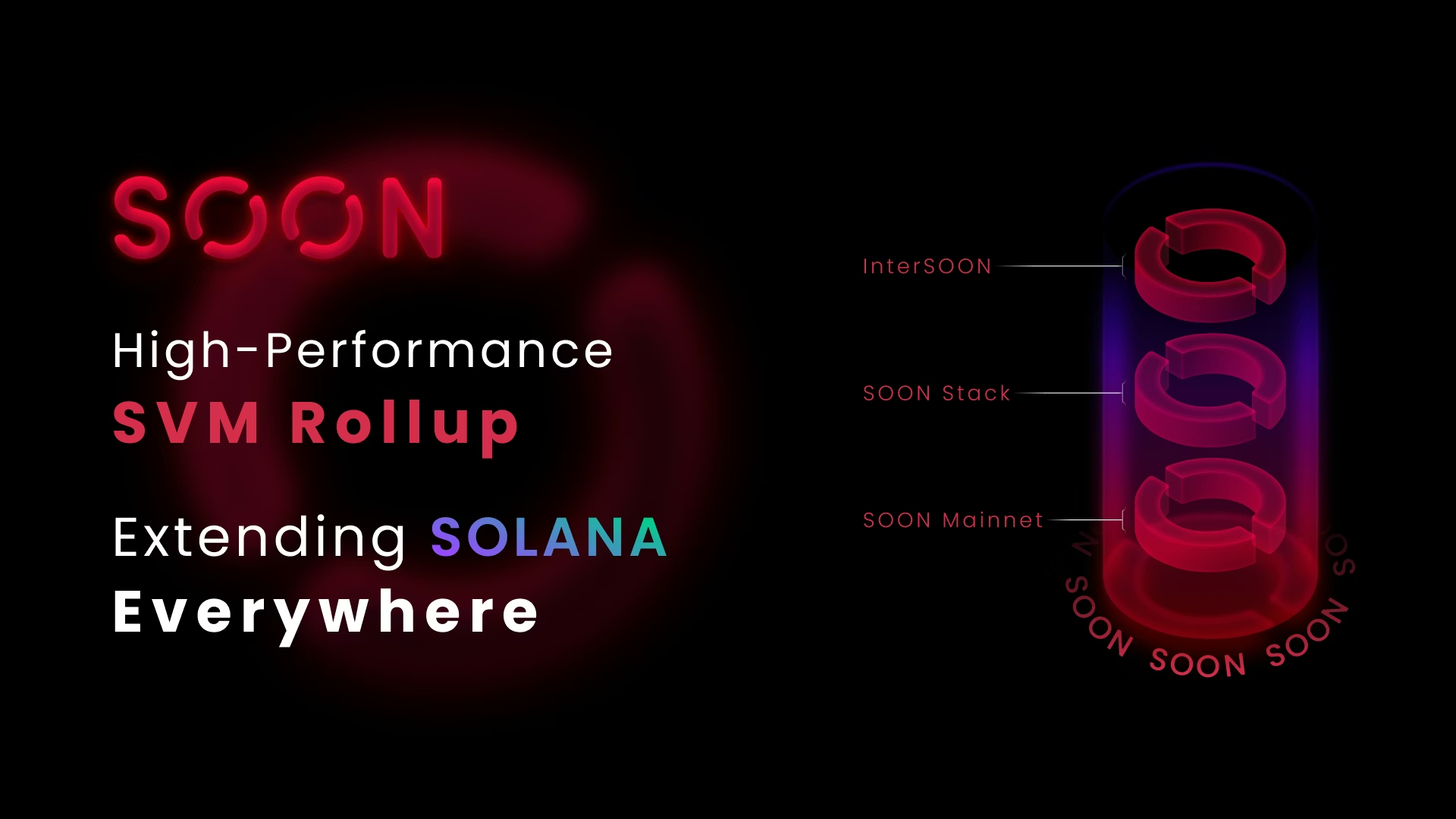
SOON is a Rollup execution layer built around the Solana Virtual Machine (SVM), designed to deliver high-performance execution capabilities across multiple blockchain ecosystems.
Mechanistically, SOON decouples the execution layer from traditional blockchains. Using a Rollup architecture, it separates transaction execution from final settlement, allowing execution to occur in a high-performance environment while underlying chains provide security.
Structurally, SOON is not a standalone public chain. Instead, it operates as an execution layer network, relying on various underlying chains for settlement and processing transaction logic in its own execution environment.
This design enables blockchains to shift from monolithic to modular architectures, making execution capabilities a composable infrastructure component.
How Is SOON Architected?
SOON's architecture follows a modular approach, separating execution, settlement, and data availability into distinct layers.
Mechanistically, SVM powers the execution layer, handling transactions and smart contract logic. The settlement layer—often provided by Ethereum or other base chains—confirms final states. The data availability layer stores transaction data.
Structurally, this creates a three-layer separation model—execution, settlement, and data—allowing independent optimization and replacement of each module.
This design allows the system to boost performance without compromising security and supports coordinated development across multiple chains.
How Do SOON Stack and Rollup Deployment Work?
SOON Stack is a toolkit for deploying SVM Rollups, enabling developers to rapidly build execution layer networks.
Mechanistically, developers use SOON Stack to create Rollup instances and configure execution environments, settlement layers, and data availability solutions, letting multiple chains share execution logic.
Structurally, SOON Stack abstracts complex chain deployment into standardized modules, allowing developers to focus on application development.
This approach lowers the barrier to Rollup deployment and enables execution layer capabilities to be replicated and scaled across ecosystems.
What Is SOON Mainnet’s Role in the Execution Layer?
SOON Mainnet is the primary instance of the execution layer network, responsible for processing real transactions and applications.
Mechanistically, Mainnet handles user transaction requests, executes smart contract logic via SVM, and submits results to the settlement layer for confirmation.
Structurally, Mainnet functions as a high-performance execution environment, connecting users to underlying blockchains and enabling efficient off-chain computation.
This design shifts execution load away from base chains, increasing overall system throughput.
How Does InterSOON Enable Cross-Chain Communication and Interoperability?
InterSOON is SOON’s cross-chain communication protocol, connecting data and assets across different chains.
Mechanistically, InterSOON uses a messaging system to transmit state information between Rollups and main chains, synchronizing transaction results across multiple chains.
Structurally, InterSOON acts as a middleware layer, linking different execution environments and forming a unified communication network across chains.
This design enables SOON to serve as a cross-ecosystem execution layer, not limited to a single chain.
What Is Decoupled SVM’s Core Mechanism and Design Significance?
Decoupled SVM is a critical SOON technology that separates the execution layer from the consensus layer for enhanced performance.
Mechanistically, SVM handles execution logic, while consensus and security are provided by the base chain. The two connect via interfaces but remain independent.
Structurally, this decoupling allows the execution layer to scale independently, avoiding base chain performance bottlenecks.
This design enables execution capabilities to be reused across multiple chains, creating a unified execution infrastructure.
How Does Horizontal Scaling Drive Scalability?
Horizontal Scaling is SOON’s scalability strategy, increasing performance by adding more execution nodes.
Mechanistically, the network expands throughput by increasing node count, rather than boosting single-node performance, allowing the network to scale as demand grows.
Structurally, horizontal scaling lets the execution layer process larger transaction volumes while maintaining stability.
This approach gives SOON greater theoretical scalability to support large-scale applications.
What Role Does the SOON Token Play in the Economic Model?
The SOON token is the central value asset linking the execution layer and ecosystem incentives, primarily used for computation fees and network operation.
Mechanistically, users consume SOON as Gas when submitting transactions or invoking applications on SOON Rollup, incentivizing execution nodes. This approach directly ties computation resources to token consumption, making fees dynamic with network usage.
Structurally, SOON serves as a unified settlement asset across multiple Appchains, maintaining consistent value standards between Rollups. InterSOON cross-chain communication also relies on SOON as the fee medium for message transmission and state synchronization.
This model creates a unified closed loop for execution, cross-chain, and incentives, positioning SOON as the foundational asset supporting the SVM Rollup ecosystem.
How Does SOON Differ from Traditional L2s or Public Chains?
SOON differs from traditional L2s and public chains in its design goals and technical approach.
Mechanistically, traditional L2s generally use EVM, while SOON employs the SVM execution environment. Public chains integrate execution and consensus within a single system.
Structurally, SOON uses a modular architecture with an independent execution layer, whereas traditional public chains are monolithic.
This distinction makes SOON focus more on execution layer capabilities rather than single-chain performance optimization.
How Should SOON’s Advantages and Limitations Be Viewed?
SOON’s strengths are its execution performance and modular design, but it faces certain limitations.
Mechanistically, high-performance execution is driven by SVM and modular architecture, while challenges stem from cross-chain complexity and ecosystem maturity.
Structurally, SOON requires collaboration with base chains and cross-chain protocols, increasing system complexity.
This structure enables SOON to balance performance and flexibility, though further ecosystem support is needed.
Summary
SOON utilizes SVM Rollup architecture to separate the execution layer from the consensus layer, delivering high-performance execution in modular blockchain systems and building new infrastructure forms through cross-chain communication and scalability.
FAQ
Is SOON a public chain or Layer 2?
SOON is a Rollup execution layer network, not a traditional public chain.
What distinguishes SVM Rollup from EVM Rollup?
The primary difference is the execution environment: SVM delivers higher-performance computation.
Does SOON rely on Ethereum?
Its settlement layer can leverage Ethereum or other base chains for security.
What does InterSOON do?
It enables communication of data and assets between different chains.
What are SOON’s core strengths?
Execution performance and scalability enabled by its modular architecture.