With seamless DeFi integration, efficient liquidation processes, collateral auctions, and a Peg Stability Module (PSM) to ensure market stability, the USDD ecosystem is designed for long-term growth, empowering users while safeguarding the protocol through real-time monitoring and community-led decision-making.
Stablecoins were developed to reduce the volatility of cryptocurrencies and provide more consistent pricing in digital markets. Early models generally relied on either fully backed reserves or supply-adjustment mechanisms, but both approaches exposed structural limitations under certain market conditions.
USDD is a decentralized stablecoin natively deployed on TRON, Ethereum Chain, and BNB Chain that aims to maintain a 1:1 value with the US dollar while maintaining on-chain transparency and usability across decentralized financial systems.
What is USDD?
USDD functions as a decentralized stablecoin designed to maintain a value close to one US dollar through a combination of mint-and-burn supply adjustments and reserve-backed collateral mechanisms

Source: USDD Website
USDD’s key features include:
-
Overcollateralization: USDD is backed by excess collateral, providing a strong buffer against market volatility and enhancing overall system stability.
-
Full transparency: All collateral backing USDD is publicly verifiable on-chain, building trust while enabling more efficient and real-time risk management.
-
Multi-chain deployment: USDD is natively deployed on TRON, Ethereum Chain and BNB Chain.
-
Peg Stability Module (PSM): Users can swap USDD with USDT/USDC at a 1:1 ratio with zero slippage, helping maintain price stability and improving capital efficiency.
-
Smart Allocator: USDD’s fully on-chain, transparent, and risk-controlled strategy that allocates assets to generate sustainable yield for the USDD ecosystem.
-
Diverse yield strategies: Users can earn through staking, looping, liquidity provision, and other DeFi applications, offering flexible ways to maximize returns.
Why was USDD created? Market context and design objectives
The development of USDD is closely linked to evolving market demands and the limitations observed in earlier stablecoin models.
Market context
Stablecoins have become foundational to digital asset markets due to their ability to support key financial functions:
-
Pricing and settlement: Provide a stable unit of account that allows assets to be priced consistently and transactions to be settled without volatility disruptions
-
Liquidity provision: Enable efficient trading by acting as a stable asset within liquidity pools and market-making mechanisms
-
Cross-platform value transfer: Facilitate the movement of value across different blockchain networks and applications with minimal price fluctuation
Design objectives
USDD was designed to address key limitations in earlier stablecoin models through the following objectives:
-
Improve capital efficiency while retaining stability mechanisms by reducing excessive collateral requirements without removing safeguards
-
Introduce reserve-backed confidence layers by incorporating external assets that help support stability during market stress
-
Enable scalable on-chain liquidity by supporting widespread use across trading, lending, and DeFi applications
-
Maintain transparency through verifiable reserves by allowing users to monitor backing assets on-chain
-
Support cross-chain interoperability by enabling USDD to operate across multiple blockchain networks for broader accessibility
USDD’s design objectives focus on balancing capital efficiency, stability, transparency, and interoperability to support a more adaptable and resilient decentralized stablecoin system.
How does USDD work?
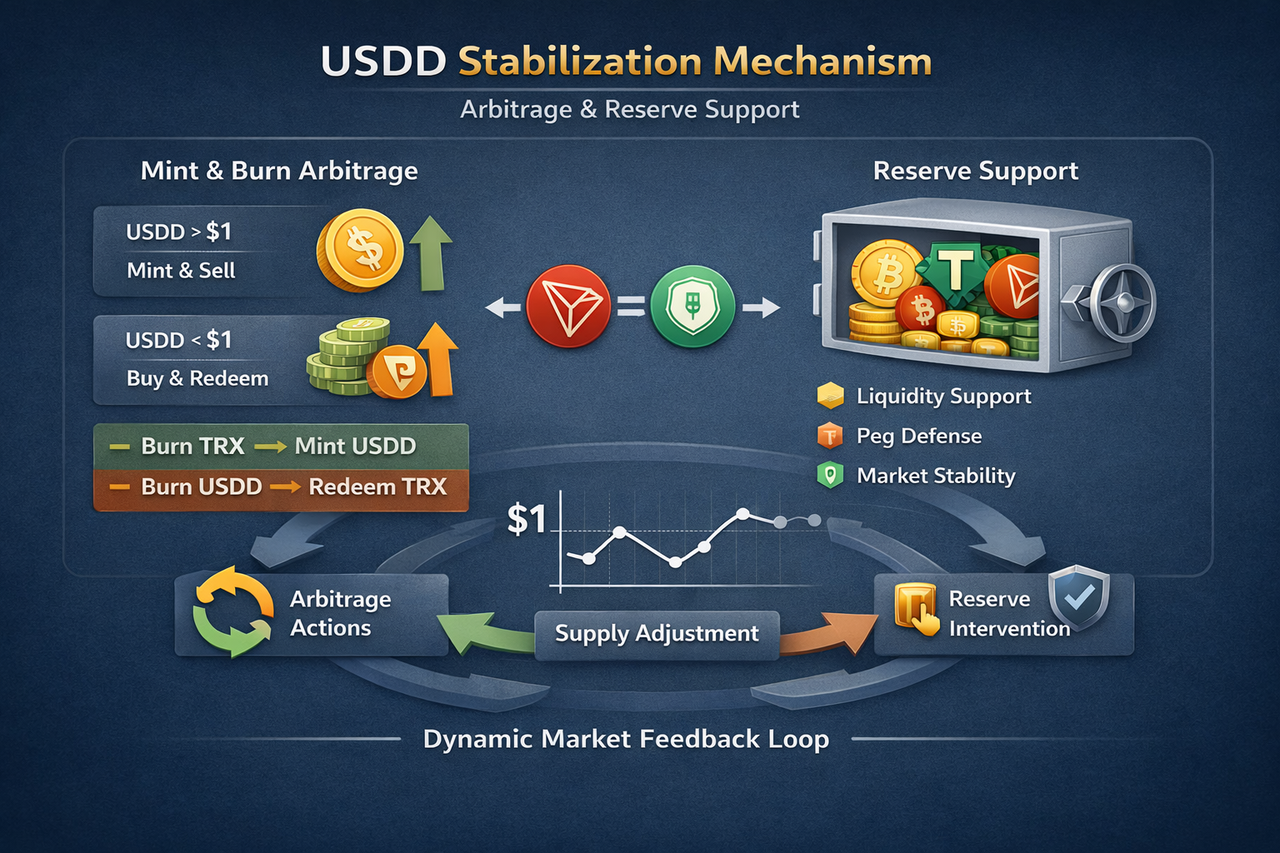
USDD maintains its dollar peg through a multi-layered stabilization model that combines market-driven arbitrage incentives with reserve-backed support to continuously adjust supply and reinforce price stability.
-
Mint-and-burn arbitrage mechanism
USDD interacts with TRON’s native token (TRX) through a mint-and-burn system where users burn TRX to create USDD or burn USDD to redeem TRX, enabling direct conversion between the two assets.
This mechanism creates price-based arbitrage incentives in which users are encouraged to mint and sell USDD when its price rises above $1, or buy and redeem it when the price falls below $1, helping bring the market price back toward its target.
As a result, supply expands or contracts dynamically based on market demand, allowing price deviations to be corrected through participant-driven actions.
-
Reserve-backed support layer
USDD is supported by a reserve pool managed by the TRON DAO Reserve, which holds a mix of assets such as TRX, major cryptocurrencies, and established stablecoins.
These reserves function as a secondary stability layer by providing additional liquidity during periods of market stress, reinforcing user confidence in the system, and supporting interventions aimed at maintaining the dollar peg.
By introducing reserve backing, the system reduces reliance on supply-based adjustments alone and adds an additional buffer to help absorb extreme market volatility.
-
Dynamic market feedback loop
USDD stability emerges from the interaction between market price signals, arbitrage activity, and reserve support mechanisms, which together form a continuous feedback system.
When the price deviates from $1, arbitrage participants respond by adjusting supply, while reserves can help stabilize conditions if market pressure increases, creating a cycle of correction that pushes the price back toward equilibrium.
However, the effectiveness of this system depends on active market participation, sufficient liquidity, and sustained confidence in both the arbitrage mechanism and the reserve backing.
USDD maintains its dollar peg through a stabilization system that combines mint-and-burn arbitrage with reserve-backed support, allowing supply adjustments and market incentives to work together in restoring price stability.
Core components and key features of USDD
USDD’s core features illustrate how its design balances stability, transparency, and capital efficiency within a decentralized financial system.
-
Stabilization architecture: Integrates supply adjustment mechanisms with reserve backing, reducing dependence on any single approach while enabling both market dynamics and collateral support to maintain price stability.
-
On-chain transparency: Enables public verification of reserve data and transactions, allowing users and observers to independently assess the system’s health and backing
-
Cross-chain issuance: Allows USDD to circulate across multiple blockchain networks, improving accessibility, liquidity distribution, and interoperability within the broader DeFi ecosystem
-
Capital efficiency orientation: Reduces the amount of locked collateral required compared to overcollateralized models, enabling more efficient use of capital while maintaining stability mechanisms
USDD combines transparent on-chain reserves, cross-chain accessibility, and a capital-efficient stabilization design, enabling it to maintain stability while remaining flexible within decentralized financial systems.
Use cases of USDD within TRON and the broader DeFi ecosystem
USDD functions as a stable-value asset across decentralized financial systems, supporting a wide range of use cases where price consistency and on-chain accessibility are essential.
Stable-value payments and transfers
Enables users to send and receive value without exposure to significant price volatility, making it suitable for everyday transactions and on-chain settlements
Liquidity provision in decentralized exchanges
Serves as a key asset in liquidity pools, helping facilitate trading pairs and contributing to market depth across DeFi platforms
Lending and borrowing activities
Allows users to supply USDD to earn yield or borrow it as a stable unit of account within decentralized lending protocols
Collateral in financial applications
Functions as a relatively stable collateral asset that can be used to support borrowing or structured financial strategies
Cross-chain value transfer
Supports movement of value across multiple blockchain networks, enabling more efficient and programmable transfers compared to traditional systems
Settlement layer for DeFi operations
Acts as a stable medium for pricing, accounting, and settling transactions within decentralized financial infrastructure
USDD’s role across these use cases reflects its function as a stable and transferable unit of value, enabling consistent interaction across trading, lending, and cross-chain financial environments.
Risks and limitations of USDD: stability, collateral, and systemic factors
While USDD is designed to balance stability and efficiency, its structure introduces several risks related to price stability, reserve composition, and broader market dependencies.
Peg stability risk
USDD may deviate from its $1 target if arbitrage activity weakens or market conditions reduce the effectiveness of supply adjustment mechanisms.
Partial collateral dependency
Because USDD is not fully overcollateralized, its stability depends on both reserves and market behavior rather than guaranteed asset backing.
Reserve composition risk
The value and liquidity of reserve assets, such as volatile cryptocurrencies, can fluctuate and affect the system’s ability to support the peg.
Liquidity and market participation risk
The stabilization mechanism relies on active traders and sufficient liquidity, meaning reduced participation can slow or weaken price corrections.
Reflexive market dynamics
Negative market sentiment can trigger a feedback loop where falling confidence leads to selling pressure, further destabilizing the system.
Systemic exposure to crypto markets
USDD is interconnected with broader digital asset markets, so volatility or shocks in related assets can impact its stability.
Governance and operational risk
Decisions related to reserve management and system adjustments may influence stability, depending on how effectively they are executed.
Together, these factors highlight that USDD’s stability is not solely mechanical but also depends on market confidence, reserve quality, and broader ecosystem conditions.
USDD’s role in the stablecoin ecosystem
USDD is positioned within the stablecoin landscape as an overcollateralized crypto-backed stablecoin, emphasizing stability through excess reserve backing rather than reliance on a single stabilization mechanism.
Stablecoin designs can generally be understood across three broad approaches:
-
Fiat-backed stablecoins prioritize price stability through direct reserves held off-chain.
-
Overcollateralized crypto stablecoins emphasize resilience by locking assets in excess of issued supply.
-
Supply-adjustment-based models rely on market incentives to regulate circulation.
USDD aligns most closely with the overcollateralized category, where stability is supported by maintaining reserves that exceed the circulating supply. This structure is designed to provide a buffer against market volatility, reducing the likelihood of instability during periods of stress.
Within this framework, USDD contributes to the broader evolution of stablecoins by reinforcing a model where:
-
Stability is anchored in verifiable reserve backing
-
Risk is mitigated through collateral surplus rather than minimal coverage
-
Transparency supports user confidence and system credibility
This positioning reflects a wider trend in the digital asset ecosystem toward collateral-focused stability models, particularly in systems that aim to operate without centralized issuers while maintaining consistent value.
Summary
USDD is a decentralized stablecoin that maintains its dollar peg through an overcollateralized structure supported by reserve-backed assets.
Its design prioritizes stability through excess collateral backing, transparency through on-chain visibility of reserves, and resilience by maintaining buffers against market volatility.
Rather than optimizing for capital efficiency alone, USDD emphasizes structural robustness, ensuring that sufficient collateral is available to support its value across varying market conditions.
This approach reflects a broader shift in stablecoin design toward security-first architectures, where maintaining confidence and stability takes precedence over minimizing collateral requirements.
FAQs
What type of stablecoin is USDD?
USDD operates as an overcollateralized crypto-backed stablecoin, maintaining its value through reserve assets that exceed its circulating supply.
Is USDD fully collateralized?
USDD follows an overcollateralized model, where reserves are designed to exceed the total supply, providing an additional buffer to support price stability.
What supports the value of USDD?
Its value is supported through arbitrage incentives involving TRX, along with a reserve pool of crypto assets that helps reinforce stability during market fluctuations.
Can USDD 2.0 lose its peg?
USDD 2.0 is designed with enhanced stability mechanisms, including stronger reserve backing and improved risk controls, but it can still deviate from its target price under extreme market conditions such as sharp liquidity shocks or a significant loss of market confidence.