As the AI industry rapidly advances, demand for hash power is surging, making GPUs and other high-performance hardware essential resources for AI infrastructure. Building and maintaining GPU clusters requires substantial capital investment, and many AI infrastructure operators face challenges with inefficient financing and high capital costs. In this context, GPU asset-backed financing models are gaining attention and becoming a key funding source for AI infrastructure expansion.
USD.AI stands out by integrating AI infrastructure financing with DeFi return models, enabling real-world hash rate assets—such as GPUs—to generate on-chain returns. Unlike traditional models relying on government bonds or stablecoin protocols based on on-chain lending spreads, USD.AI connects its sources of return directly to the financing needs of AI infrastructure. This creates a new yield-generating stablecoin model, broadening DeFi’s sources of return and introducing on-chain financial attributes to the AI hash power marketplace for the first time.
What are the sources of return for USD.AI?
USD.AI generates returns primarily from interest on AI infrastructure loans.
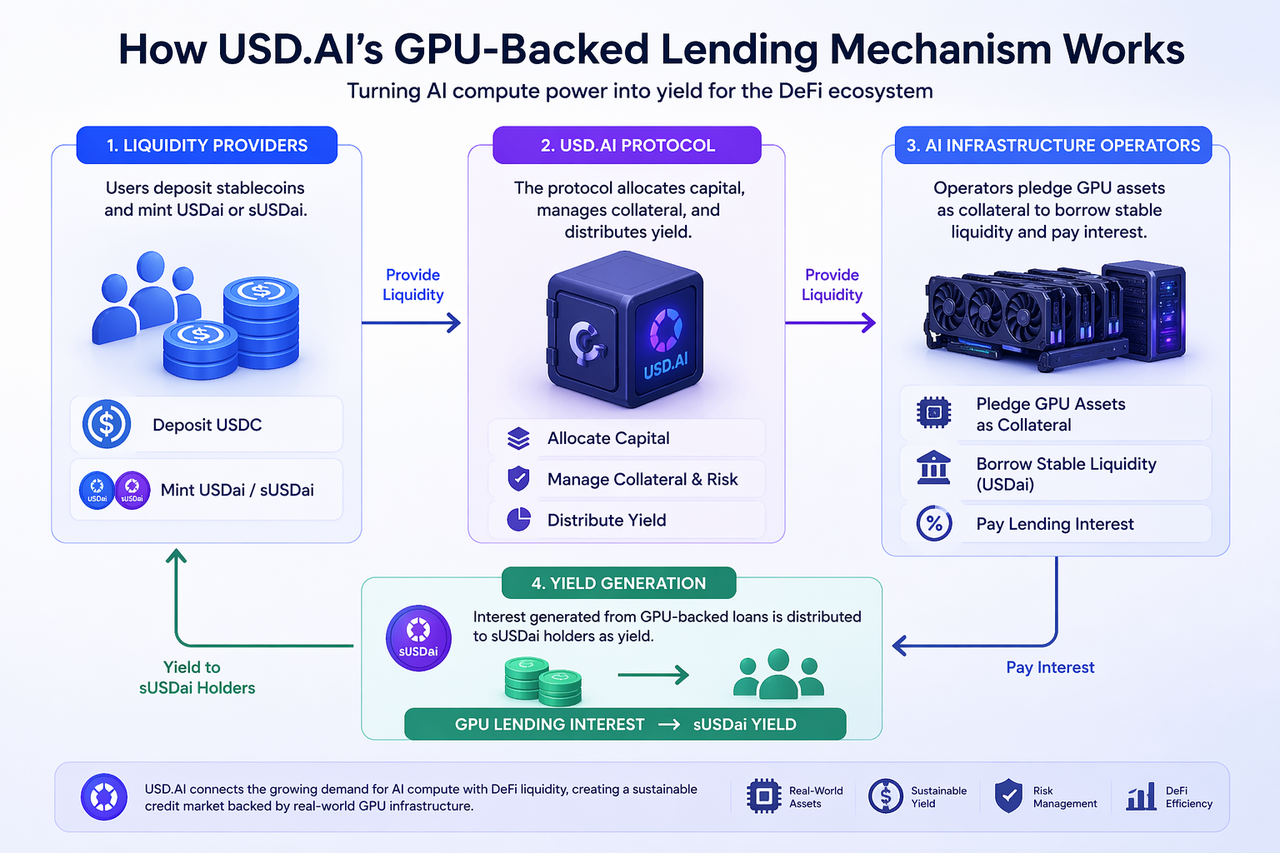
The protocol uses stable assets deposited by users to provide financing to AI infrastructure operators, who typically pledge GPUs or related hash rate devices as collateral to obtain loans. The interest paid by borrowers is the protocol’s core source of return.
This means USD.AI’s returns are not dependent on token issuance or solely on on-chain lending demand—they are driven by real-world financing needs stemming from AI infrastructure expansion.
How do AI infrastructure loans generate returns?
When AI infrastructure operators seek to scale up GPU deployments, they can secure capital through USD.AI by pledging GPU assets as collateral. These loans generally require interest payments, allowing the protocol to earn income from the loan spread.
This return mechanism is similar to traditional lending, but the underlying assets are AI computing infrastructure rather than real estate or securities. As demand for hash power rises among AI companies and loan demand grows, the protocol can collect more interest income, thereby enhancing its overall return potential.
Fundamentally, USD.AI’s returns are sourced from genuine capital demand within the AI hash power market.
How does USD.AI distribute loan returns to users?
USD.AI utilizes a dual-layer asset structure to pass loan returns to users.
After users deposit stablecoins, they receive USDai. Users who choose to hold sUSDai gain access to returns generated from underlying loans. The protocol distributes loan interest income to sUSDai holders after deducting risk reserves and operating expenses.
This mechanism directly links returns to AI infrastructure financing activities, making sUSDai a yield-bearing on-chain asset rather than relying on additional token incentives to sustain returns.
Why are AI infrastructure loan returns attractive?
The appeal of AI infrastructure loan returns lies in their foundation on real, demand-driven activity.
With the rapid growth of large model training, inference services, and AI cloud computing, GPU supply remains constrained, and infrastructure operators require substantial financing to expand hash power resources. This genuine financing demand keeps loan interest rates elevated, generating sustained returns for capital providers.
Compared to models dependent on market speculation, AI infrastructure loan returns are more closely tied to cash flows from actual economic activity, offering greater sustainability.
How does USD.AI’s return model differ from traditional DeFi returns?
Traditional DeFi returns typically derive from trading fees, yield farming, or on-chain lending spreads, whereas USD.AI’s returns originate from AI infrastructure financing.
This distinction means USD.AI’s returns are directly linked to real-world AI industry demand, not merely on-chain trading activity. As demand for AI hash power grows, protocol returns have room for expansion.
As a result, USD.AI is best described as a “real yield asset protocol,” rather than just a conventional DeFi yield platform.
What risks are associated with the USD.AI return model?
Despite the potential of AI infrastructure loan returns, certain risks remain.
First, hardware assets like GPUs are subject to depreciation risk; a rapid decline in collateral value may impact loan security. Second, shifts in AI industry demand could reduce financing needs, affecting protocol returns. Additionally, borrower defaults and inefficient liquidation processes may undermine return stability.
Therefore, the sustainability of USD.AI’s returns depends on demand in the AI hash power market and the protocol’s risk control capabilities.
Summary
USD.AI’s return model is built on AI infrastructure loans, generating interest by providing financing to GPU operators and distributing returns to users via sUSDai. This approach channels real-world AI infrastructure cash flows into the DeFi ecosystem, creating new sources of return for on-chain users. As demand for AI hash power increases, the “AI infrastructure yield protocol” represented by USD.AI may become a leading innovation in DeFi yield models.
FAQs
Where does USD.AI’s return primarily come from?
Primarily from interest on AI infrastructure loans—income earned by providing financing to GPU operators.
Why do GPU loans generate returns?
AI infrastructure operators pay loan interest to obtain capital for expanding GPU resources; this interest is the protocol’s source of returns.
How can users earn USD.AI returns?
By holding sUSDai, users receive GPU loan returns distributed by the protocol.
How are USD.AI returns different from traditional DeFi returns?
Traditional DeFi returns mainly come from on-chain activity, while USD.AI returns are driven by real-world AI infrastructure financing needs.
What risks are associated with the USD.AI return model?
Key risks include GPU collateral depreciation, fluctuations in financing demand, and borrower default risk.







