With the global intellectual property market valued at more than $60 trillion and the rapid growth of AI-generated content (AIGC), traditional IP management systems are facing increasing challenges in areas such as ownership verification efficiency, transparency of revenue distribution, and asset liquidity.
Story Protocol addresses these issues by using IP Token to transform legal agreements within traditional intellectual property systems into programmable smart contracts. This structure enables creators, developers, and content platforms to collaborate and share revenue within a decentralized environment.
Overview of the Story Protocol Token Economy
Serving as the native utility asset of the Story Protocol blockchain, the IP Token forms the foundation of the decentralized IP ecosystem and has a total supply of 1 billion tokens.
| Item |
Description |
| Token Name |
IP Token |
| Blockchain |
Story Protocol |
| Token Type |
Native utility token |
| Total Supply |
1 billion |
| Consensus Mechanism |
Proof of Stake (PoS) |
| Core Functions |
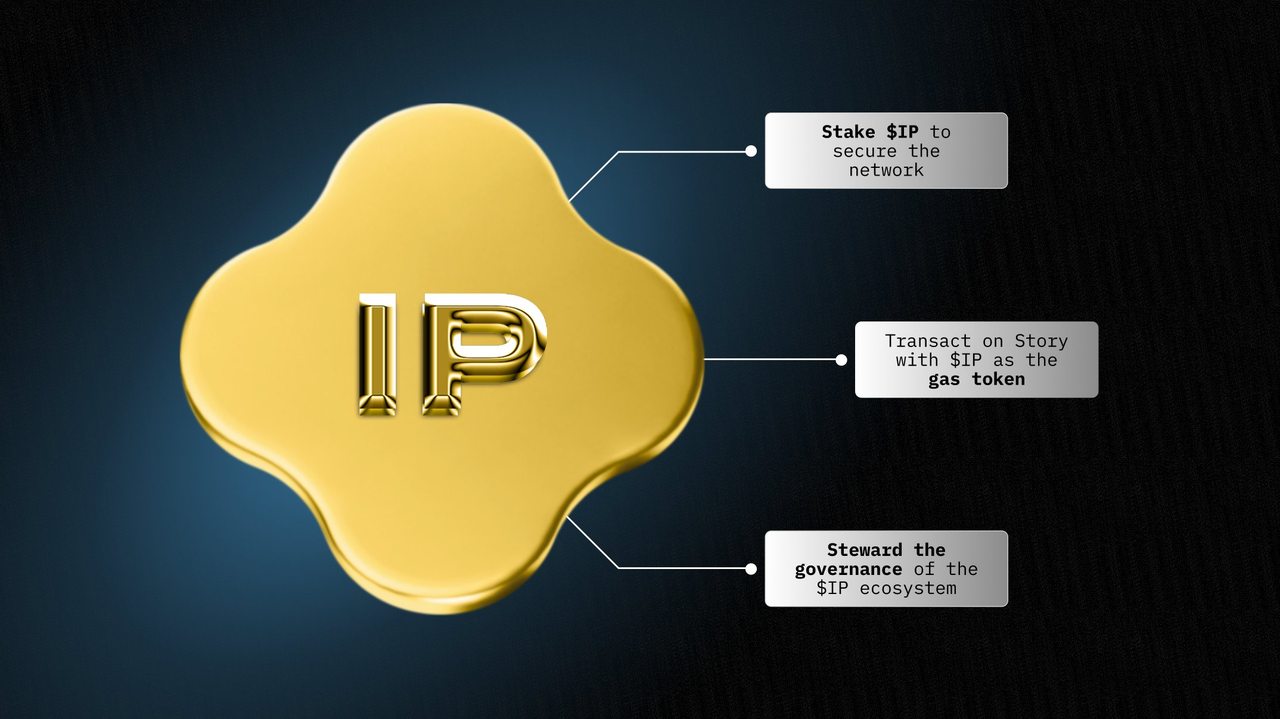
Gas fees, staking, governance, IP licensing settlement |
| Main Applications |
IP registration, royalty distribution, payments in AI data markets |
At the protocol level, the token supports network operations by covering transaction fees, enabling governance participation, and providing economic incentives for creators and developers. At the application layer, it connects creators, intellectual property holders, developers, and consumers, allowing activities such as IP registration, licensing transactions, and royalty distribution to be executed automatically on-chain.
Through this design, Story Protocol integrates intellectual property assets, licensing relationships, and revenue distribution into a blockchain-based economic system, forming a decentralized marketplace centered on IP assets. The overall token economy is structured around three key components: token supply and distribution, ecosystem incentive mechanisms, and value capture at the protocol layer.
Core Uses of the IP Token
Within the Story Protocol network, the IP Token supports multiple key functions and acts as an important driver of ecosystem activity rather than serving only as a transaction medium.
One major role involves network fee payments. When users create IP assets, register IP accounts, or execute licensing transactions, a certain amount of IP tokens is required as gas fees. These fees help maintain network operations while also providing incentives for validators.
Another role appears in the governance system. Token holders can participate in voting processes related to protocol upgrades, parameter adjustments, and broader ecosystem development decisions. Through this governance participation, the protocol gradually moves toward a decentralized decision-making structure.
The token also supports ecosystem incentives. Creators who publish IP assets, developers building applications or platforms, and users who participate in ecosystem activities may receive token rewards. Such incentives help attract new participants and contribute to network growth effects.
Token Supply and Distribution Structure of Story Protocol
To support long-term network development and encourage community participation, the token allocation model emphasizes ecosystem expansion and community growth. A significant portion of the supply is dedicated to supporting creators, developers, and application development, encouraging IP assets to be registered, licensed, and traded within the network.
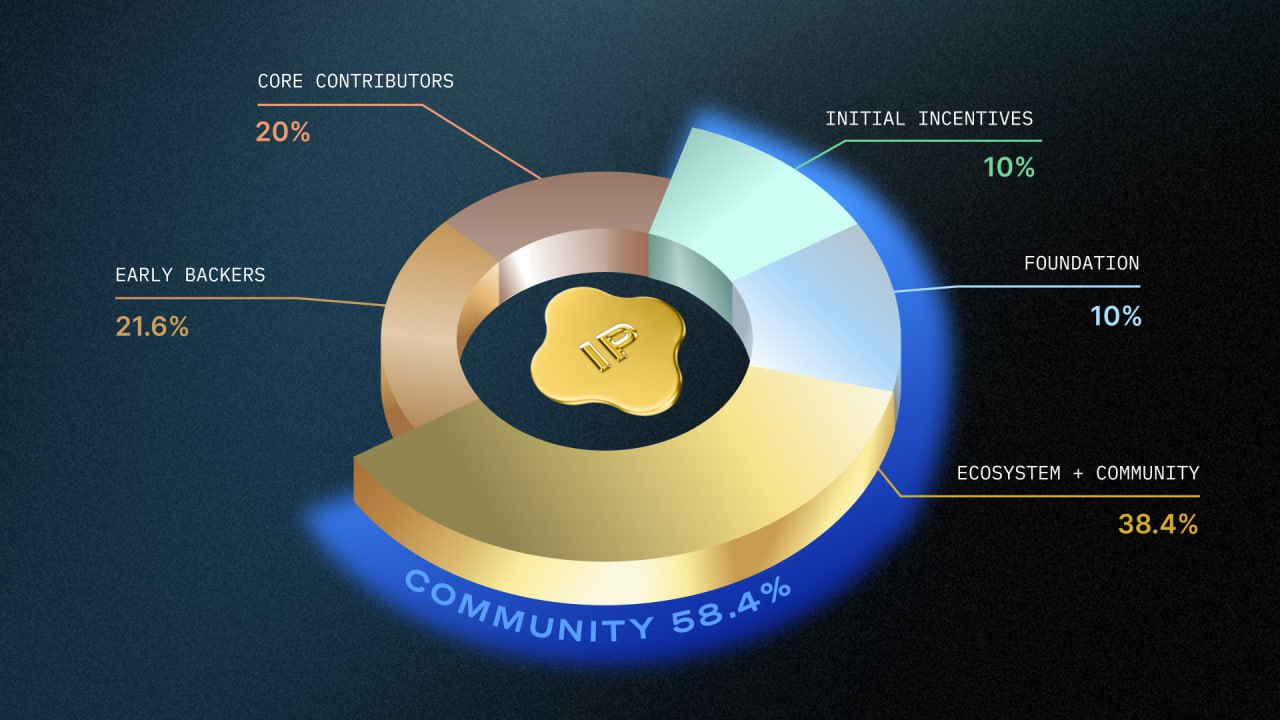
| Allocation Category |
Share |
Amount |
Purpose |
| Ecosystem and Community |
38.40% |
384 million |
Funding ecosystem developers, IP marketplaces, and DApp development, forming the core driver of ecosystem growth |
| Initial Incentives |
10% |
100 million |
Early user incentives such as airdrops, supporting a fair network launch and early participation |
| Foundation |
10% |
100 million |
Held by the Story Protocol Foundation to support research, development, and long-term protocol operations |
| Early Supporters |
21.60% |
216 million |
Allocated to private investors, typically with a 48-month linear vesting schedule to reduce selling pressure |
| Core Contributors |
20% |
200 million |
Allocated to the team and core developers with multi-year lockups to support long-term commitment |
The Role of IP Token in the Creator Economy
Beyond its infrastructure functions within the network, the IP token plays a central role in enabling value flow across the creator economy.
-
IP Registration and Ownership Verification
-
Creators use IP tokens to register intellectual property on-chain, generating an immutable proof of ownership recorded on the blockchain.
-
Automated Royalty and Revenue Distribution
-
Creators can define programmable IP licenses (PIL). When derivative works generate revenue, smart contracts automatically distribute royalties to the original IP holders in IP tokens, removing the need for intermediaries.
-
Settlement in AI Data Markets
-
In the AI era, IP tokens may serve as a payment medium when AI models access training data or generate content based on registered intellectual property, helping ensure that data contributors receive compensation.
Staking and Network Security
Story Protocol operates under a Proof of Stake (PoS) consensus mechanism, making staking an important component of network security.
Validators must stake a certain amount of IP tokens in order to participate in block production and transaction validation. Voting power typically corresponds to the amount of tokens staked. If a validator behaves maliciously, such as performing double-signing or attempting network attacks, the staked tokens may be penalized.
Token holders can also contribute to network security through delegated staking. Instead of running validator nodes themselves, users may delegate their IP tokens to trusted validators and receive staking rewards.
The protocol may also provide multiple staking options. Flexible staking allows users to withdraw tokens after a defined unbonding period, while longer lockup periods may provide higher reward rates in exchange for extended participation in network security.
Deflationary Mechanism of the IP Token
The IP token incorporates mechanisms designed to offset inflation from the initial supply and potentially increase scarcity as ecosystem activity grows.
-
Periodic Burn Mechanism
-
A portion of protocol revenue may be used to repurchase IP tokens from the market and permanently burn them. This process gradually reduces circulating supply and may support long-term value retention.
-
Transaction-Based Consumption
-
Every on-chain transaction, such as IP registration or licensing activity, requires IP tokens as gas fees. A portion of these fees may also be burned. As ecosystem usage increases, the overall circulating supply may gradually decline.
IP Token and the Creator Economy: Opportunities and Risks
The token model used by Story Protocol introduces new possibilities for creator economies, though it also faces certain challenges.
From an opportunity perspective, blockchain technology can improve transparency in copyright management while enabling automatic royalty distribution through smart contracts. This allows creators to receive revenue more directly. In addition, programmable IP structures may encourage derivative creation and collaborative content development.
However, token-based economies can also be influenced by market volatility. Over time, tokens allocated to teams and early supporters may gradually unlock, potentially creating selling pressure if demand does not keep pace. The broader success of Story Protocol also depends on adoption by developers, creators, and traditional intellectual property organizations.
For this reason, the value of the IP token is influenced both by ecosystem demand and by the pace of ecosystem development.
Conclusion
IP Token functions not only as a digital asset but also as an essential infrastructure component within the decentralized intellectual property economy envisioned by Story Protocol. By integrating IP registration, licensing transactions, royalty distribution, and network security mechanisms into its token model, the protocol aims to build a more open and transparent creator economy.
As AI-generated content and digital creative industries continue to expand, on-chain economic activity surrounding intellectual property assets may grow. Within this evolving landscape, IP tokens may increasingly serve as a bridge connecting creators with global liquidity and digital markets.
FAQs
What Is the Total Supply of the IP Token?
The total supply of IP tokens is fixed at 1 billion. In addition, part of the transaction fees on the network may be burned, which could create deflationary conditions under certain circumstances.
What Are the Main Uses of the Story Protocol IP Token?
Key uses include paying network transaction fees, participating in on-chain governance, staking to help maintain network security, and settling payments related to IP licensing transactions and royalty distribution.
How Does Story Protocol Help Creators Earn Revenue?
Creators can register their works as on-chain IP assets and earn royalties through licensing, derivative creations, or AI data usage. Revenue distribution is executed automatically through smart contracts without relying on traditional intermediaries.
How Is the IP Token Used in the AI Economy?
In AI-generated content environments, the token may be used to pay licensing fees for training data or to distribute revenue generated by AI-created content. This mechanism helps ensure that original creators receive compensation.
How Does Story Protocol Differ From Traditional Copyright Systems?
Traditional copyright systems rely on legal contracts and intermediaries to manage licensing and revenue distribution. Story Protocol introduces a blockchain-based structure where licensing and royalty distribution can be executed automatically through smart contracts, improving transparency while reducing transaction costs.







