In the crypto market, low-barrier leveraged tools are gradually replacing parts of traditional contract trading. Smart Leverage has attracted significant attention due to its no-margin requirement and absence of liquidation risk. However, this simplified user experience can easily lead users to overlook the underlying risk structure.
In reality, leverage trading always amplifies both risk and return. Smart Leverage does not eliminate risk. Instead, through dynamic leverage and automated risk controls, it transforms liquidation risk into return uncertainty and volatility risk. Understanding this shift is essential for using the tool rationally.
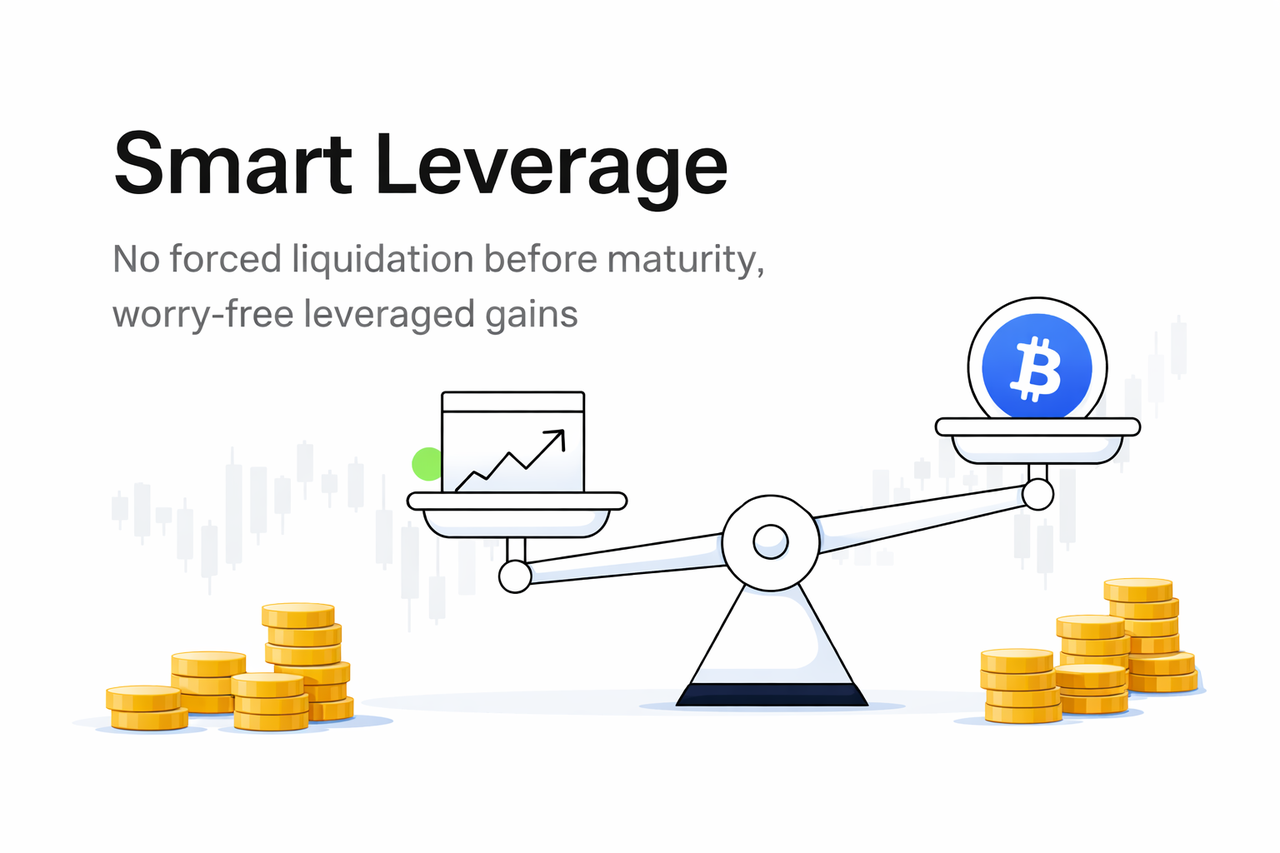
Smart Leverage is designed as a system-managed trading tool that automatically adjusts leveraged positions. Users do not need to provide margin or manually set leverage. Instead, the system dynamically adjusts positions based on market conditions to achieve leveraged exposure. While this simplifies operations and reduces liquidation risk, it also introduces new risks, particularly reduced user control over leverage and a stronger dependence of performance on market structure.
Key Risk Types of Smart Leverage
Although Smart Leverage improves upon certain risks found in traditional leveraged trading, it still carries several potential risks, mainly at the structural and market levels.
Risk 1: Uncertainty from Dynamic Leverage
Leverage in Smart Leverage is not fixed. It adjusts automatically based on market conditions. This means users cannot predict the exact leverage level or accurately forecast returns.
This uncertainty often leads to outcomes that differ from the intuitive expectation of multiplied returns. In some cases, even when market direction is correctly anticipated, actual returns may fall short of expectations.
Risk 2: Market Volatility Risk
Regardless of the mechanism, leverage inherently amplifies market movements. During periods of high volatility, the net value of Smart Leverage positions can change rapidly.
If the market moves against the user’s position, losses will still be amplified, just not in the form of liquidation.
In sideways or highly volatile markets, frequent price fluctuations can erode returns. The dynamic rebalancing of leverage may gradually reduce gains over time.
Even if the price eventually returns to its original level, users may still incur losses due to adjustments made along the way. This effect is similar to volatility decay, a commonly overlooked risk.
Risk 4: Path Dependency
Returns from Smart Leverage depend not only on the final price but also on how the price moves over time. This is known as path dependency.
For example, the same overall price change can produce very different results depending on the sequence of movements. This adds complexity and makes outcomes less predictable.
Risk 5: Extreme Market Risk
During black swan events or extreme volatility, markets can experience rapid and sharp price movements. Although Smart Leverage includes automated risk controls, it cannot fully prevent large swings in net value.
In such cases, users may face significant losses within a short period.
Risk 6: Limited User Control
The automated nature of Smart Leverage reduces operational complexity, but it also limits the user’s ability to control leverage levels or position structures precisely.
For traders who rely on advanced or highly customized strategies, this limitation can reduce flexibility and increase execution uncertainty.
Common Misconceptions About Smart Leverage
Many users misunderstand Smart Leverage. For instance, some equate “no liquidation” with “no risk,” or assume it is inherently safer than contract trading.
In reality, these assumptions are incorrect. Smart Leverage simply changes how risk manifests rather than reducing it. Another common misconception is treating it as a long-term investment tool, whereas its return structure is generally more suited to short-term or strategy-driven trading.
When Is Smart Leverage More Risky?
Risk tends to be higher in sideways markets with no clear trend, as frequent fluctuations can erode returns.
In extreme market conditions or during unexpected events, uncertainty increases and can amplify risk. Additionally, using Smart Leverage without a clear strategy or by blindly following market sentiment often leads to losses.
How to Reduce Smart Leverage Risk
The key to reducing risk lies in using the tool correctly. First, avoid overexposure and manage position size carefully. Second, prioritize markets with clear trends.
Equally important is understanding how dynamic leverage works and adjusting expectations accordingly. Users should recognize that returns are not simply multiplied by a fixed factor, which helps prevent poor decisions driven by unrealistic expectations.
Smart Leverage vs ETF / Contracts: Risk Comparison
Compared to leveraged ETF tokens, Smart Leverage carries uncertainty due to its dynamic leverage, while ETFs are more affected by fixed multipliers and rebalancing mechanisms.
Compared to contract trading, Smart Leverage removes liquidation risk but offers less control over returns, whereas contracts provide greater flexibility at the cost of higher risk.
Conclusion
Smart Leverage is not a low-risk leveraged tool. It is a tool with a different risk structure. While its automated mechanisms reduce liquidation risk, they introduce return uncertainty and path dependency.
Only by fully understanding its mechanics and risks, and combining that knowledge with sound market judgment and strategy, can users use this tool effectively.
FAQs
Is Smart Leverage completely risk-free?
No. While it eliminates liquidation risk, it still involves market volatility and return uncertainty.
Why do returns sometimes fall short of expectations
Because leverage is dynamically adjusted, and returns depend on the path of market movements.
Why are losses common in choppy markets?
Frequent fluctuations can gradually erode returns.
Is it suitable for long-term holding?
Generally not recommended. It is better suited for short-term or strategic trading.
How can I reduce risk when using Smart Leverage?
Control position size, choose appropriate market conditions, and fully understand how the mechanism works.







