Within the decentralized finance (DeFi) ecosystem, lending protocols form one of the most fundamental financial layers. Users can borrow by collateralizing assets or earn yield by supplying liquidity, making these protocols central to the broader market.
Among the many lending protocols, Aave stands out as an early pioneer, establishing a liquidity pool–based lending model. Morpho, on the other hand, builds on this foundation with an optimization approach, introducing a new matching mechanism to improve rate efficiency and carve out a differentiated role within the same sector.
Overview of the DeFi Lending Landscape: Positioning of Morpho vs Aave
As a typical native lending protocol, Aave is built around the liquidity pool model. User deposits are aggregated into a shared pool, from which borrowers draw funds. Interest rates are dynamically adjusted based on supply and demand. This structure is simple, reliable, and remains the dominant model in DeFi lending today.
In contrast, Morpho is not a fully standalone lending protocol. Instead, it operates as an optimization layer on top of Aave, and also integrates with Compound. By introducing peer-to-peer matching, it enables lenders and borrowers to transact directly, achieving more favorable rates within the same market.
Morpho vs Aave: Key Differences
The differences between Morpho and Aave span multiple dimensions, including interest rate mechanisms, capital matching, yield performance, architectural dependencies, and system complexity. At their core, the distinction is clear: Aave functions as foundational lending infrastructure, while Morpho serves as an efficiency optimization layer.
| Dimension |
Morpho |
Aave |
| Protocol Type |
Optimization Layer |
Native Lending Protocol |
| Interest Mechanism |
P2P + Pool Fallback |
Pure Liquidity Pool |
| Capital Matching |
Direct User Matching |
Shared Pool Matching |
| Yield Potential |
Higher Potential Returns |
More Stable |
| Architecture |
Dependent on Base Protocol |
Independent |
| Complexity |
Higher |
Lower |
Core Mechanism Comparison of Morpho and Aave : P2P Matching vs Liquidity Pools
Aave’s core mechanism revolves around liquidity pools. All deposits are pooled together, and borrowers draw from this shared liquidity. Interest rates are determined dynamically based on supply and demand. While this ensures strong liquidity and predictability, it also creates a spread between deposit and borrowing rates.
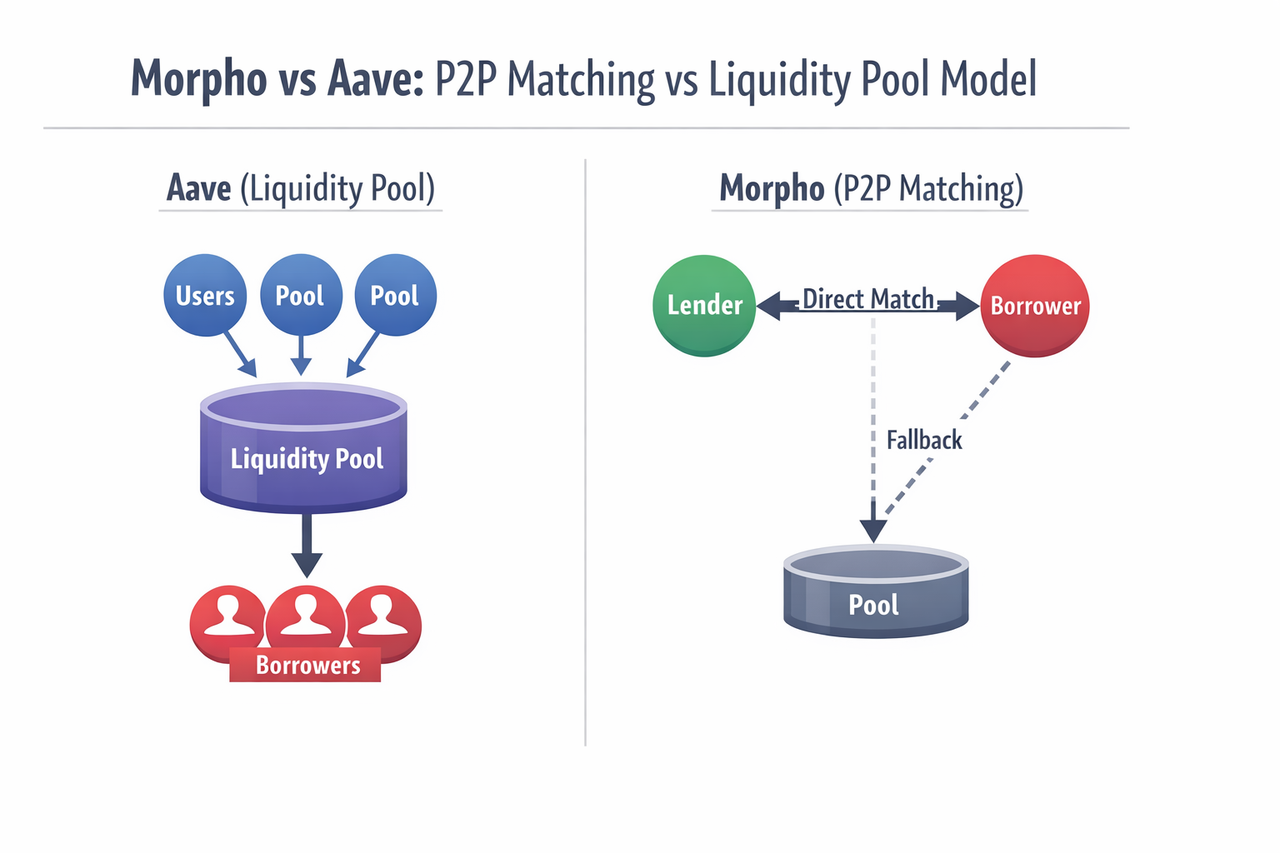
Morpho builds on this by introducing a peer-to-peer matching mechanism. When market conditions allow, lenders and borrowers are matched directly, bypassing the pool’s unified rate model. This reduces the spread between lending and borrowing rates, benefiting both sides.
When full matching is not possible, Morpho automatically routes unmatched funds back into Aave’s liquidity pool, ensuring uninterrupted liquidity.
Architecture Comparison of Morpho and Aave : Optimization Layer vs Native Protocol
From an architectural perspective, Aave is a complete lending system. Its smart contracts handle fund management, interest rate calculations, and liquidation processes, all within a unified protocol.
Morpho, by contrast, adopts a layered design. Its primary role is to optimize rate matching rather than rebuild the lending system from scratch. User assets remain stored in the underlying protocol, and liquidation and risk management are also handled at that base layer.
This approach allows Morpho to enhance efficiency while inheriting Aave’s security, but it also means Morpho depends on the stability of the underlying protocol.
User Experience Comparison of Morpho and Aave : Yield, Cost, and Usability
From the user's perspective, the main differences lie in yield and cost structures.
In Morpho, the P2P matching mechanism often allows lenders to earn higher returns than pool rates, while borrowers may benefit from lower borrowing costs. These advantages become more pronounced in markets with sufficient scale and efficient matching.
Aave, in contrast, provides a standardized interest rate environment. Rates are fully determined by supply and demand. While they may not be as optimized as Morpho’s in certain scenarios, they offer greater stability and predictability.
In terms of usability, Aave is more straightforward, while Morpho’s internal mechanics are more complex, though typically abstracted away from the user interface.
Risk Structure Comparison between Morpho and Aave
The two protocols also differ in their risk profiles.
Aave’s risks are primarily tied to its smart contracts and market volatility. Thanks to its pooled model, liquidity remains relatively stable.
Morpho introduces an additional layer of mechanism risk. Beyond the risks inherited from the underlying protocol, users must also consider P2P matching efficiency and the behavior of its optimization logic. However, its pool fallback mechanism helps ensure liquidity remains intact.
In this sense, Morpho’s risk model can be seen as “inherited plus extended,” whereas Aave represents a more contained, single-system risk structure.
Token Model Comparison: MORPHO vs AAVE
The token designs of the two protocols reflect different philosophies.
Aave’s native token, AAVE, serves not only governance purposes but also plays a role in protocol security, such as through staking mechanisms. It carries multiple functional responsibilities within the system.
MORPHO, by contrast, is primarily a governance token. Its main purpose is to participate in protocol decision-making rather than being directly tied to lending yields or fee distribution. This design emphasizes control rather than economic incentives.
As a result, the two represent distinct token strategies: functional utility versus governance-centric design.
Use Case Comparison Between Morpho and Aave
In practice, the two protocols cater to different user needs.
If users prioritize rate optimization and want to maximize returns or minimize borrowing costs, Morpho offers a more efficient solution.
If users value stability, simplicity, and a mature ecosystem, Aave remains the more direct and reliable choice as a foundational lending protocol.
Therefore, rather than being direct substitutes, Morpho and Aave provide different layers of service within the same market.
Conclusion
Although Morpho and Aave both operate in the DeFi lending space, their design philosophies differ fundamentally. Aave provides core lending infrastructure, while Morpho builds on top of it as an optimization layer, improving capital efficiency through peer-to-peer matching.
This relationship between infrastructure and optimization reflects a broader trend in DeFi, where protocols are evolving from monolithic designs toward modular systems focused on efficiency and specialization.
FAQs
Are Morpho and Aave competitors?
They compete to some extent, but are more complementary, since Morpho relies on Aave as its underlying layer.
Does Morpho fully depend on Aave?
In its early design, it relied on Aave and Compound, though its independence has increased with architectural upgrades.
Which protocol offers higher yields?
Morpho may provide higher returns under certain conditions, but this is not guaranteed.
Is Morpho safer?
Its security partly depends on Aave, while also introducing an additional mechanism layer.
Which is better for beginners?
Aave is generally more intuitive, while Morpho is better suited for users seeking rate optimization.







