As the cryptocurrency market evolves from being dominated by retail investors to a more institutional landscape, its structure has changed dramatically. The influx of larger capital has led to bigger single trades, and trading has shifted from simple buy-sell actions to more sophisticated asset allocation and risk management strategies. This trend has exposed the limitations of traditional order book-based matching mechanisms, especially when handling large orders where liquidity depth is insufficient.
When a large order hits the order book, it often sweeps through multiple price levels of maker orders, causing slippage and short-term price volatility. This not only increases trading costs but also makes outcomes less predictable. As a result, the market has sought ways to execute block trades without impacting public prices, fueling the rapid development of crypto OTC trading.
From a market structure perspective, OTC trading forms an important yet relatively “invisible” layer of liquidity in the crypto ecosystem. While OTC trades are not conducted publicly, they facilitate significant institutional capital flows, particularly for asset allocation, fund rebalancing, and project treasury management—making OTC almost the default execution route for such needs.
Basic Concepts of OTC Trading
Crypto OTC trading refers to transactions conducted directly between two parties or via intermediaries, outside public exchanges. Unlike order book trading, OTC trades are not publicly posted—they’re negotiated privately or completed through quote systems.
The core feature of OTC is “non-public execution.” Because trading intentions are not visible to the market, OTC helps avoid the price swings often triggered by large orders. OTC trades are typically executed in a single transaction at a set price, rather than being matched in batches.
Core Participants in OTC Trading
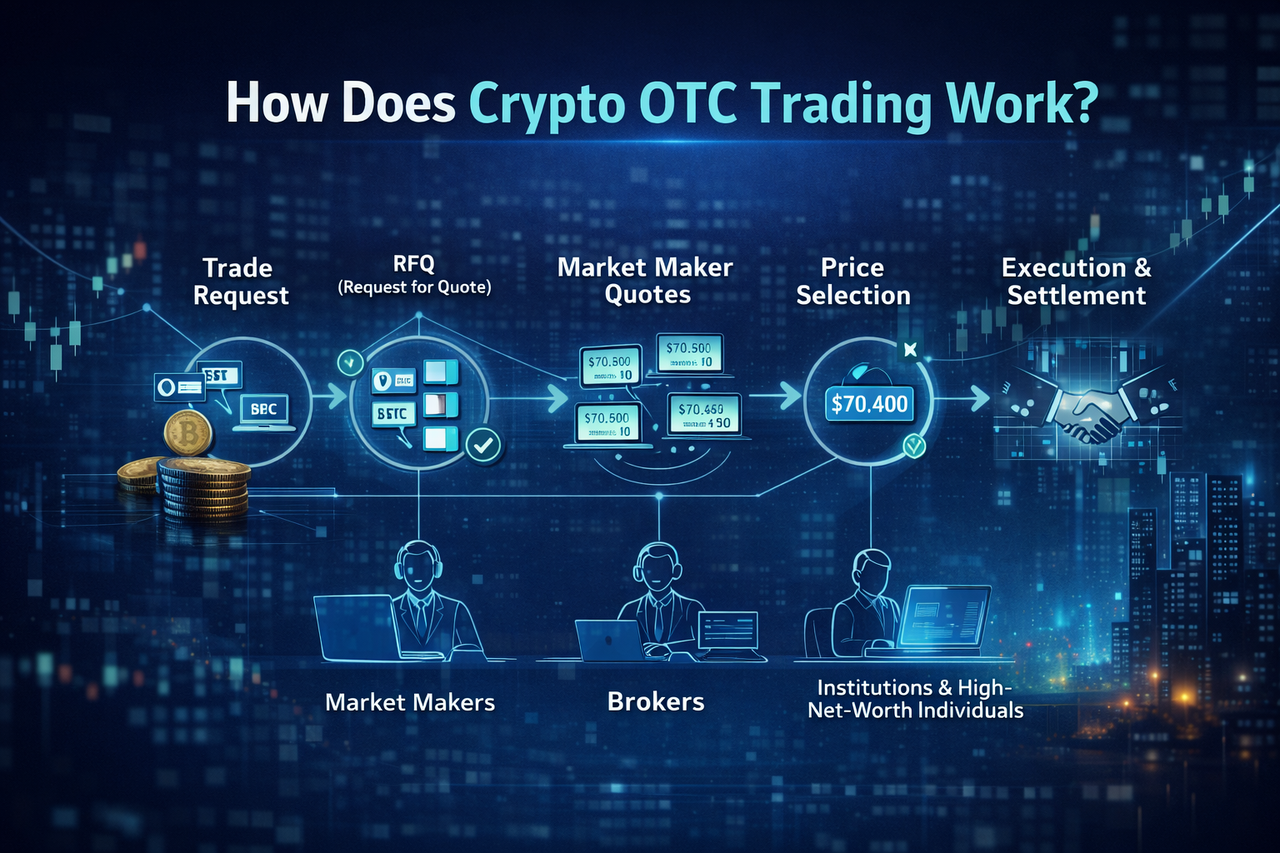
The OTC market relies on the collaboration of several key players. Market makers are central, providing continuous buy and sell quotes to support liquidity. Brokers or OTC platforms act as intermediaries, connecting counterparties and improving matching efficiency.
On the demand side, institutional investors and high-net-worth individuals are the primary participants, executing large trades for asset allocation. On the supply side, miners, project teams, and long-term holders provide tradable assets. This multi-tiered structure enables the OTC market to efficiently match diverse needs.
Complete OTC Trading Workflow
-
Initiating Trade Demand
OTC trades typically start with a specific trading need. The trader determines the asset type, trade size, and execution goals. In institutional settings, this process is often automated and integrated with investment strategies.
-
RFQ (Request for Quotation) Phase
Once the need is defined, the trader sends RFQs to multiple market makers using the RFQ mechanism. These requests specify trade size and side, but are not publicly disclosed—helping to prevent market anticipation.
-
Market Maker Quotation
Upon receiving RFQs, market makers provide quotes based on current market prices, liquidity, and their own risk exposure. These quotes include a spread and are valid for a limited time.
-
Quote Evaluation and Decision
Traders review multiple quotes and make a decision. While price is crucial, factors like execution probability, speed, and counterparty reliability also influence the choice.
-
Trade Execution
Once a quote is accepted, the trade is executed at the agreed price. Unlike exchanges, OTC trades are generally filled in full, avoiding the uncertainty of partial fills.
-
Settlement and Delivery
After execution, assets are transferred via escrow accounts or settlement systems. In some cases, third-party custodians are involved to mitigate counterparty risk and enhance security.
Key Mechanisms in OTC Trading
RFQ Mechanism: Core of Price Discovery
The RFQ mechanism allows traders to discover prices privately by soliciting multiple quotes. This approach increases price competitiveness while minimizing public market impact.
Market Maker Pricing Logic
Market makers set quotes by factoring in market price, volatility, and their own inventory. The spread reflects both risk compensation and liquidity costs.
Role of Algorithmic Trading
With ongoing technological advancements, algorithmic trading has become integral to OTC workflows. Automated RFQ distribution and quote selection significantly improve execution efficiency and help traders achieve optimal outcomes.
Execution Differences: OTC vs. Exchange
The fundamental difference between OTC and exchanges is the trading mechanism. Exchanges use order book matching for price discovery, prioritizing transparency and continuous trading. OTC, by contrast, completes trades through private quotes, focusing on stability and certainty.
This distinction makes exchanges ideal for smaller or high-frequency trades, while OTC is better suited for large trades and institutional activity. Together, they create a complementary trading ecosystem.
Advantages and Limitations of OTC Trading
OTC trading’s main advantages are minimizing slippage and avoiding market impact. Private execution allows large trades to be completed without moving public prices, and custom quotes provide more stable outcomes.
However, OTC trading also has limitations. Counterparty risk is a major concern—if the other party defaults, funds may be at risk. Also, because quotes are private, transparency is lower, making price discovery more challenging.
Real-World Applications of OTC Trading
OTC is widely used for institutional asset allocation, fund rebalancing, and project treasury management. For example, when an institution needs to allocate large assets quickly, exchange execution may cause significant price swings, whereas OTC provides a more stable solution.
Additionally, during periods of heightened volatility or tight liquidity, OTC is often used to reduce execution risk, making it highly adaptable across different market conditions.
Summary
Crypto OTC trading enables efficient block trade execution through the RFQ mechanism and market maker quotes. The process covers demand initiation, quote acquisition, trade execution, and settlement, with ongoing optimization from algorithmic trading. As the market continues to evolve, OTC will remain central to institutional trading and a vital pillar of the digital asset financial system.
FAQs
What is the fundamental difference between OTC trading and exchange trading?
OTC trading is completed privately via quotes and does not rely on a public order book; exchanges use a matching mechanism for public trading.
Why are large trades better suited for OTC?
OTC helps avoid direct market impact from large orders, reducing slippage.
What role does RFQ play in OTC?
RFQ is used to request quotes from multiple market makers and is essential for finding the best price.
Does OTC trading have zero market impact?
Not entirely, but its direct market impact is much less than that of exchange trading.
Is OTC trading safe?
Risks can be effectively managed by choosing reliable counterparties or using custodial solutions, but careful risk assessment remains necessary.