During blockchain development, users often question the architecture and performance of platforms they’re considering. Dfinity and Ethereum both enable application development, but they diverge significantly in execution models and scalability paths.
These questions generally revolve around three aspects: network architecture, execution model, and scalability. Together, these factors determine which platform is most appropriate for a given scenario.
What Is Dfinity (ICP)? The Internet Computer Explained
Dfinity is a blockchain network built on the Internet Computer Protocol, designed to deliver a decentralized environment for computation and application hosting.
Mechanically, applications run as Canisters—units containing both code and data—executed collectively by nodes within a subnet. The ICP token is used to pay for computational resources and for governance participation.
Structurally, the Dfinity network consists of nodes, subnets, and a protocol layer. Each subnet independently executes computational tasks, enabling parallel processing.
This architecture gives blockchain capabilities similar to those of cloud computing platforms.
Ethereum is a blockchain platform supporting smart contracts, primarily used to build decentralized applications (dApps) and asset systems.
Mechanically, developers deploy application logic via smart contracts and pay Gas fees to execute transactions and computations. The network maintains all contract data via a global state.
Structurally, Ethereum operates with a single-chain architecture and boosts performance through Layer2 scaling solutions.
This design offers developers a unified and open application environment.
Dfinity vs. Ethereum: Network Architecture Differences
The platforms’ network architectures drive their overall performance and scalability strategies.
Mechanically, Ethereum processes transactions on a single chain or through layered scaling, while Dfinity divides tasks among subnets, allowing parallel computation across the network.
Structurally, Ethereum nodes maintain a unified state, whereas Dfinity distributes state across multiple subnets, enabling horizontal scaling.
The takeaway: Dfinity emphasizes computational scalability, while Ethereum prioritizes consistency and security.
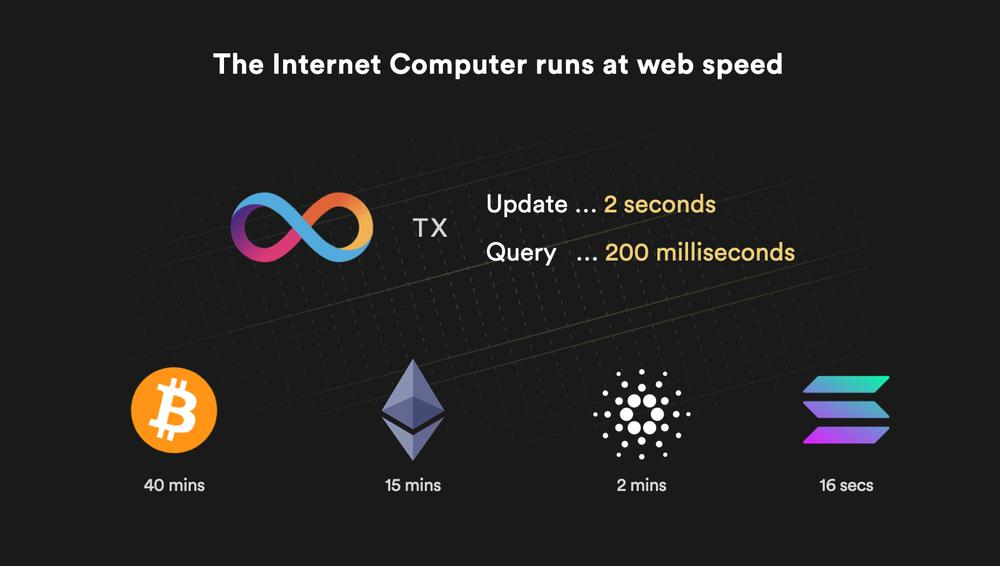
Canisters vs. Smart Contracts: Execution Differences
Execution model is one of the most critical differences.
Mechanically, Ethereum smart contracts execute per transaction and are limited by Gas, while Dfinity’s Canisters can run continuously, with resource consumption paid for in Cycles.
Structurally, Ethereum contracts primarily handle transaction logic, while Canisters function as comprehensive service units capable of complex application logic and data storage.
This distinction makes Dfinity better suited for complex applications, while Ethereum is optimized for financial protocols.
Consensus Mechanisms and On-Chain Governance: Key Differences
Consensus and governance follow distinct paths on each platform.
Mechanically, Ethereum uses Proof of Stake (PoS) for block validation, while Dfinity leverages subnet consensus and chain key cryptography for consistent execution. Dfinity also enables on-chain governance via the NNS.
Structurally, Ethereum governance relies more on off-chain coordination; Dfinity embeds governance within the blockchain system itself.
In practice, Dfinity achieves greater automation in governance, while Ethereum supports a more open, community-driven decision model.
Performance and scalability are major differentiators.
Mechanically, Ethereum boosts throughput with Layer2, while Dfinity increases overall compute power through parallel subnet processing.
Structurally, Ethereum’s scalability depends on additional layers, whereas Dfinity supports native horizontal scaling at the foundational level.
For a side-by-side comparison:
| Dimension |
Dfinity |
Ethereum |
| Architecture |
Parallel Subnets |
Single Chain + Layer2 |
| Execution |
Continuously Running Canisters |
Transaction-Based Contracts |
| Fee Model |
Cycles (Resource Consumption) |
Gas Fees |
| Scalability |
Native Horizontal Scaling |
Layered Scaling |
| Application Type |
Full-Stack Applications |
DeFi & Protocols |
This table highlights the distinct design goals and implementation strategies of each platform.
Summary
Dfinity and Ethereum represent two different paradigms: on-chain compute platforms and smart contract platforms. Their architectural and execution differences define their unique application scenarios.
FAQ
What’s the main difference between Dfinity and Ethereum?
The execution model—Dfinity focuses on on-chain computation, while Ethereum centers on transaction execution.
How do Canisters differ from smart contracts?
Canisters support continuous operation and data storage, functioning more like full application services.
Which platform offers better scalability?
It depends on the scaling approach: Dfinity uses subnets, while Ethereum relies on Layer2.
Can both be used together?
Yes; you can select the optimal platform based on application needs.
Which is better for application development?
That depends on the application’s complexity and runtime requirements.







