As Web3 applications expand beyond on-chain logic into scenarios driven by real world data, oracles have become a critical piece of infrastructure. Understanding the typical use cases of Chainlink helps clarify its role across different business contexts and the boundaries of where it is most appropriate.
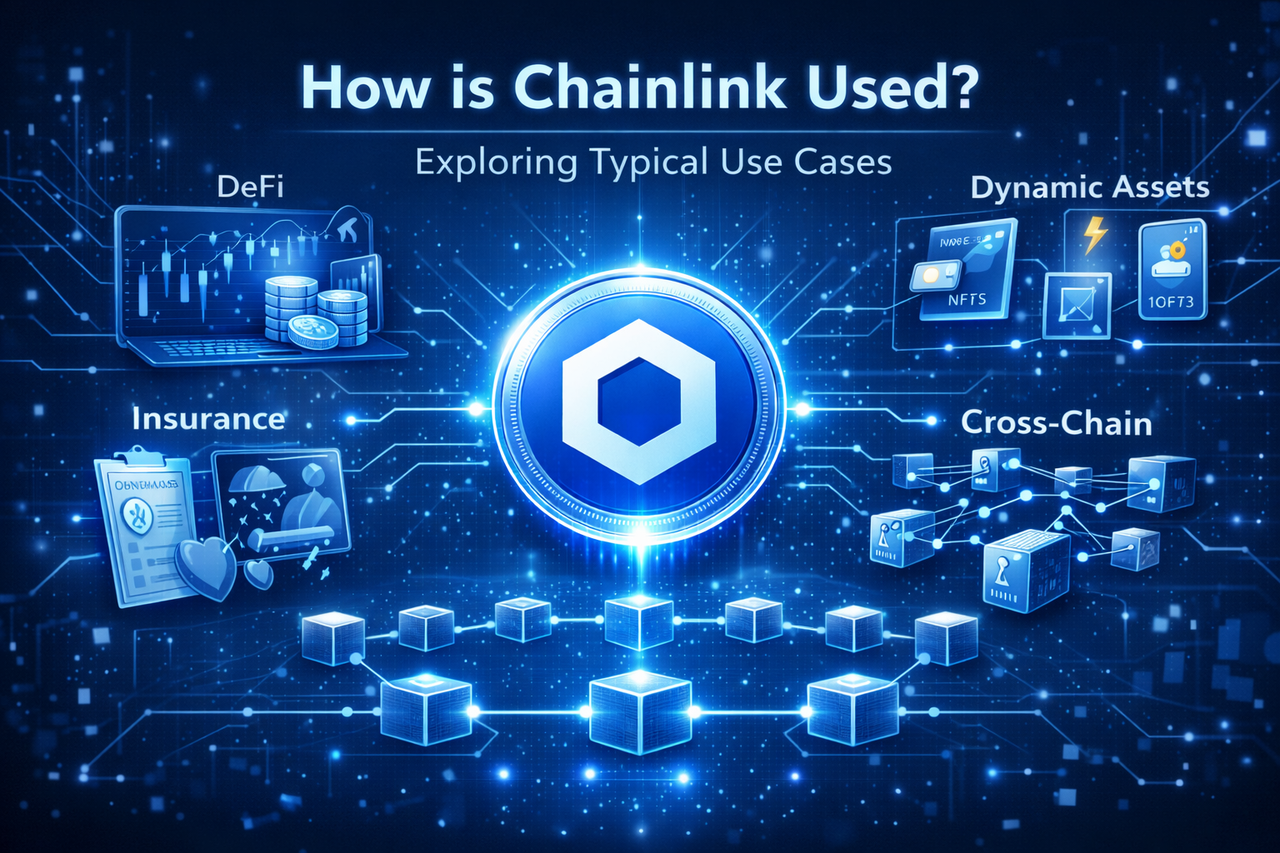
Why Can Chainlink Bring Off-Chain Data Onto the Blockchain?
Blockchain systems operate in closed environments. Smart contracts can only access on-chain data and cannot directly retrieve information from the real world. This design ensures determinism and verifiability, but it also limits the range of possible applications.
Chainlink establishes a decentralized oracle network that creates a secure channel for off chain data input. Through this mechanism, smart contracts can access price feeds, time based information, or the outcomes of real world events. Multiple independent nodes retrieve data from different sources and aggregate the results on chain, reducing the risk of single point failures or manipulation.
Chainlink’s internal architecture not only enables data delivery but also preserves the transparency and verifiability required by decentralized systems, allowing blockchain applications to depend on external information with greater confidence.
Main Types of Chainlink Applications in Decentralized Finance DeFi
In decentralized finance systems, many core functions rely on accurate pricing and market data. Chainlink supplies price feeds that allow financial protocols to perform calculations and risk management based on real market conditions.
For example, in collateralized lending protocols, asset prices are used to calculate collateral ratios and risk thresholds. In derivatives protocols, pricing data supports settlement and risk controls. In asset management scenarios, price information is used to assess portfolio performance and status.
Because financial applications often involve significant value, the reliability of data inputs is essential. Chainlink’s multi node structure and on chain aggregation mechanism help reduce the risks associated with errors from any single data source.
How Does Chainlink Support Contract Settlement and Conditional Applications?
One of the key strengths of smart contracts is automated rule execution. However, many rules depend on real world conditions. A contract may need to execute at a specific time, settle when a certain indicator reaches a threshold, or trigger follow up processes after an event occurs.
Chainlink can provide timestamp data, market indicators, or other verifiable information that enables contracts to execute automatically based on predefined conditions. This reduces the need for manual intervention and increases predictability and transparency in the execution process.
Condition based applications are common in financial settlements, automated payments, supply chain workflows, and the execution of digital agreements.
The Role of Chainlink in Insurance and Risk Triggered Scenarios
Insurance applications typically rely on real world events to trigger payouts, such as weather conditions, flight delays, or natural disasters. Traditional insurance processes depend on manual verification and centralized confirmation, while smart contract based insurance requires verifiable data inputs.
Chainlink can bring weather data, flight information, or other event outcomes onto the blockchain, enabling contracts to automatically execute payout logic once predefined trigger conditions are met. This automated approach helps improve transparency and reduce human intervention.
In risk management scenarios, reliable data inputs are equally important, since trigger conditions directly determine how the system responds.
How Is Chainlink Used for Dynamic NFTs and On Chain Assets?
As on chain asset use cases expand, asset attributes are no longer limited to static information. Some NFTs or digital assets may update their state based on real world data or the passage of time.
The attributes of digital assets may change based on sports results, weather conditions, or specific time cycles.
Chainlink provides external data inputs that allow asset states to update dynamically in response to real world conditions.
This mechanism broadens how on chain assets can behave, enabling them to reflect changes in the real world and support richer interactive experiences.
How Is Chainlink Applied in Cross Chain and Inter System Communication?
The blockchain ecosystem consists of multiple independent networks and systems, and the need for data exchange between applications continues to grow. Chainlink can act as an intermediary mechanism that allows smart contracts to become aware of external systems or the state of other blockchains.
By supplying verifiable data inputs, oracles can help contracts retrieve cross system information and support more complex interaction logic.
Contracts may execute rules based on the state of external systems or synchronize key data across different networks.
This capability enhances interoperability within blockchain systems, enabling applications to operate across a broader technical environment.
How Should We Understand the Boundaries and Limitations of Chainlink’s Use Cases?
Although Chainlink expands what blockchain applications can do, oracles cannot solve every problem. Their reliability still depends on the quality of underlying data sources and node configuration. If the original data source contains errors, the system may still be affected.
In addition, not every application requires off chain data. In scenarios where pure on chain logic is sufficient, introducing an oracle may add unnecessary complexity.
Understanding the boundaries of oracle usage helps system designers assess when it is necessary and appropriate within an overall architecture.
Summary of Typical Chainlink Use Cases
| Application Area | Data Type | How It Is Used | Value Delivered |
| DeFi | Market price data | Supports risk calculations and settlement processes | Improves the reliability of financial protocols |
| Conditional Contracts | Time and indicator data | Enables automatic rule execution | Enhances automation and transparency |
| Insurance and Risk Management | Real world event data | Triggers payouts and contract execution | Reduces the need for manual intervention |
| NFT and Digital Assets | External event and time based data | Dynamically updates asset attributes | Strengthens interactivity and expressiveness |
| Cross Chain and System Communication | External system state data | Supports interoperability logic | Expands collaborative capabilities across systems |
Overall, Chainlink’s applications are not limited to any single industry. Instead, they revolve around a core capability: providing reliable off chain inputs to smart contracts. While different scenarios require different types of data and levels of security, they share a common goal of enabling blockchain systems to operate in response to real world conditions.
Conclusion
Through its decentralized oracle network, Chainlink enables blockchains to securely access off chain data, supporting financial calculations, automated settlements, insurance triggers, dynamic asset updates, and cross system communication. Understanding its typical use cases and limitations helps clarify the essential role of oracles within Web3 infrastructure from a system level perspective.