This comprehensive guide compares ResearchCoin (RSC) and Aptos (APT), two distinct cryptocurrency assets serving different market segments. RSC, launched in November 2022, functions as a research incentivization token, while APT operates as a Layer 1 blockchain infrastructure platform utilizing the Move programming language since October 2022. The article analyzes historical price trends, current market status, tokenomics, liquidity metrics, and risk factors, with APT demonstrating superior trading volume ($2.24M vs $21.6K daily) and established market presence despite both experiencing 92% retracements from peaks. Through 2031 price forecasts, investment allocation strategies for conservative and aggressive investors, and detailed risk analysis, this guide addresses critical investor questions regarding which asset better suits different risk profiles on Gate exchange platforms, while emphasizing cryptocurrency market volatility and providing comprehensive due diligence frameworks.
Introduction: Investment Comparison Between RSC and APT
In the cryptocurrency market, the comparison between RSC vs APT has become an important topic for investors. The two tokens exhibit significant differences in market cap ranking, application scenarios, and price performance, representing distinct positioning within the crypto asset landscape.
ResearchCoin (RSC): Launched in November 2022, it has gained market recognition through its positioning as an incentive token for accelerating scientific discovery and fostering open research collaboration.
Aptos (APT): Since its launch in October 2022, it has been positioned as a high-performance Layer 1 blockchain utilizing the Move programming language, emerging as one of the notable blockchain infrastructure projects.
This article will comprehensively analyze the investment value comparison between RSC vs APT through the dimensions of historical price trends, supply mechanisms, technical ecosystems, and future outlook, attempting to address investors' most pressing question:
"Which is the better buy right now?"
I. Historical Price Comparison and Current Market Status
RSC (Coin A) and APT (Coin B) Historical Price Trends
- 2023: APT experienced notable price movement, reaching its all-time high of $19.92 on January 26, 2023, reflecting early market enthusiasm for the Aptos Layer 1 blockchain platform.
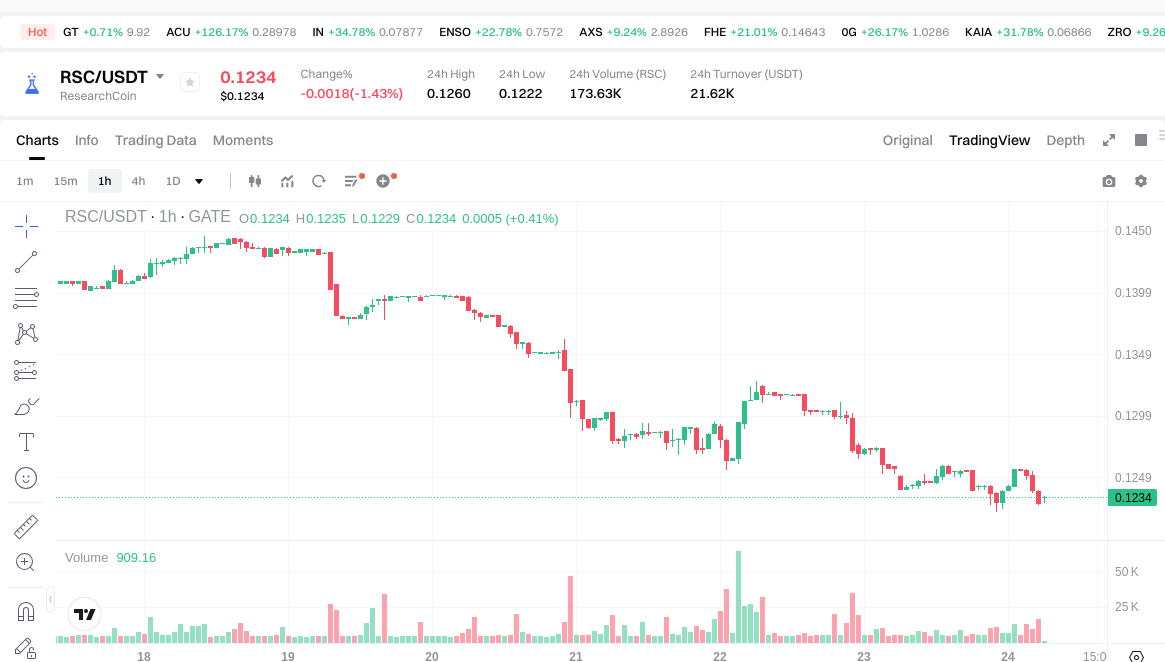
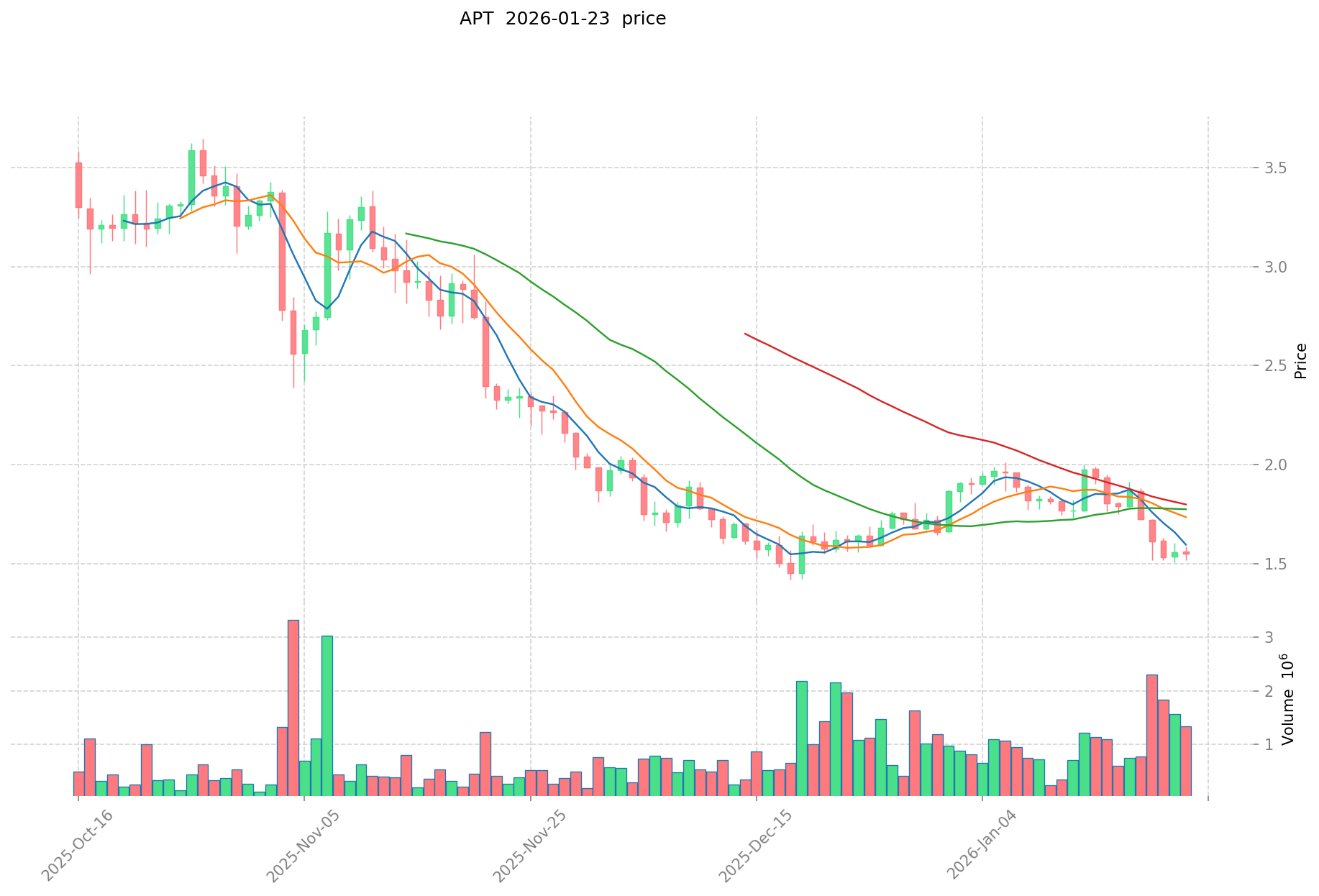
- 2025: RSC reached its peak price of $1.6 on January 3, 2025, while APT hit its all-time low of $1.42 on December 19, 2025, indicating divergent market trajectories during this period.
- Comparative Analysis: During the market cycle from 2023 to present, APT declined from its peak of $19.92 to its low of $1.42, representing significant retracement. RSC, having launched later in November 2022, demonstrated a different pattern, with its peak-to-trough movement from $1.6 to $0.112 occurring within a shorter timeframe.
Current Market Status (January 24, 2026)
- RSC Current Price: $0.1228
- APT Current Price: $1.5473
- 24-Hour Trading Volume: RSC recorded $21,649.51 versus APT's $2,241,872.77
- Market Sentiment Index (Fear & Greed Index): 24 (Extreme Fear)
View real-time prices:
II. Core Factors Affecting RSC vs APT Investment Value
Supply Mechanism Comparison (Tokenomics)
Due to insufficient reference materials regarding the supply mechanisms of RSC and APT, a detailed comparison cannot be provided at this time. The tokenomics structure, including supply caps, issuance schedules, and deflationary or inflationary models, would typically influence long-term price dynamics and investor sentiment.
Institutional Adoption and Market Application
Institutional Holdings: Current reference materials do not provide data on institutional positioning or preference between RSC and APT.
Enterprise Adoption: Information regarding the application of RSC or APT in cross-border payments, settlement systems, or institutional investment portfolios is not available in the provided materials.
National Policies: Regulatory attitudes toward RSC and APT across different jurisdictions are not covered in the available reference materials.
Technology Development and Ecosystem Building
RSC Technology Upgrades: The provided materials do not contain information about recent or planned technical developments for RSC.
APT Technology Development: Similarly, details about APT's technological roadmap or recent upgrades are not available in the reference materials.
Ecosystem Comparison: Data comparing the deployment and adoption of RSC and APT within DeFi protocols, NFT marketplaces, payment systems, or smart contract platforms is not present in the provided materials.
Macroeconomic Environment and Market Cycles
Performance in Inflationary Environments: The reference materials do not provide historical performance data or analysis regarding how RSC and APT have responded to inflationary pressures.
Macroeconomic Monetary Policy: Information on how interest rate changes, US dollar index movements, or other monetary policy factors have impacted RSC and APT is not available.
Geopolitical Factors: The influence of cross-border transaction demand, international relations, or geopolitical events on the adoption or valuation of RSC and APT is not addressed in the provided materials.
III. 2026-2031 Price Prediction: RSC vs APT
Short-term Prediction (2026)
- RSC: Conservative $0.0876-$0.1234 | Optimistic $0.1234-$0.1345
- APT: Conservative $1.07-$1.55 | Optimistic $1.55-$2.20
Mid-term Prediction (2028-2029)
- RSC may enter a gradual growth phase, with estimated price range of $0.0810-$0.2137
- APT may enter an expansion phase, with estimated price range of $1.27-$3.47
- Key drivers: institutional capital flows, ETF developments, ecosystem expansion
Long-term Prediction (2030-2031)
- RSC: Baseline scenario $0.1269-$0.2189 | Optimistic scenario $0.2590-$0.2953
- APT: Baseline scenario $2.34-$3.43 | Optimistic scenario $3.53-$3.88
View detailed price predictions for RSC and APT
Disclaimer
RSC:
| Year |
Predicted High Price |
Predicted Average Price |
Predicted Low Price |
Price Change |
| 2026 |
0.134506 |
0.1234 |
0.087614 |
0 |
| 2027 |
0.13669018 |
0.128953 |
0.08381945 |
5 |
| 2028 |
0.1540730444 |
0.13282159 |
0.0810211699 |
8 |
| 2029 |
0.213736502628 |
0.1434473172 |
0.083199443976 |
16 |
| 2030 |
0.2589582693753 |
0.178591909914 |
0.14823128522862 |
45 |
| 2031 |
0.295346371020277 |
0.21877508964465 |
0.126889551993897 |
78 |
APT:
| Year |
Predicted High Price |
Predicted Average Price |
Predicted Low Price |
Price Change |
| 2026 |
2.203414 |
1.5517 |
1.070673 |
0 |
| 2027 |
2.36572182 |
1.877557 |
0.99510521 |
21 |
| 2028 |
2.8005640212 |
2.12163941 |
1.272983646 |
37 |
| 2029 |
3.470153418996 |
2.4611017156 |
1.452050012204 |
59 |
| 2030 |
3.88497211316038 |
2.965627567298 |
2.34284577816542 |
91 |
| 2031 |
3.528058835436065 |
3.42529984022919 |
2.774492870585643 |
121 |
IV. Investment Strategy Comparison: RSC vs APT
Long-term vs Short-term Investment Strategies
- RSC: May appeal to investors interested in research incentivization models and early-stage projects with potential for ecosystem development in the scientific collaboration space.
- APT: May suit investors seeking exposure to Layer 1 blockchain infrastructure with established technical foundations utilizing the Move programming language.
Risk Management and Asset Allocation
- Conservative Investors: RSC: 20-30% vs APT: 70-80%
- Aggressive Investors: RSC: 40-50% vs APT: 50-60%
- Hedging Tools: Stablecoin allocation, options strategies, cross-asset portfolio diversification
V. Potential Risk Comparison
Market Risk
- RSC: Lower liquidity indicated by 24-hour trading volume of $21,649.51 may result in higher price volatility and potential execution challenges during market stress periods.
- APT: While demonstrating higher trading volume of $2,241,872.77, the asset has experienced significant price retracement from its peak, suggesting susceptibility to broader market sentiment shifts.
Technical Risk
- RSC: Scalability considerations and network stability factors remain areas requiring ongoing evaluation.
- APT: Potential concerns include network decentralization metrics and security vulnerability management inherent to blockchain infrastructure projects.
Regulatory Risk
Global regulatory developments may impact RSC and APT differently based on their distinct use cases—research incentivization versus blockchain infrastructure—though specific jurisdictional treatment remains subject to evolving policy frameworks.
VI. Conclusion: Which Is the Better Buy?
📌 Investment Value Summary:
- RSC Advantages: Early positioning in the research collaboration incentive space, potential upside from niche market development, lower absolute price point enabling accessible entry for retail participants.
- APT Advantages: Established Layer 1 blockchain infrastructure, higher liquidity facilitating smoother transaction execution, broader recognition within the blockchain ecosystem.
✅ Investment Recommendations:
- Novice Investors: Consider initiating exposure through APT due to its relatively higher liquidity and established market presence, while maintaining conservative position sizing given current market conditions reflected in the Fear & Greed Index of 24 (Extreme Fear).
- Experienced Investors: May evaluate a balanced allocation approach, potentially weighting APT more heavily while exploring RSC as a speculative component within a diversified crypto portfolio framework.
- Institutional Investors: Conduct comprehensive due diligence on both assets' technical fundamentals, governance structures, and ecosystem development trajectories before determining strategic allocation ratios aligned with institutional risk parameters.
⚠️ Risk Disclaimer: Cryptocurrency markets exhibit extreme volatility. This content does not constitute investment advice.
VII. FAQ
Q1: What is the primary difference between RSC and APT in terms of their use cases?
RSC is designed as an incentive token for scientific research collaboration, while APT serves as a Layer 1 blockchain infrastructure platform. RSC focuses on accelerating scientific discovery through token-based rewards for open research participation, positioning it within the niche sector of decentralized science (DeSci). APT, by contrast, operates as a high-performance blockchain using the Move programming language, targeting broader applications including DeFi, NFTs, and smart contract deployment. This fundamental distinction means investors are essentially comparing a specialized research incentive token against a general-purpose blockchain infrastructure asset.
Q2: Which token shows better liquidity for trading purposes?
APT demonstrates significantly better liquidity with a 24-hour trading volume of $2,241,872.77 compared to RSC's $21,649.51. This approximately 100x difference in trading volume means APT offers smoother entry and exit opportunities with reduced slippage risk during transaction execution. For investors prioritizing the ability to quickly adjust positions or execute larger trades without substantial price impact, APT's superior liquidity presents a clear advantage. RSC's lower liquidity may result in wider bid-ask spreads and increased difficulty executing substantial positions, particularly during periods of market stress.
Q3: How have RSC and APT performed relative to their historical peaks?
APT reached its all-time high of $19.92 on January 26, 2023, and currently trades at $1.5473, representing a decline of approximately 92% from its peak. RSC achieved its highest price of $1.6 on January 3, 2025, and currently trades at $0.1228, marking a decline of approximately 92% from its peak as well. Despite similar percentage retracements, the timeframes differ significantly—APT's decline occurred over a longer period (2023-2026), while RSC's drawdown happened within a much shorter window following its later launch in November 2022. Both assets have experienced substantial corrections from their respective peaks, reflecting broader crypto market cyclicality.
Q4: What are the key risk factors specific to each token?
RSC's primary risks include extremely low liquidity (evidenced by minimal daily trading volume), limited track record given its recent November 2022 launch, and dependence on the adoption of decentralized research incentivization models—a relatively unproven market segment. APT faces risks related to Layer 1 blockchain competition in an increasingly crowded infrastructure landscape, potential network security vulnerabilities inherent to blockchain platforms, and concentration concerns regarding decentralization metrics. Both tokens are exposed to regulatory uncertainty, though APT may face greater scrutiny as a general-purpose blockchain platform compared to RSC's specialized research application focus.
Q5: What is the predicted price trajectory for RSC and APT through 2031?
According to baseline predictions, RSC may trade between $0.1269-$0.2189 by 2030-2031, representing moderate growth from current levels of $0.1228. APT's baseline forecast suggests a range of $2.34-$3.43 for the same period, indicating potential appreciation from its current $1.5473 price. In absolute dollar terms, APT's projected price movement represents larger nominal gains, while RSC shows potential percentage returns of approximately 78% by 2031 compared to APT's projected 121% increase. These predictions assume continued ecosystem development, favorable macroeconomic conditions, and successful execution of each project's technical roadmap—all subject to significant uncertainty.
Q6: How should conservative versus aggressive investors approach allocation between RSC and APT?
Conservative investors should consider a 70-80% allocation to APT and 20-30% to RSC, prioritizing APT's established infrastructure, higher liquidity, and broader market recognition while maintaining limited exposure to RSC's higher-risk, early-stage profile. Aggressive investors may adopt a more balanced 50-60% APT and 40-50% RSC allocation, accepting RSC's elevated volatility and liquidity constraints in exchange for potential upside from the research incentivization niche. Both strategies should incorporate risk management through stablecoin reserves, position sizing discipline, and regular rebalancing. Given the current Fear & Greed Index reading of 24 (Extreme Fear), all investors should exercise caution with overall crypto portfolio exposure regardless of specific RSC-APT allocation ratios.
Q7: What factors should institutional investors prioritize when evaluating RSC versus APT?
Institutional investors should conduct comprehensive due diligence focusing on governance structures, technical audit histories, and ecosystem development metrics for both assets. For APT, critical evaluation areas include validator decentralization, network security track record, developer activity, and competitive positioning within the Layer 1 landscape. For RSC, institutions should assess the viability of the research incentivization model, token utility mechanics, partnership developments with academic or research institutions, and the sustainability of the value proposition within the DeSci ecosystem. Additionally, institutional participants must consider custody solutions, regulatory compliance frameworks, and liquidity depth sufficient to accommodate potential position sizes without excessive market impact—factors that currently favor APT over RSC.
Q8: Given current market conditions with a Fear & Greed Index of 24, how should this influence RSC versus APT investment decisions?
The Fear & Greed Index reading of 24 indicates "Extreme Fear" market sentiment, historically associated with potential accumulation opportunities but also reflecting genuine downside risks. In this environment, APT's higher liquidity and established infrastructure may provide more resilient downside protection compared to RSC's lower liquidity, which could amplify volatility during panic selling episodes. Investors considering entry during extreme fear periods should prioritize gradual position building through dollar-cost averaging rather than concentrated lump-sum deployment. For RSC specifically, extreme fear conditions may present attractive entry points for risk-tolerant investors willing to accept illiquidity, though position sizing should remain conservative. APT may serve as a relatively safer crypto allocation during fearful markets, though all crypto assets remain subject to substantial volatility regardless of market sentiment indicators.
* The information is not intended to be and does not constitute financial advice or any other recommendation of any sort offered or endorsed by Gate.