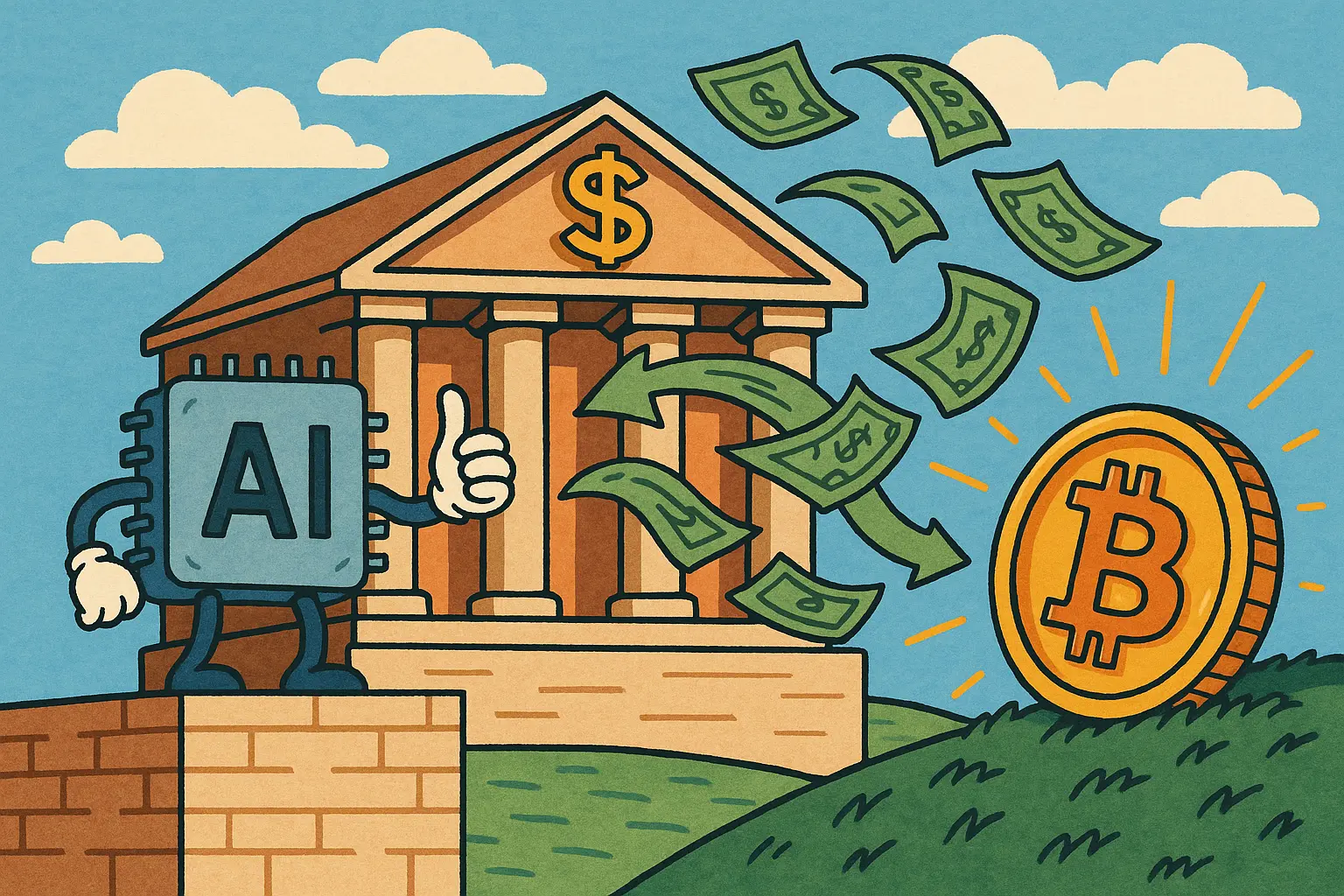
Crypto services company NYDIG research director Greg Cipolaro suggests that artificial intelligence (AI) could be positioned as a general-purpose technology similar to electricity, with profound macroeconomic impacts on employment markets, economic growth, and risk appetite that could significantly influence Bitcoin. Cipolaro points out that if AI triggers labor market turbulence, prompting central banks worldwide to adopt fiscal expansion and monetary easing policies, the resulting liquidity stimulus could create favorable conditions for Bitcoin.
NYDIG’s Two Scenarios: Bullish and Bearish Paths for Bitcoin in AI’s Impact
Cipolaro’s report outlines two very different paths through which AI could affect Bitcoin:
Bullish Scenario 1: If AI causes labor market disruptions and widespread unemployment, prompting central banks to implement monetary easing, the resulting liquidity expansion and low real interest rate environment would benefit Bitcoin.
Bullish Scenario 2: If AI-driven growth is accompanied by liquidity expansion and controlled real interest rates, this environment could also provide positive support for Bitcoin.
Bearish Scenario: Conversely, if AI-driven stronger growth pushes up real yields, tightens monetary policy, and reduces easing demand, Bitcoin could face resistance.
Key Indicators for These Scenarios
Monetary Policy Direction: Whether AI triggers rising unemployment is a key variable influencing central bank easing.
Real Interest Rate Levels: Liquidity expansion benefits most when accompanied by controlled real interest rates.
Quality of AI Growth: If strong growth raises inflation and real yields, it could be detrimental to Bitcoin.
Labor Market Turbulence: AI replacing jobs may trigger dual fiscal and monetary stimulus policies.
How AI Is Reshaping Macroeconomics: From Employment Impact to Technological Integration
In reality, AI’s employment impact is already beginning to show. Jack Dorsey’s payments company Block announced layoffs of about 40% due to AI influences, and Dorsey predicts more companies will follow suit. Goldman Sachs reported in August that widespread AI adoption could replace up to 7% of the U.S. workforce but also create new job opportunities.
Cipolaro admits that AI transformation will be “challenging,” requiring redesigning workflows, developing new skills, and increasing investments. However, he predicts AI development will follow the same “historical pattern” as previous technological advances—integrating rather than eliminating. “Companies that effectively integrate new technologies will expand profit margins and productivity gaps; workers who adapt to new tech will increase their value; those resisting new tech may fall behind,” he said.
In the cryptocurrency space, AI applications are also rapidly expanding. In October, Coinbase launched a new tool called “Payments MCP,” allowing AI agents to access on-chain financial tools similar to humans, further blending AI with blockchain infrastructure.
Frequently Asked Questions
Q: Why does NYDIG believe AI could be beneficial for Bitcoin?
A: NYDIG research director Cipolaro points out that if AI causes widespread employment shocks, forcing central banks to adopt monetary easing, the resulting liquidity expansion and low real interest rate environment have historically supported risk assets like Bitcoin.
Q: What does the “general-purpose technology” framework for AI mean?
A: Cipolaro compares AI to electricity or steam engines—transformative “general-purpose technologies” that broadly impact employment, productivity, and monetary policy. This systemic influence makes AI’s macroeconomic effects difficult to evaluate within traditional industry frameworks.
Q: What is NYDIG’s bearish scenario for Bitcoin?
A: If AI-driven strong growth pushes up inflation and real yields, prompting central banks to tighten monetary policy, risk assets like Bitcoin could face headwinds. Ultimately, whether AI becomes an opportunity or challenge for Bitcoin depends on its impact on monetary policy.
Disclaimer: The information on this page may come from third parties and does not represent the views or opinions of Gate. The content displayed on this page is for reference only and does not constitute any financial, investment, or legal advice. Gate does not guarantee the accuracy or completeness of the information and shall not be liable for any losses arising from the use of this information. Virtual asset investments carry high risks and are subject to significant price volatility. You may lose all of your invested principal. Please fully understand the relevant risks and make prudent decisions based on your own financial situation and risk tolerance. For details, please refer to
Disclaimer.
Related Articles
ADP Report: Over the four weeks ending February 28, the U.S. private sector added an average of 9,000 jobs per week
Gate News reports that on March 17, the U.S. Automatic Data Processing Company (ADP) released its weekly employment report showing that over the four-week period ending February 28, 2026, private sector employers added an average of 9,000 jobs per week.
GateNews2h ago
ARK Chief Investment Officer: AI Has Boosted Labor Productivity by 2.8%, Expected to Reach 6% Over the Next Decade
Cathie Wood stated that artificial intelligence has improved labor productivity and will significantly boost growth to 6% annually over the next decade. The application of large language models has surprised many skeptics, with frontier AI companies like Anthropic and OpenAI experiencing significant revenue growth, with projected future revenues expected to reach 10 trillion to 12 trillion dollars, creating a major impact on GDP.
GateNews3h ago
Mysterious Trader Bets Federal Reserve Will Maintain High Rates Long-Term, Profits Around $10 Million from SOFR Options Trading
On March 17, a short-term interest rate options trade betting on the Federal Reserve maintaining higher rates for an extended period closed for a profit of approximately $10 million, exiting ahead of the Federal Reserve's policy meeting. The core thesis of the trade predicted that U.S. interest rates in 2028 would be higher than market expectations. Driven by inflation concerns, the market has downward-revised its expectations for rate cuts.
GateNews3h ago
Bank of America Survey: Investor Sentiment Turns Pessimistic in March, but Less Severe Than During April 2025 Tariff Impact Period
A Bank of America survey on March 17 shows that investor sentiment is pessimistic, affected by the Iran war and concerns about private credit, with the expected proportion of strong global economic growth plummeting to 7%. Despite the decline in sentiment indicators, it remains higher than the low point in April 2025.
GateNews3h ago
Moody's Chief Economist: Continued Blockade of the Strait of Hormuz Would Make US Economic Recession Inevitable
Moody's economists warn that a blockade of the Strait of Hormuz would worsen the U.S. economic outlook, making recession difficult to avoid. The current recession probability has reached as high as 49% and is expected to exceed 50%. Unlike the past, the U.S. economy lacks post-pandemic stimulus support, employment data is weak, and future growth may be only 0.7%.
GateNews5h ago
Trump Intensifies Pressure on Fed, Demanding "Immediate" Rate Cuts
Trump is calling for the Federal Reserve to immediately convene a special meeting to cut rates, emphasizing that now is the time for action and noting that lower interest rates would help reduce national debt servicing costs and stimulate the economy. Despite his pressure, market expectations for this rate cut remain low, as the Federal Reserve faces challenges from inflation and rising oil prices and may not quickly adjust policy. The crypto market has already priced in expectations of no rate cut, with focus shifting to the Federal Reserve's future policy direction.
区块客5h ago


