As the blockchain industry expands from basic transfers to advanced financial use cases like DeFi, payment networks, and Real World Assets (RWA), the marketplace increasingly demands higher performance from foundational public chains. This is particularly critical in financial services such as asset issuance, payment settlement, and high-frequency trading, where networks must deliver high throughput, low latency, and scalability—or risk being unable to support large-scale on-chain financial operations.
While traditional public chains offer the benefits of decentralization and openness, they often struggle with limited throughput, transaction congestion, and execution inefficiencies when facing complex financial scenarios. Protocols like Pharos and Plume, which focus on bringing RWA on-chain, are designed to address these challenges.
What Is Pharos’s Parallel Execution Architecture?
A core innovation in Pharos for boosting network performance is its parallel execution architecture. Unlike traditional blockchains that rely on serial processing—executing transactions one at a time—this method is prone to congestion as network load rises, leading to longer confirmation times and higher trading fees. Parallel execution allows multiple non-conflicting transactions to be processed simultaneously, significantly increasing overall efficiency.
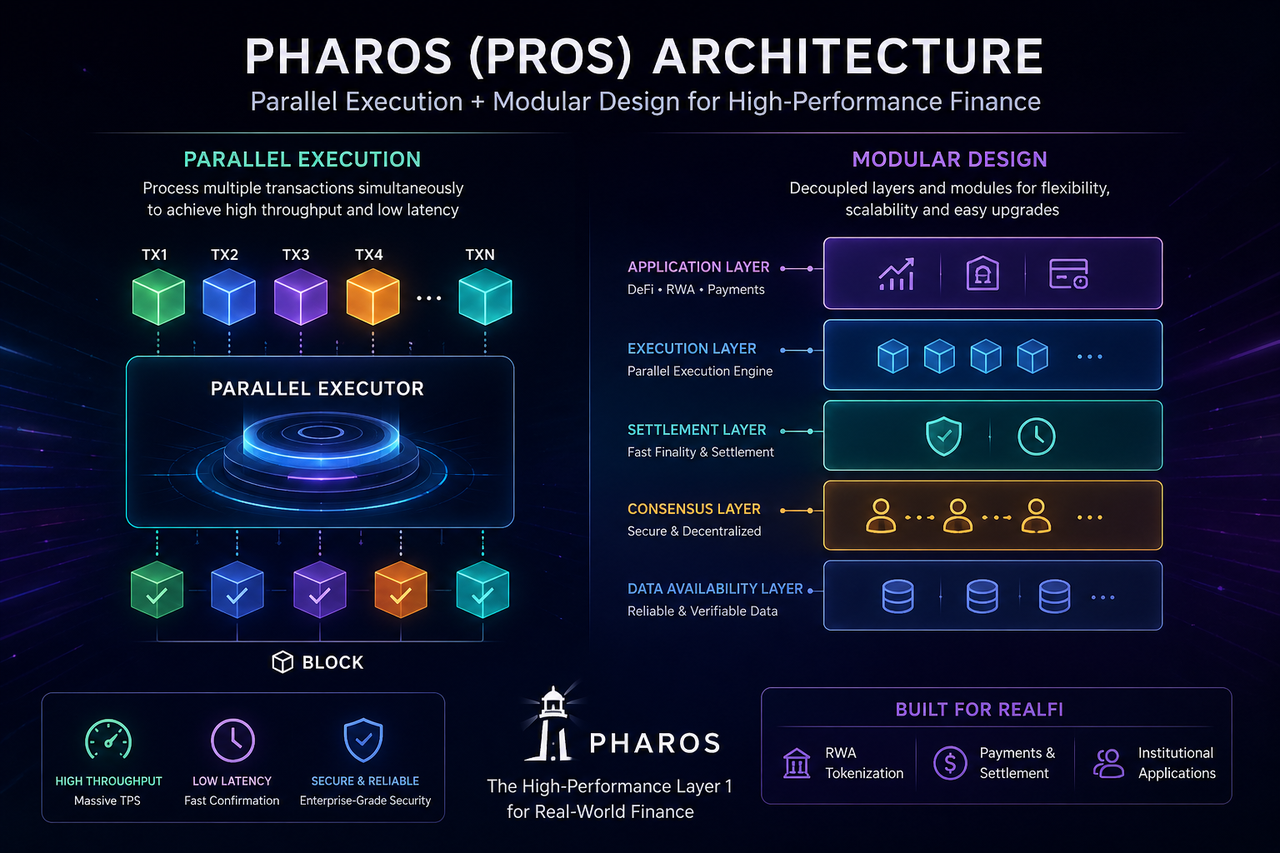
Parallel execution is especially impactful in financial contexts. RWA trading, payment settlements, and on-chain clearing often involve large volumes of high-frequency transactions. If the underlying network still relies on serial processing, it simply cannot meet the throughput required for financial-grade operations. Pharos’s parallel execution mechanism boosts network processing power, enabling faster transaction confirmations and ensuring the performance needed for large-scale on-chain finance.
How Does Modular Design Enhance Network Scalability?
Beyond parallel execution, Pharos’s modular design is another key innovation. Modular architecture separates the blockchain network’s functions—such as the execution layer, consensus layer, and application layer—so each module can be independently optimized and upgraded without disrupting the entire system.
This approach is particularly valuable for financial applications, which often require custom functionality for different asset types and business workflows. For instance, RWA issuance may require compliance modules, while payment systems prioritize settlement efficiency. Pharos’s modular design enables flexible feature expansion to meet diverse financial demands, all while maintaining network stability. This positions Pharos for superior scalability as financial application needs evolve.
Why Is Parallel Execution Ideal for Financial Scenarios?
Financial operations are characterized by high transaction volumes, rapid processing, and sensitivity to confirmation times. Payments demand instant confirmations, asset clearing requires bulk data processing in short windows, and institutional fund flows need consistent network reliability. Traditional public chains often experience delays under high concurrency, which erodes efficiency and drives up transaction costs.
Parallel execution directly addresses these challenges. By processing multiple independent transactions at once, Pharos increases throughput without compromising network efficiency, making it well-suited for high-frequency financial operations. For RWA and payment networks managing large-scale transactions, parallel execution dramatically enhances the on-chain financial experience and represents a key step forward for financial infrastructure.
How Does Modular Architecture Support RWA and Institutional-Grade Finance?
RWA and institutional-grade finance set a much higher bar for blockchain networks than standard on-chain applications. Beyond transaction performance, these scenarios demand compliance support, asset management, and flexible business processes. Traditional public chains, with their tightly coupled architectures, struggle to adapt quickly to such complex needs. In contrast, modular design provides the flexibility to expand and customize financial modules as required.
Pharos leverages modular architecture to deliver flexible foundational support for RWA scenarios. For example, compliance modules can be added to asset issuance workflows, settlement modules can be enhanced for payments, and interoperability modules can be extended for cross-chain asset circulation. This adaptability makes Pharos a strong candidate for financial infrastructure, offering a tailored on-chain environment for institutions and asset issuers.
What Are Pharos’s Technical Architecture Advantages?
Pharos’s technical edge lies in its dual focus: enhancing on-chain performance and optimizing the underlying structure for financial business needs. Parallel execution eliminates throughput bottlenecks in high-frequency trading, while modular design expands the network’s scalability and adaptability. This combination makes Pharos ideally suited to support complex financial activities, including payments, settlements, and real asset circulation.
For the rapidly growing RWA market, this architectural approach is especially relevant. Only when the underlying network delivers both high performance and scalability does large-scale on-chain circulation of real assets become viable. Pharos’s architecture is purpose-built for this future, aligning closely with the evolving demands of on-chain finance.
Summary
Pharos (PROS) delivers a high-performance, flexible foundation for on-chain finance through its parallel execution and modular design. Parallel execution boosts transaction throughput and reduces latency in high-frequency financial scenarios, while modularity enhances the network’s adaptability to complex business needs—providing ample scalability for RWA and institutional finance.
As the on-chain financial marketplace continues to expand, competition among public chain infrastructures will increasingly center on performance and scalability. Pharos’s finance-focused architecture aims to establish a network optimized for real-world asset tokenization. If its ecosystem continues to mature, this technical foundation could become a cornerstone for the future of RealFi.
FAQs
What is Pharos’s parallel execution architecture?
Pharos’s parallel execution architecture is a system that enables multiple transactions to be processed simultaneously. Compared to traditional serial execution, it increases throughput and cuts transaction latency, making it ideal for high-frequency financial scenarios.
What are the advantages of Pharos’s modular design?
Modular design separates the execution layer and other functional modules, enhancing network scalability and allowing Pharos to flexibly support diverse needs like RWA, payments, and institutional finance.
Why is parallel execution suited for financial applications?
Financial applications require the processing of large volumes of high-frequency transactions with rapid confirmation. Parallel execution enables simultaneous processing, boosting efficiency and minimizing network congestion risks.
How does Pharos’s technical architecture benefit RWA?
Pharos’s technical architecture provides a robust, efficient infrastructure for RWA asset issuance, on-chain settlement, and institutional-grade finance by combining high throughput with modular support.







